
Mid-Day Meal Scheme: Nutritional Support for Children
Published: Jul 6, 2026
Key Highlights
- Nutrition: PM-POSHAN reaches about 11 crore kids in over 10 lakh schools. States like Telangana innovate with ragi java, eggs, and school gardens, while places like Gujarat see fewer meals but higher spending.
- Attendance: President Murmu has backed up research showing the meal scheme raises school enrolment, attendance, and retention.
- Child labour: A major study found mid-day meals slashed child labour by 47 percent, mainly by reducing chores at home.
- Global praise: UNICEF counts the Mid-Day Meal Scheme among India’s key drivers in fighting child poverty.
- Ongoing challenges: Coverage has slipped from 12.16 crore to 10.99 crore students in two years, West Bengal hasn’t received fresh funds, and contaminated food sickened hundreds. Some states are spending more while serving fewer meals.
- Looking ahead: There’s momentum to add breakfast and reach more students; Telangana already feeds Intermediate students and is pushing ahead with digital reforms.
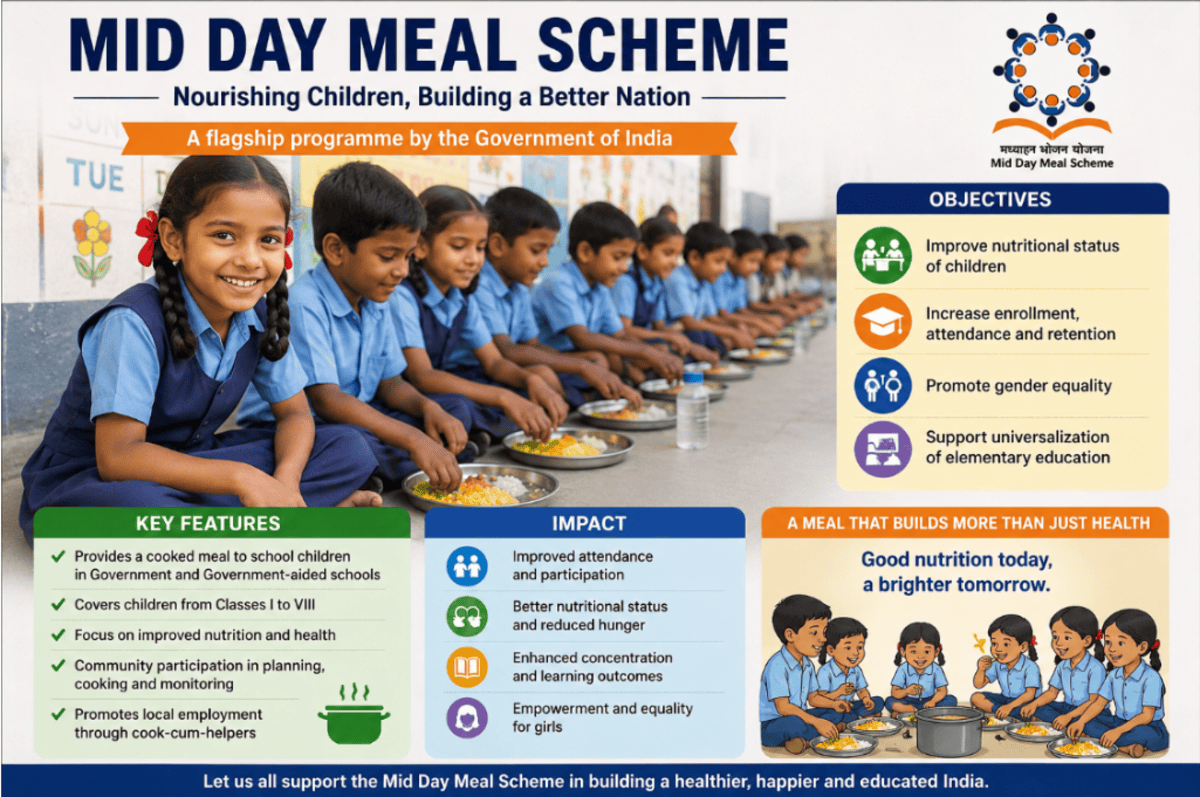
Every school day across India, there’s a familiar scene that plays out in classrooms. It’s not about blackboards or homework. It’s the slow build of hunger—kids beginning to fidget, yawning, heads nodding on desks, more eyes glued to the kitchen door than the teacher. Then, the smell of hot rice and dal wafts in. Faces brighten instantly. For a surprising number of children, this is their first real meal today.
For some, it’s the only one. That’s the quiet power of the Mid-Day Meal Scheme—India’s huge effort to feed schoolkids nationwide. Rebranded as PM-POSHAN, it now reaches about 11 crore children in more than 10.35 lakh government and aided schools, according to Union Education Ministry data. At an event this March, President Droupadi Murmu called it an investment in our nation’s youth.
School Nutrition
Look at Telangana. Here, kids don’t just get rice and dal. According to the Deccan Chronicle, more than 17.91 lakh students across the state now get ragi java—a nutritious malt—three days a week. Every child gets three eggs each week, with the government bumping up the per-egg rate. And they’ve built over 11,000 school nutrition gardens, growing fresh veggies right where children study.
That’s the kind of local thinking that matters. But things don’t look the same everywhere. Take Gujarat. Reports show that the number of mid-day meals served actually dropped by 1.76 lakh between 2022 and 2025—even as spending on the scheme shot up more than 57 percent. Officials blame this on higher kitchen costs, but others say more city kids now pack lunch from home. Not everyone buys that reasoning.
On top of that, only about half of central funds set aside for school education actually get spent. The news gets more worrying in other areas. In a reply to Parliament, the Education Ministry admitted that 674 kids fell sick in 11 incidents linked directly to contaminated mid-day meals over the past five years—in states ranging from Bihar to Delhi to West Bengal. There are guidelines around food safety, sure, but numbers like that can’t be brushed aside.
Child Welfare
For struggling families, it can tip the scales—making school feel worth more than sending your kid to work for extra cash. A standout study from Singapore Management University, using Indian survey data, found the meals had a stunning effect: the programme cut child labour down by 47 percent compared to states that never adopted the scheme.
This happened mostly because kids spent less time on chores at home but also because more of them attended school—both boys and girls. UNICEF has noticed all this, too. The State of the World’s Children 2025 report says that India’s main programmes, including the Mid-Day Meal Scheme, played a role in reducing poverty in India. India’s programmes, including the Mid-Day Meal Scheme still have more work to do to help people, in India.
An Indian Express editorial recently argued that adding breakfast to PM-POSHAN would match up with what nutritionists and educators now recommend. The paper points to Tamil Nadu: since they rolled out a breakfast programme in 2022, it’s reached about 24 lakh students and lifted school attendance and health. Other states—Rajasthan, Kerala, Chhattisgarh, Gujarat, Delhi—now want to do the same. And just this year, Telangana decided to expand the mid-day meal to cover Intermediate students in junior colleges. Deputy Chief Minister Mallu Bhatti Vikramarka called it a “new chapter” in student welfare.
Implementation Successes and Impact
Problems aside, there’s real progress here. The mid-day meal is something that UNICEF thinks is very important. They believe it is helping to improve nutrition and education in a way just like other big schemes, such as Poshan Abhiyaan and Samagra Shiksha. This is making a lot of progress more than people thought was possible. President Murmu thinks the mid-day meal is a step toward building a stronger nation. It is helping to break down barriers to learning that start with stomachs.
The mid-day meal is really helping to make a difference. It is doing this by providing food for children, which is something that the mid-day meal and other schemes, like Poshan Abhiyaan and Samagra Shiksha are working on. States are also leading by example, especially Telangana. They now pay nearly 47,000 cook-cum-helpers a monthly honorarium, most of it from state funds. Cooking charges went up, bills get settled online, even attendance is now tracked with facial recognition. Those are serious upgrades.
Persistent Challenges
West Bengal has not received any central funds since 2023-24. At the time other places are still getting the money they are supposed to get. The parliamentary standing committee on education is really concerned about this. West Bengal is not getting the funds it needs and this is a big issue. The parliamentary standing committee, on education wants to know why West Bengal is being treated differently..
They called for a fixed quarterly fund release and tough action to halt the slide in meals served. Food safety lingers as a worry. Eleven serious outbreaks in five years—674 kids sickened—shows what happens when the system stumbles. Yes, school kitchens are supposed to use certified ingredients, cooks get trained, committee members must taste food before it’s served, and random lab tests happen. But the gaps are there. Look at Gujarat again: as meals served dropped, spending ballooned. More schools started outsourcing food to NGOs, with payments to nonprofits nearly doubling in just two years.
Future Recommendations
The great thing is, there’s real talk happening about fixing the gaps. Proposals to add breakfast to PM-POSHAN are on the table in several states, no matter who’s in power. The National Education Policy 2020 itself notes that kids do their best learning after a hearty morning meal. Telangana leads with its move to feed Intermediate students and by giving technology a bigger role—like digital attendance and online payments to reduce leaks and delays.
But, as The Indian Express wisely pointed out, adding responsibilities means we have to support the workers who deliver the scheme. Anganwadi and ASHA workers have gone on strike more than once to protest low pay and overwork. Expanding the scheme without boosting support risks burning them out.
Frequently Asked Questions
Why is school nutrition important for students’ learning and development?
School nutrition is essential because healthy meals provide children with the energy and nutrients needed for better concentration, improved academic performance, stronger immunity, and overall physical and mental development.
How does the PM-POSHAN Scheme improve school nutrition in India?
The PM-POSHAN Scheme strengthens school nutrition by providing nutritious cooked meals to millions of students in government and aided schools. Several states have also introduced eggs, millet-based foods, and fresh vegetables to improve the nutritional quality of meals.
What are the biggest challenges in improving school nutrition across India?
Some of the biggest challenges in improving school nutrition include ensuring food safety, maintaining consistent funding, improving meal quality, strengthening monitoring systems, and expanding nutritious meal options such as breakfast to support better health and learning outcomes.
How does school nutrition affect school attendance and student performance?
School nutrition encourages regular school attendance by providing healthy meals that reduce hunger, improve concentration, and help students participate more actively in classroom learning.
What role do state governments play in strengthening school nutrition programmes?
State governments improve school nutrition by introducing locally nutritious foods such as millets, eggs, fruits, and vegetables, upgrading kitchen facilities, and using technology to monitor meal quality and delivery.
What improvements can make school nutrition programmes more effective in the future?
School nutrition programmes can become more effective by adding breakfast, improving food safety standards, increasing support for cooks and staff, ensuring timely funding, and regularly monitoring meal quality to meet children’s nutritional needs.
What are the long-term benefits of investing in school nutrition?
Investing in school nutrition helps improve children’s physical growth, cognitive development, academic performance, and overall health while contributing to a more productive workforce in the future.
Statutory Citations & References
[1]”President Murmu Says PM POSHAN Scheme’s Nutritious Meals Are an Investment in Nation’s Human Capital,” News On AIR, May 1, 2026. https://www.newsonair.gov.in/president-murmu-says-pm-poshan-schemes-nutritious-meals-are-an-investment-in-nations-human-capital/
[2] “Total 674 Children Fell Ill From Contaminated Mid-Day Meals In Five Years: Govt.,” Outlook India, Dec 4, 2025. https://www.outlookindia.com/national/total-674-children-fell-ill-from-contaminated-mid-day-meals-in-five-years-govt
[3]”Do government benefit programs reduce child labor?: Causal evidence from the Midday Meal Scheme in India,” Singapore Management University, June 2025. https://ink.library.smu.edu.sg/soe_research/2840/
[4] “Extending PM-Poshan to include breakfast will help align national policy with nutritional and educational realities,” The Indian Express, Oct 31, 2025. https://indianexpress.com/article/opinion/editorials/extending-pm-poshan-breakfast-national-policy-nutritional-educational-realities-10336709/
[5]”In Gujarat, number of mid-day meals falling, but spending on scheme rising: here’s why,” The Indian Express, Apr 4, 2026. https://indianexpress.com/article/cities/ahmedabad/gujarat-mid-day-meals-falling-spending-rises-10618621/
[6]”Only 51% Of Central School Education Funds Utilised: Parliamentary Panel Flags Concern,” NDTV, Mar 27, 2026. https://www.ndtv.com/education/only-half-of-central-school-education-funds-utilised-parliamentary-panel-11273896
[7]”India Cut Poverty Sharply; Beti Bachao, Mid Day Meal Schemes Helped Children: UNICEF,” News18, Nov 20, 2025. https://www.news18.com/india/india-cut-poverty-sharply-beti-bachao-mid-day-meal-schemes-helped-children-unicef-ws-kl-9721652.html
[8]”17.91 Lakh Telangana Students Served Ragi Gruel,” Deccan Chronicle, Mar 1, 2026. https://www.deccanchronicle.com/southern-states/telangana/1791-lakh-telangana-students-served-ragi-gruel-1940619
[9]”Telangana presents Rs 3.24 lakh crore Budget; unveils new midday meal scheme to intermediate students,” The New Indian Express, Mar 20, 2026. https://www.newindianexpress.com/states/telangana/2026/Mar/20/telangana-presents-rs-324-lakh-crore-budget-unveils-new-midday-meal-scheme-to-intermediate-students
Simplify your Business
Eve Consultancy is your trusted partner for end-to-end compliance services, including Company Incorporation, GST Registration, Income Tax Filing, MSME Registration, and more. With a quick and hassle-free process, expert guidance, and affordable pricing, we help businesses stay compliant while they focus on growth. Backed by experienced professionals, we ensure smooth handling of all your legal and financial requirements. WhatsApp us today at +91 9711469884 to get started.
Maximize Your Business Potential
Looking for a partner to advise on GST, ITR, Business Registration, or Financial Strategy? Our experts ensure your compliance is seamless and your solutions are optimized.
Book a Strategy ConsultationEve Finance: Your Daily Financial Eve-olution!
Finance made simple, fast, and fun! 🏦💡 Sign up for your daily dose of financial insights delivered in plain English. In just 5 minutes, you’ll be smarter and better!