
3 Strategies for Hybrid Cloud Architecture in Scalable Enterprise Computing
Published: Aug 16, 2026
Key Highlights
- A hybrid cloud merges private cloud and public cloud platforms.
- It fosters scalability and agility within enterprise IT architecture.
- It enables cost savings and disaster recovery.
- It requires efficient management and adequate security.
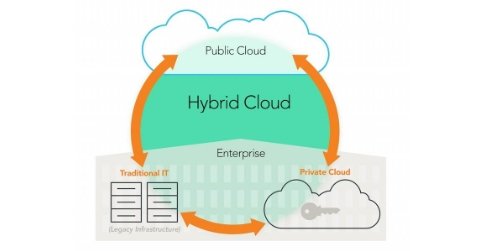
As a business grows in size, so does the need for computing resources. It becomes impossible to solely rely on the on-premise infrastructure or any one type of cloud. The hybrid cloud comes in at this point. Combining the best aspects of on-premise and public cloud infrastructures enables enterprises to develop an optimal IT architecture.
Hybrid Cloud Architecture Definition
A hybrid cloud architecture refers to the use of private or on-premises data centers alongside the main public cloud service providers such as Amazon Web Services, Microsoft Azure, and Google Cloud.
What Are Some Uses for Hybrid Clouds in an Enterprise IT Architecture?
Using a hybrid cloud in enterprise IT architectures is a necessity since it provides the following:
- Scalability: The ability to easily increase workload capacity through cloud computing resources when necessary
- Flexibility: Running applications in private clouds while doing simple operations in the cloud
- Cost Management: Minimizing infrastructure costs due to pay-as-you-go services in the cloud
- Continuity: The ability to have better backup and disaster recovery services
Key Components of a Hybrid Cloud Environment
- On-Premise Infrastructure: The traditional data centers are working with secure information.
- Public Cloud Services: Cloud platforms provide scalable computing, storage, and networking.
- Connectivity & Integration: Secure connections like VPNs or dedicated links ensure seamless communication.
- Management & Orchestration Tools: Tools that monitor and manage workloads across environments for efficiency.
How Hybrid Cloud Enables Scalability
Hybrid clouds offer dynamic scalability through efficient workload allocation. For instance, when there is heavy traffic, it is possible to add extra resources to the cloud environment without any effect on the on-premise infrastructure.
Challenges with Hybrid Cloud Deployment
- Security Issues: There might be some threats related to storing information in various environments.
- Complex Administration: Requires experience and advanced technology.
- Compatibility Problems: It may prove difficult to integrate various systems.
Conclusion
Hybrid cloud infrastructure technology has revolutionized enterprise IT architecture design. Through the fusion of private cloud and public cloud capabilities, scalability, agility, and resilience are realized. As digital transformation continues to advance, hybrid cloud will continue to be a fundamental aspect of efficient enterprise IT architecture.
Frequently Asked Questions
What is a hybrid cloud architecture?
A hybrid cloud architecture combines on-premise infrastructure or private clouds with public cloud services to create a flexible and scalable IT environment.
Why is hybrid cloud important for enterprise computing?
It enables businesses to scale resources efficiently, reduce costs, improve flexibility, and enhance business continuity.
Why is hybrid cloud important for enterprise computing?
It enables businesses to scale resources efficiently, reduce costs, improve flexibility, and enhance business continuity.
How does a hybrid cloud improve scalability?
It allows organizations to expand computing resources on demand by using public cloud services during periods of high workload.
What are the benefits of using a hybrid cloud architecture?
Benefits include scalability, flexibility, cost optimization, improved disaster recovery, enhanced security, and better resource utilization.
What role do public cloud services play in a hybrid cloud?
Public cloud services provide scalable computing, storage, networking, and on-demand resources that complement private infrastructure.
How does a hybrid cloud support business continuity?
It provides reliable backup, disaster recovery, and failover capabilities to minimize downtime during system failures.
What are the common challenges of hybrid cloud deployment?
Common challenges include security risks, complex management, system integration issues, and compatibility between different platforms.
How is secure connectivity maintained in a hybrid cloud?
Secure communication is established using technologies such as VPNs, dedicated network connections, and encrypted data transfers.
Why is hybrid cloud considered the future of enterprise IT architecture?
It combines the security of private infrastructure with the scalability and flexibility of public cloud services, making it ideal for modern digital transformation and business growth.
Statutory Citations & References
[1] Amazon Web Services, “What is a Hybrid Cloud?,” AWS Documentation. Available: https://aws.amazon.com/hybrid/
[2] Microsoft, “Hybrid Cloud Solutions,” Microsoft Azure. Available: https://azure.microsoft.com/en-in/solutions/hybrid-cloud-app/
[3] Google Cloud, “Hybrid and Multicloud Solutions,” Google Cloud Documentation. Available: https://cloud.google.com/solutions/hybrid-and-multicloud
[4] IBM, “What is Hybrid Cloud?,” IBM Cloud Learn Hub. Available: https://www.ibm.com/topics/hybrid-cloud
[5] National Institute of Standards and Technology, “The NIST Definition of Cloud Computing,” NIST Special Publication 800-145, 2011. Available: https://nvlpubs.nist.gov/nistpubs/Legacy/SP/nistspecialpublication800-145.pdf
Maximize Your Business Potential
Looking for a partner to advise on GST, ITR, Business Registration, or Financial Strategy? Our experts ensure your compliance is seamless and your solutions are optimized.
Book a Strategy ConsultationEve Finance: Your Daily Financial Eve-olution!
Finance made simple, fast, and fun! 🏦💡 Sign up for your daily dose of financial insights delivered in plain English. In just 5 minutes, you’ll be smarter and better!