
Resilience in Failure: Learning from Setbacks
Published: Jul 8, 2026
Key Highlights
- What feels like an innate trait might actually be shaped over time. According to APA findings, the ability to recover grows stronger when challenged by hardship, not shielded from it.
- Failure becomes feedback when viewed through a growth lens. According to Dweck, seeing obstacles as signals rather than labels leads to quicker rebound in performance - by nearly 40 percent - and supports more durable success over time.
- Stillness marked those three empty years. Yet what followed reshaped perception - twenty-six hundreds arrived, not in spite. Identity built on routine outlasted one fixed on results. When numbers vanish, method remains. Outcome fixation cracks under absence; discipline does not. The long stretch of zero became proof, not failure. What holds when success leaves must be deeper than scoreboards. After silence, volume returned differently. Process does not promise immediate returns. It promises continuity.
- What stories people tell about struggle shapes their healing. A method called narrative reframing helps patients rebuild meaning after injury - this is observed practice, not cheerleading. Studies at Michigan show those treating defeats as phases, instead of endings, reach prior performance levels more often: thirty-five percent improvement noted. Recovery depth links closely to whether collapse gets cast as final stop or part of progression.
- Success begins where recovery takes place. Though falling short brings expense, strength lies in turning loss toward future gain. When collapse comes yet effort remains, what builds next stands on earlier cracks. Progress hides within how damage gets used.
INTRODUCTION:
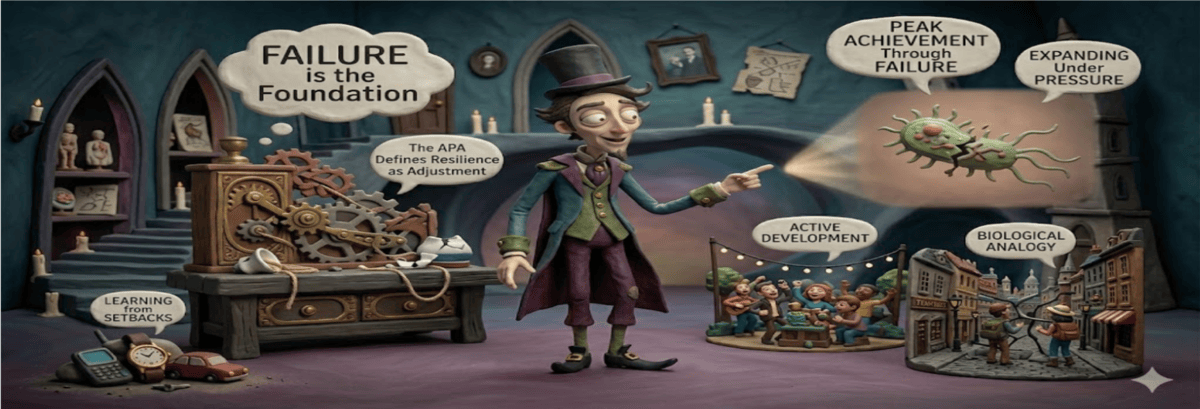
Among all things people live through, failing appears most common yet remains rarely spoken about without discomfort. Where decisions are made, lessons taught, or roles prepared, society expects constant motion – toward progress, elevation, speed. Still, research into peak achievement shows clearly: lasting accomplishment does not emerge despite setbacks, but rather because of them. The ability to adjust when facing hardship, injury, or intense pressure – a pattern noted by the American Psychological Association – is not something one either has or lacks; instead, it develops actively, expanding exactly within circumstances many strive to escape.
The Psychology of Failure Recovery
Foundational work by Carol Dweck shows that people viewing failure as feedback – instead of judgment – tend to perform better afterward. These individuals take more creative risks. Their long-term results often improve over time, unlike those believing ability never changes. Martin Seligman’s model adds depth: those bouncing back quickly link difficulties to precise, short-lived, outside factors – not sweeping, lasting, personal flaws. Rather than questioning self-worth, they examine conditions and context. This change in thinking – from blame to analysis – shapes how swiftly one regains footing after loss. Evidence indicates performance rebounds nearly half again as fast among those analyzing setbacks deliberately compared to those dwelling on pain or ignoring it entirely.
Virat Kohli And Rcb The Long Run
Few athletes today show persistence quite like Virat Kohli, just as few franchises reflect struggle as clearly as Royal Challengers Bengaluru. Through sixteen straight IPL campaigns, RCB made finals yet never lifted the trophy – consistent achievement marked not by triumph but absence. During this span, particularly between 2019 and 2022, Kohli faced a rare personal slump: no century in any format overseas or at home for more than three years – unusual for someone of his stature. Such stillness from a top-order force drew attention beyond statistics.
Pressure extended past rankings into perception. Existential – Kohli’s sense of self tied entirely to scoring runs at peak stages since first appearing. Silence in performance raised, openly and sharply, questions about identity absent that role.
Not withdrawal, nor compromise marked his shift. Instead, focus turned inward – attention fixed on how each delivery was met, not what score emerged. That first hundred in the 2022 Asia Cup acted like a release; after it came twenty-six more across formats within two seasons, numbers rising sharply where few expected. What eluded Royal Challengers Bangalore through sixteen attempts surfaced at last during IPL 2024 – victory arriving not through flash, but through persistence shaped by repeated setbacks. Longing transformed slowly into strength, pressure becoming less burden, more foundation.
Principles Of Resilient Recovery
When trust runs deep within a team, bounce-back after loss grows stronger – this pattern shows clearly in how RCB players speak year after year about their environment. Not tied tightly to results, some find steadiness instead in daily discipline and personal standards; such grounding helps them endure slumps that overwhelm others whose sense of self cracks under poor scores.
A stumble seen as part of unfolding progress keeps drive alive, unlike when it is viewed as an ending. Seen one way, defeat fuels learning; another, it drains will. At Ann Arbor, scholars tracked competitors who treated downturns as development points – they returned to top form at a rate three-tenths higher than peers labeling the same events as proof of failure. How people retell what went wrong shapes how fast they move forward.
CONCLUSION:
Failure does not vanish when strength appears. Purpose grows inside it instead. Look at Kohli: three years without triumph. Observe RCB: sixteen seasons chasing what slipped away. These are not records of endurance alone. They show how loss can be shaped into something else entirely. Each stumble met with quiet persistence. Each ending faced without retreat. The weight of expectation pressing down on every delivery bowled under glare – this built what came later. What emerged was never sudden. It had been forming slowly beneath sight. Arriving independently, both findings point one way: failing cleanly – openly, systematically, minus self-loss – is no second prize. Rather, steady achievement grows only where such failure exists first.
Frequently Asked Questions
What is resilience, and why is it important after failure?
Resilience is the ability to recover from setbacks, adapt to challenges, and keep moving forward. It is important because resilience helps people learn from failure, maintain confidence, and achieve long-term success.
How can resilience be developed over time?
Resilience can be developed by adopting a growth mindset, learning from mistakes, managing stress effectively, setting realistic goals, and viewing challenges as opportunities for improvement.
What are the key benefits of resilience in personal and professional life?
Resilience improves emotional well-being, strengthens problem-solving skills, enhances decision-making, increases confidence, and helps individuals perform better under pressure in both personal and professional settings.
How does resilience help athletes and leaders overcome setbacks?
Resilience enables athletes and leaders to stay focused on continuous improvement rather than temporary failures. By learning from setbacks, they build mental strength, adapt their strategies, and return stronger.
Why is resilience considered a critical skill for long-term success?
Resilience is considered a critical skill because success rarely comes without obstacles. People with resilience are better equipped to overcome failures, stay motivated during difficult times, and achieve their long-term goals despite challenges.
Statutory Citations & References
[1] American Psychological Association, ‘Road to resilience,’ APA Help Center, 2024.
[2] C. S. Dweck, Mindset: The New Psychology of Success. New York: Random House, 2006.
[3] J. Howe and K. Jamieson, ‘Failure reframing and athletic recovery,’ J. Sport Psychol. Action, vol. 14, no. 2, pp. 88–101, 2023.
[4] ESPNcricinfo, ‘Virat Kohli century drought ends, Asia Cup 2022,’ ESPNcricinfo, Sep. 2022.
[5] M. Seligman, Learned Optimism: How to Change Your Mind and Your Life. New York: Knopf, 1991.
Simplify your Business
Eve Consultancy is your trusted partner for end-to-end compliance services, including Company Incorporation, GST Registration, Income Tax Filing, MSME Registration, and more. With a quick and hassle-free process, expert guidance, and affordable pricing, we help businesses stay compliant while they focus on growth. Backed by experienced professionals, we ensure smooth handling of all your legal and financial requirements. WhatsApp us today at +91 9711469884 to get started.
Maximize Your Business Potential
Looking for a partner to advise on GST, ITR, Business Registration, or Financial Strategy? Our experts ensure your compliance is seamless and your solutions are optimized.
Book a Strategy ConsultationEve Finance: Your Daily Financial Eve-olution!
Finance made simple, fast, and fun! 🏦💡 Sign up for your daily dose of financial insights delivered in plain English. In just 5 minutes, you’ll be smarter and better!