
The Remittance Economy Under Fire: What a Major Gulf Conflict Could Mean for India’s Current Account Deficit
Published: Jun 22, 2026
Key Highlights
- India’s remittances depend heavily on workers in Gulf countries.
- Gulf instability could cut remittances. Raise oil prices at the same time.
- Lower remittances would widen India’s CAD. Pressure the rupee.
- Inflation will rise because fuel prices are higher and the rupee is not doing well.
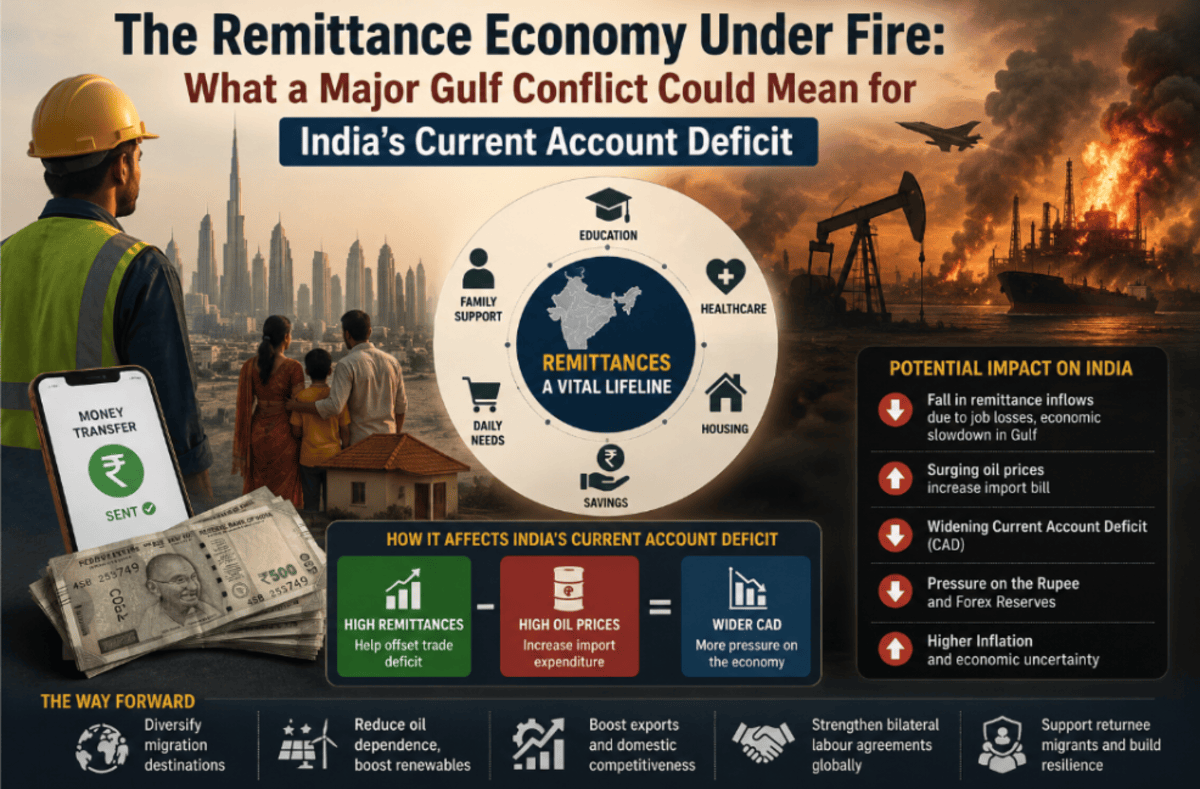
We usually think of wars as events that happen elsewhere. Today, conflicts can affect us in many ways. Their effects can be felt through oil prices, job markets, money transfers and trade routes.
For India, a large-scale war in the Gulf could hit home in real ways. This is not just because the Gulf is where we buy most of our oil from. It’s also home to millions of workers, whose remittances keep their families afloat and give a quiet but crucial boost to the national economy.
Now, global economic nerves are already frayed. Adding Gulf tensions into the mix raises a question: what happens to India’s remittance lifeline, and how would that affect the country’s Current Account Deficit (CAD)? This isn’t about diplomatic posturing. It’s about jobs, household budgets, the rupee’s value and inflation – things that touch life.
The Remittance Economy
India has been the world’s remittance recipient for years. Billions of dollars flow into the country annually from workers, especially from Gulf nations like the UAE, Saudi Arabia, Qatar and Kuwait.
These aren’t abstract numbers on a balance sheet. For millions of families, remittances are what pay for a child’s school fees a parent’s hospital visit, a roof repair or clearing a debt. They represent stability and a shot at a life. Most of these workers come from towns and villages, and they send back a big chunk of what they earn.
States like Kerala, Uttar Pradesh, Bihar and Telangana have been particularly shaped by Gulf migration. In some districts, remittance money has quietly transformed economies – fueling small businesses, real estate and services.
At the level, remittances are a steady anchor. Remittances tend to stay put in rough times, unlike foreign investors’ money that can flee at the first sign of trouble. That reliability helps India to manage its trade deficit and keep its finances on an even keel.
What is a Current Account Deficit (CAD)?
Current Account Deficit: When a country’s spending in foreign currency on imports exceeds what it gets in from its exports and other inflows. India always runs a CAD largely because it depends on imported crude oil, electronics and industrial goods.
A moderate CAD is fine – even normal – for a growing economy. But if it widens much, the rupee can come under pressure, reserves can shrink, and inflation can flare up.
Remittances help shrink that deficit. Think of them as earnings that offset part of India’s huge import bill. So if remittances drop, India’s external position weakens.
Why Gulf Instability Hits Hard
The Gulf matters to India for two reasons: oil and jobs. We buy a share of our crude from there… Millions of our people work there – in construction, driving, hospitality, housekeeping and more.
If tensions explode into a regional conflict oil prices could spike sharply. For India, that means an import bill right away, which widens the trade deficit… Since oil affects transport and industrial costs, inflation would likely follow.
At the time, an unstable Gulf economy would mean fewer jobs for Indian migrants. Big projects get put on hold. Companies cut labour costs. Wages. Jobs vanish. If that happens, remittances sent back home drop.
What This Means for Indian Families and the Economy
A fall in remittances wouldn’t just show up in reports. You’d feel it in homes across India. Families that rely on Gulf income would suddenly struggle with rising prices, loan EMIs and shrinking savings.
In states with numbers of migrants local spending would take a hit. Real estate deals would cool down. Small shops and service businesses that thrive on remittance money would feel the pinch. The social fallout could include unemployment, less money for kids’ education and a lot of financial anxiety.
Another worry is migration. If Gulf economies really tank many workers may have to come to India looking for jobs. That would add to the pressure on a stretched domestic labour market.
Rupee Pressure and Inflation
Fewer remittances mean less money comes into India. At that time higher oil prices mean we need dollars to pay for imports. Remittances are a source of dollars, for India. Higher oil prices put pressure on Indias import bill. That imbalance weakens the rupee. A falling rupee makes everything imported more expensive – especially fuel and industrial raw materials. Inflation rises as transport and production costs go up. The Reserve Bank of India would then be caught in a spot: trying to control inflation without choking growth.
How India Can Become Vulnerable
The Gulf is not a stable place, and that is a big warning for India to make some changes. We need to find ways to get energy, so we do not have to buy so much oil from other countries. India should invest in things like wind power. We also need to help Indian workers find jobs in places outside of the Gulf. This will help India because Indian workers will not have to go to the Gulf to work.
The threat of instability in the Gulf is a problem, for India and we need to do something about it. Third, boosting manufacturing and exports is crucial. More exports mean foreign exchange earnings, which takes pressure off the CAD. Finally, the government should have support systems for returning migrants – skill training, job placement help and financial reintegration programmed.
The Bottom Line
India’s ties with the Gulf run deep – through oil, trade and millions of families with someone working from home. Remittances have long been a stabiliser for the economy… Gulf instability shows how risky over-dependence can be.
A serious conflict there could slash remittances. Jack up oil prices at the same time. That would hammer India’s Current Account Deficit weaken the rupee and stoke inflation… Beyond the macros real families would pay the price.
Frequently Asked Questions
How does the Remittance Economy help reduce India’s Current Account Deficit?
The Remittance Economy brings billions of dollars into India from overseas workers, especially in the Gulf. These inflows help offset import expenses and reduce the Current Account Deficit, strengthening India’s external financial position.
How could Gulf instability affect the Remittance Economy and Current Account Deficit?
A major conflict in the Gulf could lead to job losses for Indian migrant workers, reducing remittance inflows. A weaker Remittance Economy would mean less foreign currency entering India, potentially widening the Current Account Deficit.
Why would Gulf conflict increase inflation in India?
A Gulf conflict could drive up global oil prices, increasing India’s import costs. At the same time, lower remittances may weaken the rupee, making imports even more expensive. Higher fuel and transportation costs would likely raise inflation across the economy.
Statutory Citations & References
[1] World Bank – Migration and Labor Mobility, World Bank, 2026.
[2] RBI Bulletin – February 2026, Reserve Bank of India, Feb. 2026.
[3] IMF World Economic Outlook Updates, International Monetary Fund, Apr. 2026.
[4] IEA Oil Market Report, International Energy Agency, Mar. 2026.
[5] Ministry of External Affairs – Overseas Indian Affairs, Ministry of External Affairs, 2026.
[6] UNCTAD Global Trade Update, United Nations Conference on Trade and Development, 2026.
[7] Asian Economic Integration Report, Asian Development Bank, 2026.
Simplify your Business
Eve Consultancy is your trusted partner for end-to-end compliance services, including Company Incorporation, GST Registration, Income Tax Filing, MSME Registration, and more. With a quick and hassle-free process, expert guidance, and affordable pricing, we help businesses stay compliant while they focus on growth. Backed by experienced professionals, we ensure smooth handling of all your legal and financial requirements. WhatsApp us today at +91 9711469884 to get started.
Maximize Your Business Potential
Looking for a partner to advise on GST, ITR, Business Registration, or Financial Strategy? Our experts ensure your compliance is seamless and your solutions are optimized.
Book a Strategy ConsultationEve Finance: Your Daily Financial Eve-olution!
Finance made simple, fast, and fun! 🏦💡 Sign up for your daily dose of financial insights delivered in plain English. In just 5 minutes, you’ll be smarter and better!