
How Rising Oil Prices Can Affect India’s Inflation, Rupee and Financial Markets
Published: Oct 10, 2026
Key Highlights
- Oil Prices India and Inflation: Rising crude oil prices can increase fuel, transportation, and manufacturing costs, contributing to inflation.
- Oil Prices India and the Rupee: Higher oil import bills increase demand for US dollars and may put pressure on the Indian rupee.
- Oil Prices India and RBI Policy: Persistent energy-price increases can complicate the Reserve Bank of India's efforts to balance inflation control with economic growth.
- Oil Prices India and Financial Markets: Higher oil prices can affect corporate profit margins, bond yields, equity valuations, and investor sentiment.
- Oil Prices India and Import Dependence: India's reliance on imported crude oil makes its economy vulnerable to fluctuations in global energy prices.
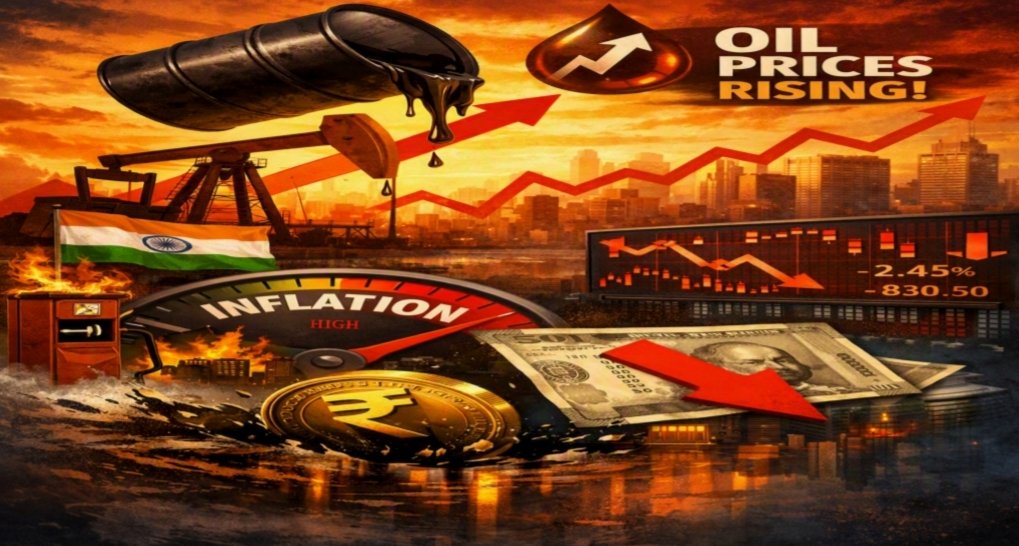
Oil prices India are a major factor influencing the country’s economy and financial markets. Rising global crude oil prices can increase inflation, put pressure on the Indian rupee, affect interest rates, and influence stock and bond markets. As energy prices rise, concerns about global inflation and uncertainty surrounding monetary policy are also increasing.
Why Oil Prices Matter
India imports over 80% of the crude oil it consumes, which makes the economy sensitive to changes in global oil prices. When crude becomes expensive, the cost of importing oil rises, increasing the demand for US dollars and putting pressure on the country’s external balance.
The impact does not stop with fuel. Higher energy costs can raise transportation, manufacturing and other business expenses. Companies may pass some of these higher costs to consumers, creating broader inflationary pressure. In March 2026, the Government of India noted that the effect of a crude-price increase on inflation depends on factors including the exchange rate, global demand and supply, monetary-policy transmission and the extent of pass-through to domestic prices.
Impact on Inflation
One of the most important concerns from rising oil prices is inflation. Fuel and transportation costs influence the prices of many goods and services because businesses across the economy depend on energy and logistics.
When oil stays expensive for a long time, it costs more for companies to make and ship their products. and households may see higher prices. This can make the task of managing inflation more difficult for the Reserve Bank of India (RBI), especially when policymakers are also trying to support economic growth.
The RBI’s August 2026 monetary-policy minutes highlighted that volatile global oil prices and higher energy costs can create risks of broader inflation through higher input prices.
Pressure on the Rupee
Higher oil prices can also put pressure on the Indian rupee. Since India pays for imported crude largely in US dollars, a higher oil import bill increases demand for dollars.
If this pressure continues, the rupee may depreciate. A weaker rupee can make imported crude and other goods more expensive in domestic currency, adding to imported inflation. Recent market movements have shown this relationship: in September 2026, rising crude prices were cited by market participants as one factor behind pressure on the rupee.
What It Means for Financial Markets
The effects of higher oil prices can also reach equity and bond markets. For companies that depend heavily on fuel, transportation or energy-intensive inputs, higher costs can put pressure on profit margins. At the same time, some energy-related businesses may benefit from higher crude prices.
Bond markets face a different concern. If higher oil prices lead to higher inflation, investors may expect interest rates to stay elevated for longer. That can put upward pressure on bond yields and increase borrowing costs. Equity valuations can also be affected when expectations for interest rates change.
The Monetary Policy Challenge
This creates a difficult situation for central banks. Higher oil prices can raise inflation while also increasing costs for businesses and households. Globally, persistent energy-price increases can therefore make investors more careful about the expectation of quick interest-rate cuts.
For India, the RBI has to balance inflation risks with economic growth. If higher energy costs begin to spread into broader prices, monetary-policy expectations can change quickly. This is why oil prices have become an important variable for investors watching both the Indian and global economy.
What Should Be Watched?
Everything depends on how high oil prices climb and how long they stay there. A brief spike is manageable, but a prolonged energy shock will hit inflation, strain the rupee, and disrupt financial markets. To get ahead of the risk, both investors and policymakers are monitoring a specific checklist: global crude rates, the rupee-dollar peg, incoming inflation data, RBI decisions, bond yields, and foreign institutional investment.
Conclusion
Rising oil prices can affect India through several interconnected channels. Higher crude prices can increase inflation, raise the import bill, put pressure on the rupee and influence expectations about interest rates. These effects can then spill over into equity and bond markets.
The key issue is not simply whether oil prices rise, but whether elevated prices persist long enough to become a broader inflationary problem. As global markets adjust to changing energy prices and monetary-policy expectations, oil will remain an important factor in India’s economic and financial outlook.
Key Regulatory Takeaways-
Oil Prices India and Inflation: Rising crude oil prices can increase fuel, transportation, and manufacturing costs, contributing to inflation.
Oil Prices India and the Rupee: Higher oil import bills increase demand for US dollars and may put pressure on the Indian rupee.
Oil Prices India and RBI Policy: Persistent energy-price increases can complicate the Reserve Bank of India’s efforts to balance inflation control with economic growth.
Oil Prices India and Financial Markets: Higher oil prices can affect corporate profit margins, bond yields, equity valuations, and investor sentiment.
Oil Prices India and Import Dependence: India’s reliance on imported crude oil makes its economy vulnerable to fluctuations in global energy prices.
FAQs
How do rising oil prices India affect the economy?
Rising oil prices in India can increase fuel and transportation costs, raise inflation, increase the import bill, and put pressure on the Indian rupee. These effects can also influence business costs and financial markets.
Why are oil prices India important for inflation?
Oil prices in India influence inflation because crude oil is a major input for fuel, transportation, manufacturing, and logistics. Higher energy costs can increase the prices of goods and services.
Statutory Citations & References
[1] Government of India, Ministry of Finance, Impact of Rising Global Crude Oil Price on Inflation in the Country, Lok Sabha, Mar. 9, 2026. [Online]. Available: Link
[2] Reserve Bank of India, Minutes of the Monetary Policy Committee Meeting, August 3–5, 2026, Reserve Bank of India, Mumbai, Aug. 2026. [Online]. Available: Link
[3] Reuters, “Indian central bank likely intervenes to shield rupee as oil prices climb,” Sep. 15, 2026. [Online]. Available: Link
[4] Reuters, “India inflation rises to 4.82% in August, strengthening case for rate hike,” Sep. 14, 2026. [Online]. Available: Link
[5] Business Standard, “Oil tops 100,rupeebreaches95/ as stocks reel on US-Iran tensions,” Sep. 9, 2026. [Online]. Available: Link
[6] ING Think, “What lies ahead for the Indian rupee in a higher oil price environment?,” 2026. [Online]. Available: Link
Maximize Your Business Potential
Looking for a partner to advise on GST, ITR, Business Registration, or Financial Strategy? Our experts ensure your compliance is seamless and your solutions are optimized.
Book a Strategy ConsultationEve Finance: Your Daily Financial Eve-olution!
Finance made simple, fast, and fun! 🏦💡 Sign up for your daily dose of financial insights delivered in plain English. In just 5 minutes, you’ll be smarter and better!