
The Cheapest Battery in the World Is Made of Something You’ve Been Trying to Prevent
Published: Jun 19, 2026
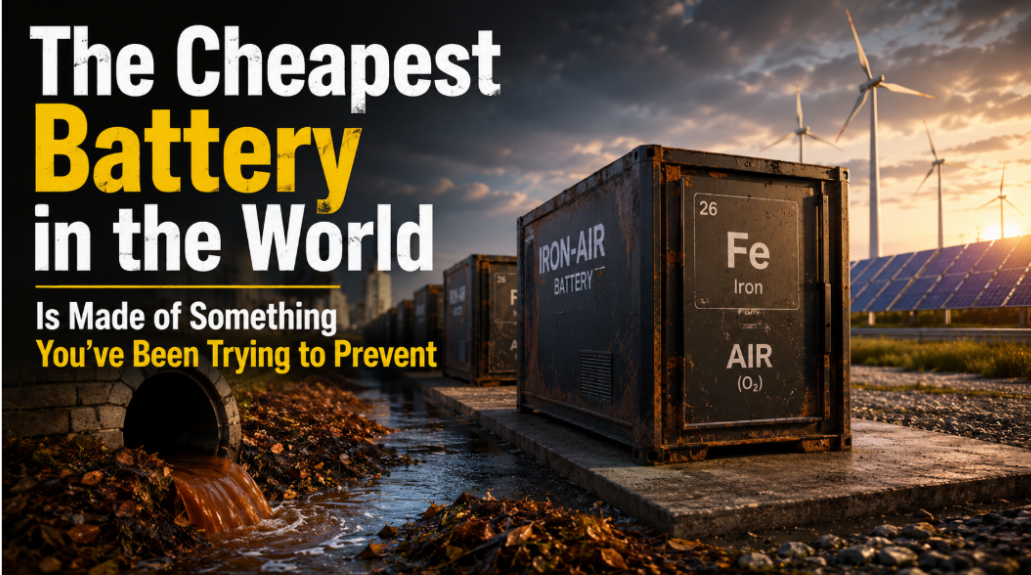
There is a storage problem with electricity that no one talks about loud enough. When the sun shines, solar panels produce power. Wind turbines spin when winds blow. But the grid needs electricity at 8pm on a still cloudy evening too and right now the answer to that problem is either burn something or hope the timing works out. Neither is a long term solution.
Iron-Air Batteries and Their Potential for Large-Scale Energy Storage
The battery conversation in clean energy has been dominated by lithium for so long that most people assume lithium is the only serious option. It is not. And the reasons it is not are becoming more relevant every year as the scale of energy storage required to make renewable energy actually reliable starts becoming clear.
Iron-air batteries have been sitting in the background of electrochemical research for decades, occasionally promising, never quite ready, always running into the same set of technical problems. That situation has been changing and the change matters for anyone paying attention to where large-scale energy storage is actually going.
What Iron-Air Batteries Actually Are
The basic chemistry is not difficult to understand conceptually. An iron-air battery works by oxidizing iron in the presence of oxygen from the air during discharge, basically controlled rusting, and then reversing that process during charging. On the way out, iron turns to iron oxide, and on the way back in, iron oxide turns to iron.
Iron rusts. Everybody knows this.What’s genius about the iron-air battery design is that the same chemical reaction that destroys bridges and ships can be used, controlled and reversed, to store and release electrical energy at a cost lithium simply can’t match.
Iron is the fourth most abundant element in the crust of the Earth. It’s cheap, widely available and doesn’t originate from a handful of politically sensitive countries. It doesn’t involve the kind of mining operations that have made lithium and cobalt increasingly difficult to source ethically and reliably.
Why Scale Changes Everything
The thing about energy storage that makes iron-air batteries specifically interesting and not just generically promising. Lithium ion batteries are great at what they do but they are optimised for a specific kind of storage, high energy density in a compact form, which is exactly what you need in a phone or a car but not necessarily what you need when you are trying to store enough electricity to power a city through a week of cloudy weather.
Grid scale energy storage has very different requirements. The battery need not be light. It doesn’t have to go into a small space. It needs to store a huge amount of energy, at a cost low enough that the whole system makes economic sense, last long enough to justify the capital investment, and be built from materials that can actually be sourced at the volumes required without breaking supply chains or pricing the technology out of reach.
Iron-air batteries score well on all of those criteria in ways that lithium simply does not at the scales being discussed for serious grid backup. The cost per kilowatt hour of stored energy in an iron-air system is potentially a fraction of what lithium costs at equivalent capacity and that gap matters enormously when you are talking about hundreds of megawatt hours rather than the few kilowatt hours in a home battery system.
The Technical Challenges That Kept This From Happening Sooner
If iron-air batteries are so promising the obvious question is why they are not already everywhere. The answer involves a few stubborn technical problems that took a long time to crack well enough for commercial viability.
The first is efficiency. The charge and discharge cycle in an iron-air battery involves some energy loss that has historically been higher than in lithium systems. Getting the round trip efficiency, the percentage of energy you put in that you actually get back out, to a commercially acceptable level required significant advances in electrode design and electrolyte chemistry.
The second is the side reaction problem. Iron-air batteries tend to split water from the electrolyte and make hydrogen gas instead of doing the useful electrochemical work they are supposed to be doing when charging. That’s energy loss and performance decline over time. Managing and minimizing this reaction without making the system too complicated or expensive to operate was one of the core engineering challenges the field spent years working on.
The third is cycle life. A battery that degrades significantly after a few hundred charge and discharge cycles is not useful for grid storage where the expectation is that the system runs for ten to twenty years. Improving the durability of the iron electrode through better materials and cell design was essential before any of this became commercially serious.
Where Things Stand Now
Companies working on iron-air technology have made genuine progress on all three of these fronts in recent years. Form Energy in the United States is probably the most visible example, having built systems targeting multi-day energy storage at costs that would make grid scale deployment economically viable alongside renewable generation.
The target use case is not replacing lithium ion batteries in applications where they already work well. It is filling the gap that lithium cannot fill affordably, the days and weeks of storage backup that would make a grid running primarily on solar and wind actually reliable rather than just mostly reliable with fossil fuel backup for the difficult periods.
India specifically has reasons to pay close attention to this. A country with enormous solar potential, growing electricity demand, significant domestic iron ore reserves and a stated commitment to clean energy transition has an obvious interest in storage technology that uses cheap abundant materials and scales to the sizes needed for serious grid applications.
Conclusion
Iron-air batteries are not a replacement for every other form of energy storage. They are a solution to a specific and important problem that other technologies are not well positioned to solve cheaply at scale.
The clean energy transition has always had two parts. Generation and storage. The generation side has moved faster than most people expected, solar and wind costs have fallen dramatically over the past decade. The storage side has been the constraint and it has been the constraint partly because the dominant storage technology was designed for a different application and does not scale to grid requirements without becoming very expensive very quickly.
Iron-air batteries represent a genuinely different approach to that problem, built around abundance rather than scarcity, optimised for duration rather than density and potentially cheap enough to make multi-day grid storage economically viable at a scale that could actually change how reliable renewable energy becomes.
Rust turns out to be more useful than anyone gave it credit for.
Frequently Asked Questions
How do iron-air batteries store and release energy?
Iron-air batteries store energy through a reversible chemical reaction in which iron oxidizes (rusts) during discharge and converts back to iron during charging. This process allows them to store large amounts of electricity for long-duration energy storage applications.
Why are iron-air batteries considering a promising alternative to lithium-ion batteries?
Iron-air batteries use abundant and low-cost materials, making them potentially much cheaper than lithium-ion batteries for grid-scale energy storage. They are particularly suited for storing electricity over multiple days, helping balance renewable energy sources like solar and wind.
Can iron-air batteries improve the reliability of renewable energy grids?
Yes. Iron-air batteries are designed to provide long-duration energy storage, allowing excess renewable energy to be stored and used during periods of low solar or wind generation. This can help create a more reliable and resilient clean energy grid.
Statutory Citations & References
[1] B. Sun, H. Wang, and C. Peng, “Harnessing solid-state technology for next-generation iron–air batteries,” Royal Society of Chemistry (RSC), 2024. [Online]. Available: https://doi.org/10.1039/d4se01224k
[2] K. Bogomolov, “Will Iron Forge the Future of Metal‐Air Batteries in Grid Scale Energy Storage?” PMC, 2024. [Online]. Available: https://pmc.ncbi.nlm.nih.gov/articles/PMC12094147/
[3] Q. Tang, et al., “Proton‐Mediated and Ir‐Catalyzed Iron/Iron‐Oxide Redox Kinetics for Enhanced Rechargeability and Durability of Solid Oxide Iron–Air Battery,” Wiley (Advanced Science), 2022. [Online]. Available: https://doi.org/10.1002/advs.202203768
[4] S. Trocino, et al., “High performance solid-state iron-air rechargeable ceramic battery operating at intermediate temperatures (500–650 °C),” Elsevier BV (Applied Energy), 2019. [Online]. Available: https://doi.org/10.1016/j.apenergy.2018.10.022
[5] N. Ketjoy, et al., “Grid-Scale Battery Energy Storage and AI-Driven Intelligent Optimization for Techno-Economic and Environmental Benefits: A Systematic Review,” MDPI, 2024. [Online]. Available: https://www.mdpi.com/2313-0105/12/1/31
[6] M. Mann, V. Putsche, and B. Shrager, “Grid Energy Storage: Supply Chain Deep Dive Assessment,” Office of Scientific and Technical Information (OSTI) / US Department of Energy, 2022. [Online]. Available: https://doi.org/10.2172/1871557
[7] M. Aneke and M. Wang, “Energy storage technologies and real life applications – A state of the art review,” Elsevier BV (Applied Energy), 2016. [Online]. Available: https://doi.org/10.1016/j.apenergy.2016.06.097
[8] M. D. Anderson and D. S. Carr, “Battery energy storage technologies,” Institute of Electrical and Electronics Engineers (IEEE), 1993. [Online]. Available: https://doi.org/10.1109/5.241482
Simplify your Business
Eve Consultancy is your trusted partner for end-to-end compliance services, including Company Incorporation, GST Registration, Income Tax Filing, MSME Registration, and more. With a quick and hassle-free process, expert guidance, and affordable pricing, we help businesses stay compliant while they focus on growth. Backed by experienced professionals, we ensure smooth handling of all your legal and financial requirements. WhatsApp us today at +91 9711469884 to get started.
Maximize Your Business Potential
Looking for a partner to advise on GST, ITR, Business Registration, or Financial Strategy? Our experts ensure your compliance is seamless and your solutions are optimized.
Book a Strategy ConsultationEve Finance: Your Daily Financial Eve-olution!
Finance made simple, fast, and fun! 🏦💡 Sign up for your daily dose of financial insights delivered in plain English. In just 5 minutes, you’ll be smarter and better!