
How GSTAT’s Anti-Profiteering Ruling Affects High-Income Group Housing Units
Published: Oct 7, 2026
Key Highlights
- GSTAT anti-profiteering provisions aim to ensure that businesses pass on GST rate reductions and input-tax benefits to consumers.
- GSTAT anti-profiteering proceedings can examine whether businesses retained tax benefits instead of passing them on through lower prices.
- GSTAT anti-profiteering matters may involve detailed reviews of pricing, invoices, input-tax credits, and tax-rate changes.
- Businesses should maintain clear documentation to demonstrate compliance with GSTAT anti-profiteering requirements.
- The evolving GSTAT anti-profiteering framework highlights the importance of transparent pricing and proper GST compliance.
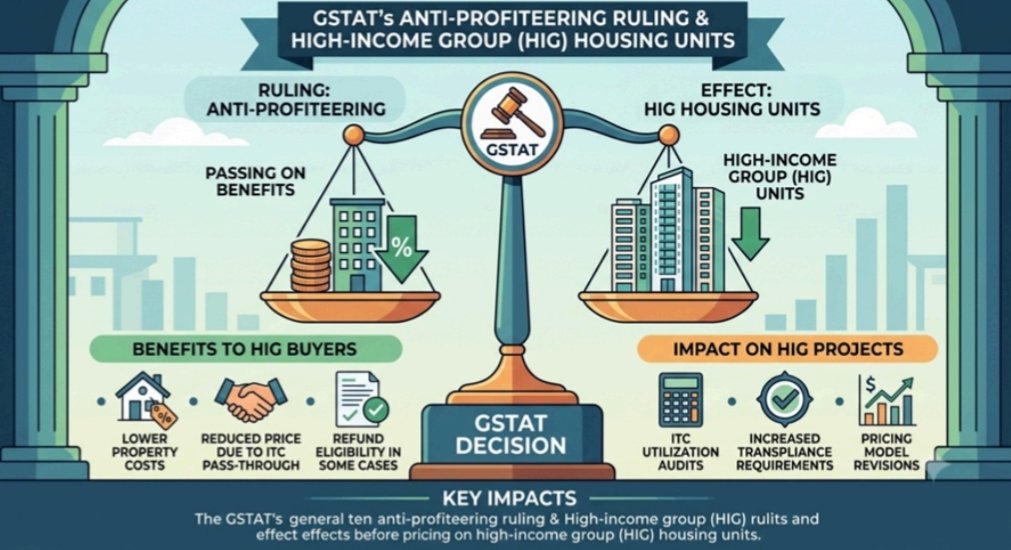
GSTAT anti-profiteering rules are becoming increasingly important for flat buyers in India who discover that a builder may have withheld a tax benefit that should have been passed on to them. If you ever purchased a flat, you may understand the frustration of finding out months after signing papers with a builder that a GST benefit was not reflected in the price. Such a grievance is at the heart of a recent order from the Goods and Services Tax Appellate Tribunal (GSTAT), offering important lessons for premium apartment buyers.
In case of Bengal Emami Housing Ltd., the GSTAT Division Bench has narrowed down the scope of anti-profiteering scrutiny to a way that, at first glance, seems surprising but makes intuitive sense – the Lower Income Group (LIG) and Middle Income Group (MIG) units, whose prices are not subject to any cap, simply did not qualify as a subject of scrutiny as there was not any tax cushion embedded in their prices in the first place. The GSTAT anti-profiteering scrutiny was narrowed down towards the project’s HIG housing units whose sale prices depend on the market forces, and not statutory caps.
The Background: A Housing Project with Three Income Brackets, One Tax Question
The project in question had 440 units distributed across LIG, MIG, and HIG categories. As under GST, whenever there’s an increase in a builder’s ITC upon a change of tax regime this must be passed on to homebuyers in the form of reduced prices, the DGAP conducted an investigation into the entire project to assess whether any of the 440 units had suffered from profiteering. Bengal Emami Housing, however, argued that LIG and MIG units were subject to a West Bengal Housing Department notification requiring the pricing to reflect only “direct cost only”, meaning there would be nothing to pass on as there was no pre-GST tax incorporated into the pricing of these flats.Crucially, the DGAP did not quarrel with this line
What GSTAT Actually Decided Upon
The Tribunal held that the builder’s argument, that statutorily-capped LIG and MIG prices could not be a subject of anti-profiteering computation, was valid. The only legitimate target of profiteering scrutiny, then, were the HIG housing units – the flats that were subject to the whims of the open market. Once the computation was narrowed down to the HIG housing units, the amount that had been profiteered came out to be ₹70,58,488, or roughly ₹70.58 lakh. GSTAT ordered Bengal Emami Housing to pass on this sum (including GST) to all eligible HIG homebuyers named in the DGAP’s clarificatory annexure. In addition to the principal amount, the company was ordered to pay 18% annual interest to each buyer, calculated from the date that each buyer originally paid the extra amount through till the date of actual refund. This interest clock does not stop upon any legal tussle – it simply continues ticking until the homebuyers are made whole. There is also a penalty provision – a 10% penalty under Section 171(3A) of the CGST Act was held to be leviable in principle, although the Tribunal gave the company a way out. If Bengal Emami Housing paid the full ₹70.58 lakh within 30 days of the order, the penalty was to be waived. It’s a fairly typical carrot-and-stick approach – pay promptly, avoid the extra sting. The company was also required to file a compliance report with the jurisdictional GST Commissioner within three months, closing the loop on enforcement.
What This Holds for Any Builder or Buyer
This is not just a story of one builder and one buyer. It is a template. Builders who construct mixed-income projects, with both statutorily-capped and freely-priced units, now have a clearer idea of where the anti-profiteering liability lies. The exposure is limited to the freely-priced units: the HIG housing units. For buyers, this ruling is a reminder that the GST benefit pass-through is not optional but enforceable, with interest accrued on any delay. For developers, it is a nudge to keep meticulous, segment-wise cost and pricing records as regulators draw sharp lines between capped and uncapped categories. It is also part of a pattern – the GSTAT has been quietly laying down rules for how ITC-benefit computations work across various builder disputes, including in places like Hyderabad, Noida, and Kolkata in the last year, with reference to the Delhi High Court’s Reckitt Benckiser India Pvt. Ltd. v. Union of India.
If there’s anything that a buyer looking at a complaint of GST anti-profiteering or wondering if a refund is due should take away from this ruling, it’s this – check which income bracket their unit falls into and whether that bracket’s pricing was ever statutorily capped – and don’t assume silence from your builder means that there’s nothing to be claimed.
Key Regulatory Highlights
GSTAT anti-profiteering provisions aim to ensure that businesses pass on GST rate reductions and input-tax benefits to consumers.
GSTAT anti-profiteering proceedings can examine whether businesses retained tax benefits instead of passing them on through lower prices.
GSTAT anti-profiteering matters may involve detailed reviews of pricing, invoices, input-tax credits, and tax-rate changes.
Businesses should maintain clear documentation to demonstrate compliance with GSTAT anti-profiteering requirements.
The evolving GSTAT anti-profiteering framework highlights the importance of transparent pricing and proper GST compliance.
Frequently Asked Questions
What is GSTAT anti-profiteering?
GSTAT anti-profiteering refers to the regulatory framework and appellate proceedings concerning whether businesses have passed GST rate reductions or input-tax benefits to consumers.
Why is GSTAT anti-profiteering important?
GSTAT anti-profiteering is important because it helps ensure that businesses do not retain tax benefits that should be reflected in consumer prices.
Statutory Citations & References
References
Bengal Emami Housing Ltd. — GSTAT ruling summary, TaxGuru: Link
“Anti-profiteering for housing projects applies strictly to HIG,” TaxHeal (full order text): Link
TaxGuru, Anti-Profiteering case archive (comparative rulings): Link
“Anti-Profiteering authority directs builder to return GST ITC benefit,” TaxScan (Vasavi and GP Infra LLP case, for comparison): Link
“GSTAT Upholds Anti-Profiteering Demand Against Siddha Infradev,” StudyCafe: Link
Maximize Your Business Potential
Looking for a partner to advise on GST, ITR, Business Registration, or Financial Strategy? Our experts ensure your compliance is seamless and your solutions are optimized.
Book a Strategy ConsultationEve Finance: Your Daily Financial Eve-olution!
Finance made simple, fast, and fun! 🏦💡 Sign up for your daily dose of financial insights delivered in plain English. In just 5 minutes, you’ll be smarter and better!