
The World Is Your Market: How Global Markets Are Reshaping International Business in 2026
Published: Jul 6, 2026
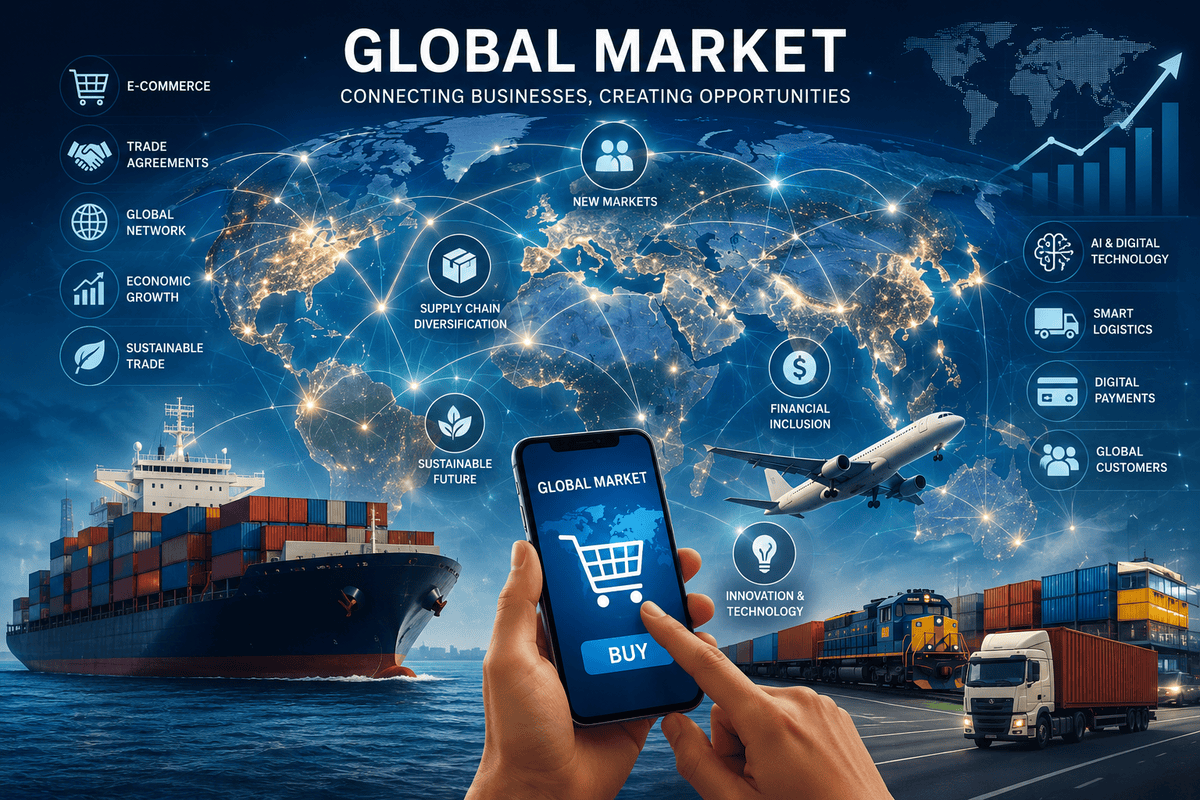
Picture a young firm in Hyderabad that exports handcrafted fabrics to consumers in Tokyo without having to set up a physical store but merely clicking on their smartphone. This is no fantasy. It is already a reality. International business and global markets have entered an age where boundaries mean nothing, and possibilities are endless for those who can navigate the world of trade.
With geopolitics changing the flow of international commerce and artificial intelligence revolutionizing the logistics involved, the mechanics of global business in 2026 are more complicated and much more fascinating than ever before. Here’s what everyone from entrepreneurs to students to professionals should be aware of.
1. The New Architecture of Global Markets
The global economy is not dominated by the West anymore. There is a clear change in the global economic landscape, with its center moving towards the East. Regions such as India, Southeast Asia, and Africa are developing as global powerhouses, with their young and digital population desiring commodities and innovations.
As per data from the World Trade Organization, the volume of global merchandise trade is estimated to expand at 3.3% in 2026. Furthermore, it is expected that developing countries will lead compared to the traditional global markets in terms of growth. Therefore, there are new avenues for doing international business.
2. Key Forces Driving International Trade Today
Several significant trends are currently transforming the nature of international business and trade:
• E-Commerce and Digital Trade: International cross-border e-commerce is estimated to grow to $8 trillion by 2027, with players such as Amazon Global, Shopee, and Meesho allowing micro-enterprises to engage in international commerce.
• Restructuring of Supply Chains: After the pandemic, China Plus One policies have decentralized production centers from China to Vietnam, India, and Mexico, restructuring the entire supply chain structure.
• Next-Generation Trade Agreements: New trade agreements between countries are being made, creating new pathways for businesses. India, for example, has recently signed free trade agreements with the United Arab Emirates and Australia.
• Green Trade Policies: With the implementation of the EU’s Carbon Border Adjustment Mechanism (CBAM), international exporters will need to comply with sustainable manufacturing practices to conduct business globally.
3. Opportunities for International Business in 2026
For entrepreneurs and companies who wish to enter the international market, 2026 will be an exciting year. Technological advancements have made entry into the global market much easier. Companies do not necessarily need a brick-and-mortar office in Germany to market their products to Germans because cloud technology, localized payment systems, and AI customer service take care of all the complexities.
Some industries experiencing rapid growth across borders are fintech, education technology, Software-as-a-Service, sustainable fashion, and digital health. Indian IT companies, for example, are landing billion-dollar projects from the Middle East, Europe, and North America. This is a clear indication that the global market is ready for international businesses of high caliber.
4. Challenges That Cannot Be Ignored
There exist real challenges in global markets. Volatility in currency exchange rates, geopolitical risks, regulations, and mismatch of cultures have led to failure among highly resourced expansion projects. The Russia-Ukraine crisis, US-China trade dispute, and increasing protectionism in Europe have demonstrated that international business is not exempted from political risks.
Wise organizations ensure that they leverage local talent and diversify their market presence. Knowledge of the regulatory landscape in the targeted market, including tariffs, labor laws, and data localization laws, is no longer an advantage but a necessity for international businesses.
Conclusion: Think Globally, Act Strategically
The world economy and international business have ceased being the monopoly of big companies. By 2026, an adequately positioned small enterprise with its value proposition will be able to serve all continents. The instruments are available; the channels are open. But the key question remains, are you ready to enter?
International commerce requires inquisitiveness, cultural sensitivity, and patience. Network internationally ahead of time; know your target market before you get into it. Remember that in global commerce, reputation moves faster than goods and services.
Frequently Asked Questions
What are global markets, and why are they important for businesses?
Global markets refer to international marketplaces where businesses buy and sell goods and services across countries. They are important because they provide access to new customers, increase revenue opportunities, and encourage innovation through global competition.
What are the biggest opportunities in global markets for businesses?
Global markets offer opportunities in industries such as fintech, SaaS, sustainable fashion, digital health, and e-commerce. Businesses can reach international customers through online platforms, AI-powered tools, and localized payment systems without establishing a physical presence abroad.
How are global markets changing in 2026?
Global markets are evolving through digital trade, AI-powered logistics, sustainable business practices, and new free trade agreements. Emerging economies such as India and Southeast Asia are also playing a larger role in driving global economic growth.
Statutory Citations & References
[1] World Trade Organization, “Global Trade Outlook and Statistics 2026,” WTO, Geneva, 2026.
[2] “Cross-Border E-Commerce Market Report 2026,” Statista, 2026.
[3] “India Free Trade Agreements Tracker,” Ministry of Commerce and Industry, Government of India, 2026.
[4] “Carbon Border Adjustment Mechanism (CBAM),” European Commission, 2026.
[5] “Emerging Markets Outlook 2026,” International Monetary Fund, Washington D.C., 2026.
Simplify your Business
Eve Consultancy is your trusted partner for end-to-end compliance services, including Company Incorporation, GST Registration, Income Tax Filing, MSME Registration, and more. With a quick and hassle-free process, expert guidance, and affordable pricing, we help businesses stay compliant while they focus on growth. Backed by experienced professionals, we ensure smooth handling of all your legal and financial requirements. WhatsApp us today at +91 9711469884 to get started.
Maximize Your Business Potential
Looking for a partner to advise on GST, ITR, Business Registration, or Financial Strategy? Our experts ensure your compliance is seamless and your solutions are optimized.
Book a Strategy ConsultationEve Finance: Your Daily Financial Eve-olution!
Finance made simple, fast, and fun! 🏦💡 Sign up for your daily dose of financial insights delivered in plain English. In just 5 minutes, you’ll be smarter and better!