
Risk tolerance psychology– how founders process uncertainty differently
Published: Aug 9, 2026
Key Highlights
- Founders with strong risk tolerance psychology are better equipped to navigate uncertainty and make informed decisions.
- Developing an entrepreneurial risk mindset helps entrepreneurs balance innovation with calculated risk-taking.
- Continuous learning, adaptability, and resilience are essential traits for entrepreneurial success.
- Effective risk management involves evaluating opportunities strategically rather than avoiding uncertainty altogether.
- Psychological preparedness and informed decision-making contribute significantly to sustainable business growth.
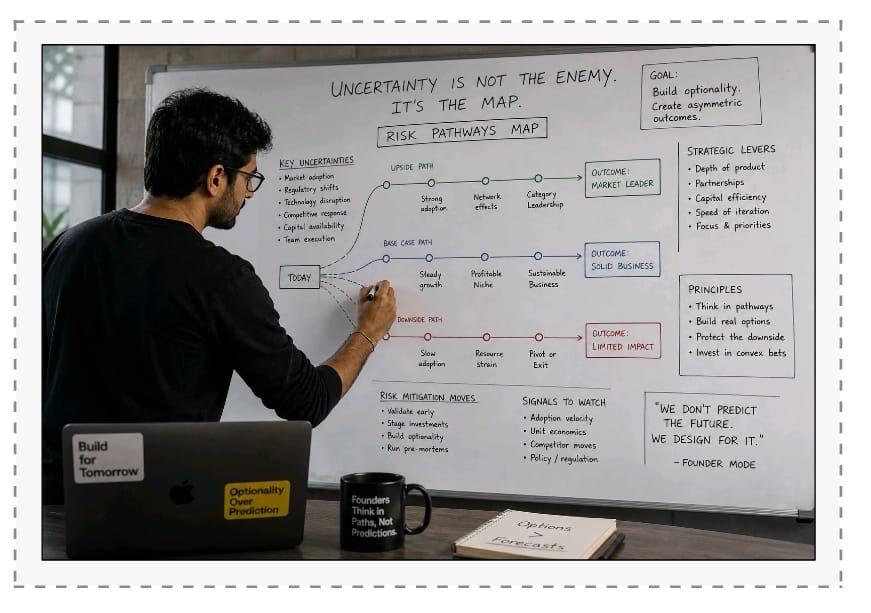
Most people look at a founder who has just lost their third consecutive startup and see failure. The founder looks at the same situation and sees calibration data. That gap — that almost inexplicable difference in how uncertainty is absorbed, processed, and ultimately acted upon — is the beating heart of what we now call founder risk tolerance psychology. It is not recklessness. It is not naivety. It is a genuinely different operating system.
The question of why some people can stomach extraordinary uncertainty while others are paralysed by even modest ambiguity has preoccupied behavioral economists, venture capitalists, and psychologists for decades. What the research keeps finding — and what the venture world has long suspected — is that entrepreneurial risk mindset is not simply a personality quirk. It is a distinct cognitive architecture, shaped by a combination of early experiences, domain expertise, and a peculiar relationship with regret.
This matters beyond the philosophical. Understanding how founders process risk differently from career professionals, investors, or employees has enormous practical implications — for how capital gets allocated, how teams are built, and how the startup ecosystem functions as a whole.
The Neuroscience of Calculated Daring
When a typical professional encounters an uncertain outcome, the amygdala — the brain’s threat-detection centre — fires up and the body prepares a defensive response. Risk, in this framing, is something to be minimized. Founders, research suggests, process the same stimulus differently. Studies out of the University of Cambridge and the Max Planck Institute for Human Development have found that experienced entrepreneurs tend to exhibit reduced loss aversion relative to the general population. They do not feel losses less acutely. They simply weight them differently in their decision architecture.
This is a critical distinction. The cliché of the fearless founder misses the point entirely. Sara Blakely, the founder of Spanx, has spoken openly about how her father’s habit of asking at dinner ‘what did you fail at this week?’ rewired her relationship with failure from an early age. The question was not meant to celebrate failure — it was meant to destigmatize the attempt. That kind of early conditioning produces adults who categorize risk as information rather than threat, which is an entirely different cognitive posture.
Similarly, Elon Musk’s now-legendary decision in 2008 to split his last $40 million between SpaceX and Tesla — two companies widely considered dead in the water by the broader investment community — was not the move of someone indifferent to loss. It was the move of someone whose internal probability calculus was calibrated differently. Musk himself described it as a conscious acknowledgment that both companies would likely fail, paired with a conviction that not trying would be worse. That asymmetry — where inaction is the greater risk — is the hallmark of founder risk tolerance psychology in its most concentrated form.
When Confidence Isn’t Arrogance: The Competence-Risk Loop
One of the most persistent misreadings of entrepreneurial confidence is confusing it with arrogance or irrationality. The reality is far more nuanced. Founders who thrive in high-uncertainty environments tend to deploy what psychologists call ‘domain-specific risk tolerance’ — they are not broadly reckless, but they carry a deep, earned conviction in specific areas that allows them to tolerate ambiguity where others see only chaos.
Consider the story of Brian Chesky and Joe Gebbia, the Airbnb co-founders who literally slept on air mattresses in their San Francisco apartment to fund their early operations. The conventional reading is that they were desperate. The accurate reading is that they had processed the risk of non-action — watching the housing market, sensing an emerging behavioral shift in how people thought about accommodation and trust — and found the personal cost of not trying to be greater than the humiliation of failure. Their risk tolerance was not uniform across life; it was laser-focused on a specific thesis they had reason to believe in.
This pattern repeats across the startup ecosystem. Founders rarely bet recklessly across the board. They bet heavily and specifically. The entrepreneurial risk mindset, when it is functioning at its best, is not about being comfortable with all uncertainty — it is about having enough domain conviction to absorb the uncertainty that comes with executing a specific insight.
The Regret Asymmetry That Drives Founders Forward
Academic work on founder psychology keeps circling back to a concept that sits at the intersection of behavioral economics and existential philosophy: regret minimization. Jeff Bezos famously described this framework in an interview, explaining that he imagined himself at 80 years old looking back at his decision to leave a comfortable Wall Street job and start Amazon. The question he asked was not ‘what if I fail?’ — it was ‘what if I never tried?’
This is not a mere motivational heuristic. It represents a genuine asymmetry in how founders weight types of regret. Research published in the Journal of Business Venturing consistently shows that entrepreneurs rate errors of omission — things they failed to attempt — as significantly more psychologically damaging than errors of commission — things they tried and got wrong. This fundamentally restructures the risk calculus. When not-doing something feels more dangerous than doing it, conventional risk aversion inverts.
The implications for investor-founder dynamics are significant. Founders operating with this regret asymmetry will frequently pursue paths that look irrational from the outside — extending runway beyond what institutional logic would suggest, doubling down on products the market has been lukewarm about, refusing acquisition offers that seem objectively favorable. These decisions are not delusion. They are, in many cases, the natural output of a psychological framework in which premature closure carries a heavier emotional tax than prolonged uncertainty.
Rejection, Financial Adversity, and the Calibration Effect
There is a dimension to founder risk psychology that rarely makes it into the business press: the role of financial rejection in sharpening entrepreneurial risk mindset. Almost every founder of consequence has a story about being told no — by banks, by institutional lenders, by VCs, by early customers. And the ones who build durable companies tend to describe those rejections not as trauma but as calibration events.
Pat Gelsinger, who returned to Intel as CEO after a decades-long career that included significant professional setbacks, often describes the period when he left Intel the first time as the moment he stopped fearing organizational rejection. Having faced it and survived, the category of ‘things that can stop me’ meaningfully contracted. This is a pattern in founder psychology more broadly — adversity, particularly financial adversity, appears to have a dose-dependent effect on risk tolerance, up to a point. Founders who have been through funding droughts, payroll crises, or public product failures tend to carry a quieter internal confidence than those who have sailed smoothly.
This is not to romanticize hardship — the psychological toll of financial rejection can also produce paralysis, burnout, and genuinely poor decision-making. The difference, when examined closely, seems to lie in whether the founder has built what psychologists call ‘psychological distance’ from outcomes — the ability to separate self-worth from venture outcomes. Those who cannot make that separation often find that adversity contracts their risk appetite permanently. Those who can find that it quietly expands it.
Conclusion: The Operating System Behind the Bet
Founder risk tolerance psychology is not a personality type you either have or you don’t. It is, more accurately, a cognitive operating system — shaped by experience, deepened by domain expertise, restructured by adversity, and refined by a specific kind of relationship with regret. The founders who endure — who build companies that matter, that last, that absorb punishing uncertainty and keep moving — are not the ones who feel no fear. They are the ones who have learned, through exposure and reflection, to interpret that fear as signal rather than instruction.
For the investor watching from the other side of the table, this distinction is everything. The candidate who speaks calmly about their biggest failure is not necessarily resilient. The one who can articulate exactly what the failure taught them, and precisely how it reconfigured their risk model, usually is. Entrepreneurial risk mindset, at its core, is not about courage — it is about the quality of your relationship with uncertainty. The best founders don’t eliminate doubt. They have simply learned to work with it, and in doing so, they turn the most human of fears into their most reliable competitive asset.
Frequently Asked Questions
What is founder risk tolerance psychology?
Founder risk tolerance psychology studies how entrepreneurs perceive and manage uncertainty while making business decisions.
Why is risk tolerance important for founders?
Risk tolerance helps founders make strategic decisions, adapt to challenges, and pursue growth opportunities confidently.
How do entrepreneurs process uncertainty differently?
Entrepreneurs often view uncertainty as an opportunity for innovation and learning rather than a barrier to success.
What is an entrepreneurial risk mindset?
An entrepreneurial risk mindset is the ability to evaluate risks objectively and make informed decisions despite uncertainty.
Can risk tolerance be developed over time?
Yes. Experience, continuous learning, and exposure to challenges can improve an individual’s ability to manage risk effectively.
How does psychology influence entrepreneurial decisions?
Psychological factors such as confidence, resilience, adaptability, and emotional intelligence influence entrepreneurial decision-making.
What are the benefits of calculated risk-taking?
Calculated risks can lead to innovation, business growth, competitive advantage, and improved problem-solving abilities.
Why do successful founders embrace uncertainty?
Successful founders understand that uncertainty is a natural part of entrepreneurship and often creates opportunities for growth and innovation.
How can aspiring entrepreneurs develop a risk mindset?
They can build a risk mindset through practical experience, mentorship, continuous learning, and strategic planning.
Does every successful entrepreneur have a high risk tolerance?
No. Successful entrepreneurs focus on managing and calculating risks rather than taking unnecessary risks.
Statutory Citations & References
Kahneman, D. & Tversky, A. (1979). Prospect Theory: An Analysis of Decision under Risk. Econometrica, 47(2), 263–291.
Baron, R. A. (2008). The Role of Affect in the Entrepreneurial Process. Academy of Management Review, 33(2), 328–340.
Sarasvathy, S. D. (2001). Causation and Effectuation: Toward a Theoretical Shift from Economic Inevitability to Entrepreneurial Contingency. Academy of Management Review, 26(2), 243–263.
Blakely, S. (2016). Spanx Founder Sara Blakely: My Father Taught Me to Embrace Failure. CNBC. https://www.cnbc.com/2016/10/13/spanx-founder-sara-blakely-my-father-taught-me-to-embrace-failure.html
Shane, S. & Venkataraman, S. (2000). The Promise of Entrepreneurship as a Field of Research. Academy of Management Review, 25(1), 217–226.
Journal of Business Venturing — Multiple issues on founder psychology and risk behavior. Elsevier. https://www.journals.elsevier.com/journal-of-business-venturing
Bezos, J. (1997). Regret Minimization Framework. Amazon Shareholder Letter / Various interviews. Referenced via: https://www.inc.com/jeff-haden/jeff-bezos-says-this-is-the-best-way-to-make-life-decisions.html
Simplify your Business
Eve Consultancy is your trusted partner for end-to-end compliance services, including Company Incorporation, GST Registration, Income Tax Filing, MSME Registration, and more. With a quick and hassle-free process, expert guidance, and affordable pricing, we help businesses stay compliant while they focus on growth. Backed by experienced professionals, we ensure smooth handling of all your legal and financial requirements. WhatsApp us today at +91 9711469884 to get started.
Maximize Your Business Potential
Looking for a partner to advise on GST, ITR, Business Registration, or Financial Strategy? Our experts ensure your compliance is seamless and your solutions are optimized.
Book a Strategy ConsultationEve Finance: Your Daily Financial Eve-olution!
Finance made simple, fast, and fun! 🏦💡 Sign up for your daily dose of financial insights delivered in plain English. In just 5 minutes, you’ll be smarter and better!