
1.2 Billion Climate Refugees by 2050: The Coming Wave That Will Redraw Borders and Spark Climate Migration
Published: Jun 17, 2026
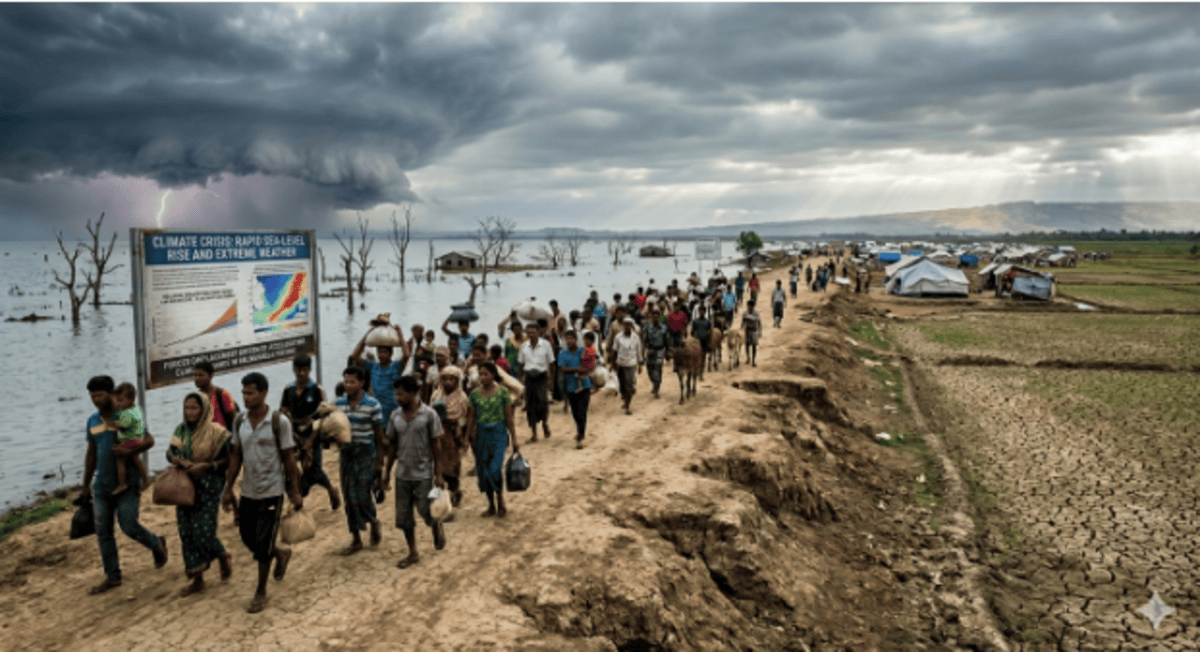
Forced displacement and climate migration are emerging as key issues of the twenty-first century globally. Climate change and environmental degradation, coupled with rising temperatures and extreme weather events, are making climate-vulnerable areas of the world more at risk of forced displacement. With the increasing climate migration, millions of people could be forced to flee their homes for safety, resources, and stable living conditions. The scale of environmental displacement is now estimated to affect as many as 1.2 billion people by 2050, increasingly creating the need for international cooperation, policy change, and adaptation to climate change to tackle forced displacement.
The increasing climate crisis is creating refugees.
Human migration is more and more influenced by climate change around the world. Poor livelihoods are being compromised by flooding, droughts, hurricanes, wildfires, and rising sea levels, forcing many areas to become uninhabitable. Agricultural and coastal communities are most sensitive to environmental uncertainties.
International climate evaluations estimate that already millions of people are forced to move each year because of climate-related disasters. Whereas economic-driven migration is generally in search of opportunity, climate migration is more often a matter of urgency and survival. This transition is reshaping the directions of governments and humanitarian organizations’ migration policy and disaster response.
How is climate change causing forced displacement?
Access to food, water, shelter, and work is directly affected by environmental changes. Agricultural output decreases during extended dry spells, and during floods and storms, houses and property are damaged. These conditions render people socially vulnerable and frequently cause population displacement.
Some of the highest risks are in small island nations and densely populated coastal areas. Sea rise is a clear and present danger to low-lying populations, where displacement is likely to be an issue for the foreseeable future. Poor resources and infrastructure further hinder adaptation in many developing countries. Other studies show that climate-induced displacement can also lead to heightened migration tensions in the affected areas due to political change and/or competition over resources.
The economic and political implications
Migration on a large scale has economic and political consequences. The high rate of population migration can over-stretch receiving areas’ housing, healthcare, jobs, and public infrastructure. The sudden influx of displaced populations, especially in urban areas, may be challenging for governments to handle.
Climate migration may have geopolitical implications at an international level, as it changes borders and geopolitical relations. The countries with significant numbers of refugees might be more selective with immigration laws, and the vulnerable countries might call for a higher level of global climate responsibility.
Economic inequalities also significantly impact the resilience of communities to environmental challenges. Higher-income countries tend to have more adaptive capacity, while lower-income countries are more vulnerable to the impacts of climate change.
Global climate adaptation – what is needed?
Preparing for climate migration requires international cooperation and proactive planning. Governments need to fund climate adaptation measures, including resilient infrastructure, sustainable agriculture, disaster preparedness, water management, etc. Such measures can help to mitigate environmental vulnerabilities and mitigate displacement risks.
International organizations are also making climate-displaced populations a point of focus for legal protection. There are gaps in humanitarian protection policies, as many climate migrants are not classed as refugees under the Convention definition.
Furthermore, mitigation of GHGs is still crucial in the context of long-term environmental degradation. With less effective climate action, displacement trends are likely to grow more severe in the next few decades.
Human Resilience and Community Response
However, climate migration is fraught with difficulties, and communities continue to show resilience and adaptability. There is a growing number of local organizations, humanitarian groups, and governments that collaborate to help the displaced by relocating them, educating them, and providing employment assistance.
Community-based adaptation strategies have also proven to be useful in retaining vulnerable people in their places of origin, if at all feasible. Building local resilience could lessen the magnitude and extent of potential future displacement and enhance long-term social stability.
Conclusion
As climate change increases, forced displacement and climate migration can be anticipated to become more important global issues. Many areas of the world are at risk from rising climate pressures, impacting livelihoods, infrastructure, and social stability.
Governments and international bodies need to focus on climate adaptation, humanitarian protection, and sustainable development, given the growing forced displacement and shrinking of the climate migration footprint. How effective the world is at responding to one of the largest human mobility challenges in history will likely be settled over the next few decades.
Frequently Asked Questions
How can governments reduce the risk of forced displacement?
Forced displacement is expected to rise significantly by 2050 because climate change is intensifying extreme weather events and environmental pressures worldwide. As livelihoods, housing, and essential resources become less secure, millions of people may be forced to migrate to safer areas.
Which regions are most vulnerable to climate migration and forced displacement?
Low-lying coastal areas, small island nations, drought-prone agricultural regions, and densely populated developing countries are among the most vulnerable. Communities in these areas face increased risks from sea-level rise, water shortages, crop failures, and natural disasters, making climate migration more likely.
What is forced displacement, and how is climate change contributing to it?
Forced displacement occurs when people are compelled to leave their homes due to threats such as natural disasters, environmental degradation, conflict, or unsafe living conditions. Climate change is increasing forced displacement by causing floods, droughts, wildfires, hurricanes, and rising sea levels that make many regions difficult to inhabit.
Statutory Citations & References
[1] A. I. Almulhim, G. N. Alverio, A. Sharifi, R. Shaw, S. Huq, M. J. Mahmud, S. Ahmad, and I. R. Abubakar, “Climate-induced migration in the Global South: An in-depth analysis,” npj Climate Action, vol. 3, art. no. 47, 2024.
[2] R. Beyer, M. T. Miranda Espinosa, S. Ponserre, M. Mengel, and A. Milan, “Heterogeneous effects of climate change on displacement-inducing disasters,” Frontiers in Climate, vol. 6, art. no. 1260028, 2024.
[3] S. Meng, “Environmental governance is critical for mitigating human displacement due to weather-related disasters,” Communications Earth & Environment, vol. 5, art. no. 363, 2024.
[4] E. R. Bower, A. Badamikar, G. Wong-Parodi, and C. B. Field, “Enabling pathways for sustainable livelihoods in planned relocation,” Nature Climate Change, vol. 13, pp. 919–926, 2023.
[5] D. Das and S. Basu, “Climate change, migration, and internally displaced populations in the Indian Ocean Region – evidence from South Asia and East Africa,” Journal of the Indian Ocean Region, vol. 19, no. 2, pp. 167–190, 2024.
Simplify your Business
Eve Consultancy is your trusted partner for end-to-end compliance services, including Company Incorporation, GST Registration, Income Tax Filing, MSME Registration, and more. With a quick and hassle-free process, expert guidance, and affordable pricing, we help businesses stay compliant while they focus on growth. Backed by experienced professionals, we ensure smooth handling of all your legal and financial requirements. WhatsApp us today at +91 9711469884 to get started.
Maximize Your Business Potential
Looking for a partner to advise on GST, ITR, Business Registration, or Financial Strategy? Our experts ensure your compliance is seamless and your solutions are optimized.
Book a Strategy ConsultationEve Finance: Your Daily Financial Eve-olution!
Finance made simple, fast, and fun! 🏦💡 Sign up for your daily dose of financial insights delivered in plain English. In just 5 minutes, you’ll be smarter and better!