
Feature Engineering for Predictive Models
Published: Aug 10, 2026
Key Highlights
- No algorithm compensates for poor features. If your team's first instinct when model performance stagnates is to swap the architecture, reconsider. Audit your features first.
- . Domain knowledge is a competitive moat. Features engineered from deep industry insight are far harder for competitors to replicate than any open-source model choice.
- . Build a feature store early. Treat engineered features as institutional assets. Document them, version them, and make them reusable across model iterations.
- . Automate candidate generation, curate with human expertise. AutoML tools are time-savers, not replacements. The curation step is where your team's judgment creates value.
- . Interaction features are often the biggest wins. Ratios, relative measures, and cross-feature products frequently outperform raw columns — and they are easy to miss without deliberate exploration.
BUSINESS TECHNOLOGY |
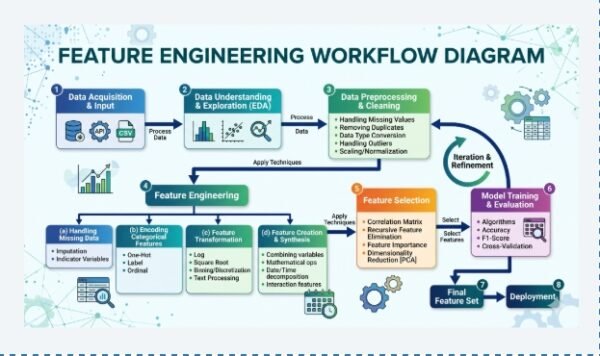
The Unglamorous Engine Behind Every Great AI PredictionYou can have the most sophisticated neural network ever designed sitting in your infrastructure, and it will still produce garbage if you feed it the wrong inputs. That is the uncomfortable truth that data science teams rarely put in pitch decks. Feature engineering — the process of selecting, transforming, and constructing the raw variables that go into predictive ML models — is responsible for more model failures, and more model victories, than any architectural choice your team will ever debate.
What Feature Engineering Actually Is — Strip Away the Hype
At its most basic, feature engineering is the art of translating raw, messy, real-world data into a structured signal that a machine learning algorithm can meaningfully interpret. A timestamp, for instance, is not just a timestamp. Depending on your prediction task, the hour of the day, the day of the week, whether it falls on a national holiday, the time elapsed since a prior event — each of these derivatives carries information the original column never explicitly contained. That transformation work is feature engineering.
What separates competent teams from exceptional ones is understanding that features are not discovered — they are constructed. You have to bring domain knowledge, business intuition, and a fair amount of creative thinking to the table before you even open a Jupyter notebook. A raw column called ‘customer_tenure’ means little to a gradient boosted tree. ‘Months since last purchase relative to average customer lifecycle’ is a feature that speaks a language the model actually understands.
This is why feature engineering sits at the intersection of data science and subject matter expertise. It cannot be outsourced to the algorithm, and it cannot be automated away entirely — despite what several AutoML vendors would prefer you to believe.
Three Real-World Cases That Prove the Point
The clearest illustration of feature engineering’s power comes from credit risk modelling. When fintech lenders began targeting thin-file borrowers — individuals with little to no formal credit history — traditional predictive ML models failed because the inputs they relied on simply did not exist. The breakthrough came not from more data, but from better-engineered features. Lenders who started constructing variables from mobile recharge patterns, UPI transaction velocity, merchant category diversity, and late-night versus daytime spending behaviour found that these engineered signals predicted default risk with an accuracy that rivalled models built on years of traditional credit bureau data.
Uber’s surge pricing engine offers a second case worth studying. The core prediction task is demand forecasting at hyper-local, near-real-time granularity. Raw location coordinates and ride counts are essentially useless without the features built around them — rolling averages by hexagonal grid zones, weather event flags, stadium and concert schedule integrations, and time-decay weighted demand signals. None of those exist in the raw data lake. Every single one was crafted by engineers who understood both the statistical requirements of the model and the human behaviour they were trying to anticipate.
A third example sits closer to the business journalism world: churn prediction in subscription media. Raw cancellation data tells you who left; it does not tell you who is about to leave. Teams at streaming platforms have found that behavioural velocity features — declining session depth over the prior three weeks, increasing time between logins, and a growing proportion of sessions that end without content completion — carry far more predictive power than static demographic variables. The model did not discover this on its own. A feature engineering pipeline put those signals in front of it.
The Dirty Work Nobody Talks About
Feature engineering is genuinely unglamorous work. Encoding categorical variables is another area where naive choices cost teams dearly. One-hot encoding a city column in a national logistics dataset can add thousands of dimensions to your feature space, most of which carry noise rather than signal. Target encoding, frequency encoding, or embedding-based approaches each have trade-offs that depend entirely on the cardinality of the variable and the volume of your training data. There is no universal answer. That’s precisely why feature engineering demands human judgement rather than automated substitution.
Interaction features are perhaps the most underappreciated weapon in the toolkit. Two features that individually show weak correlation with the target can, when combined, expose a relationship the model would never surface on its own. A customer’s average order value is moderately predictive of churn. Their average order value relative to their category’s median is substantially more predictive. That ratio — a single engineered feature — can shift a model’s F1 score in ways that adding another algorithmic layer simply will not.
Where Automation Helps and Where It Misleads
The last two years have brought serious tooling to the feature engineering space — Featuretools, tsfresh, and vendor-side platforms like Tecton and Feast have all moved the needle on automating parts of the pipeline. These tools are genuinely useful, particularly for time-series data and for generating large candidate feature sets that human analysts can then evaluate. They reduce the brute-force exploration time meaningfully.
But there is a ceiling. Automated feature generation produces quantity; it cannot replace the domain intuition that produces quality. A fraud detection model built on features auto-generated from transaction logs will miss the patterns that a fraud analyst who has spent years reading dispute cases will immediately flag. This is where founders building AI products need to think carefully about their team structure. Hiring strong ML engineers without pairing them with domain specialists — whether those are credit analysts, logistics planners, or clinical researchers depending on the vertical — is a reliable path to mediocre models that look impressive on toy benchmarks and underperform in production.
Conclusion
The most honest thing you can say about feature engineering is that it is where machine learning actually earns its money. Algorithms have become commodities — gradient boosting, transformers, and ensemble methods are open-source, well-documented, and broadly accessible. What remains genuinely scarce is the ability to look at a raw dataset and see the latent structure within it, to construct variables that encode business logic, behavioural nuance, and temporal context into a form that a model can leverage. That skill is hard to scale, harder to automate, and absolutely central to building predictive ML models that do what they promise. Teams that treat feature engineering as infrastructure — investing in it systematically, documenting features with the same discipline they apply to code, building feature stores that accumulate organisational learning — are the ones whose models keep improving long after competitors have hit a ceiling. The algorithm is just the messenger. Feature engineering writes the message.
Frequently Asked Questions
What is feature engineering?
Feature engineering is the process of selecting, transforming, and creating variables that improve a machine learning model’s ability to make accurate predictions.
Why is feature engineering important in machine learning?
It converts raw data into meaningful inputs, often having a greater impact on model performance than the choice of algorithm.
How does feature engineering improve predictive models?
It uncovers hidden patterns and relationships in data, making predictions more accurate and reliable.
What is the difference between raw data and engineered features?
Raw data is unprocessed information, while engineered features are transformed variables designed to better represent predictive signals.
Can feature engineering outperform model architecture improvements?
Yes. Better features often improve performance more than switching to a more complex algorithm.
What are interaction features?
They are new variables created by combining two or more existing features to reveal relationships that individual features may not capture.
Why are temporal features useful in prediction tasks?
Features such as time of day, day of the week, or time since the last event often capture behavioral patterns that improve predictions.
What challenges arise when encoding categorical variables?
Choosing the wrong encoding method can increase noise, create high-dimensional data, and reduce model performance
How do feature stores support machine learning workflows?
They centralize, document, and reuse engineered features, ensuring consistency across training and production.
Why can’t AutoML completely replace feature engineering?
AutoML automates parts of the process, but it cannot fully understand business context or create high-quality domain-specific features.
Statutory Citations & References
Domingos, P. (2012). A few useful things to know about machine learning. Communications of the ACM, 55(10), 78–87. https://doi.org/10.1145/2347736.2347755
Zheng, A. & Casari, A. (2018). Feature Engineering for Machine Learning: Principles and Techniques for Data Scientists. O’Reilly Media, Sebastopol, CA.
Kuhn, M. & Johnson, K. (2019). Feature Engineering and Selection: A Practical Approach for Predictive Models. CRC Press, Boca Raton, FL. Available at: http://www.feat.engineering/
Chen, T. & Guestrin, C. (2016). XGBoost: A Scalable Tree Boosting System. Proceedings of the 22nd ACM SIGKDD International Conference on Knowledge Discovery and Data Mining. https://doi.org/10.1145/2939672.2939785
Tecton.ai (2023). The Feature Store for Machine Learning. Technical Overview. Available at: https://www.tecton.ai/feature-store/ [Accessed April 2025].
Feast (2024). Open Source Feature Store for Machine Learning. Available at: https://feast.dev/ [Accessed April 2025].
Jiang, J. et al. (2021). Credit risk assessment for thin-file consumers using alternative data. Journal of Financial Data Science, 3(2), 44–62.
Transform your brand
Drive massive brand engagement with over 10 million college students across 3,000+ premier institutions, both online and offline. EvePaper is India’s leading youth marketing consultancy, connecting brands with the next generation of consumers through innovative, engagement-driven campaigns.
Mail us at: collaborate@evepaper.com
About us
Maximize Your Business Potential
Looking for a partner to advise on GST, ITR, Business Registration, or Financial Strategy? Our experts ensure your compliance is seamless and your solutions are optimized.
Book a Strategy ConsultationEve Finance: Your Daily Financial Eve-olution!
Finance made simple, fast, and fun! 🏦💡 Sign up for your daily dose of financial insights delivered in plain English. In just 5 minutes, you’ll be smarter and better!