
6 Practical Insights into Disaster Recovery Planning for IT Business Continuity
Published: Aug 16, 2026
Key Highlights
- Disaster recovery is closely linked to IT business continuity
- Plans may not always translate into effective action
- System dependencies can amplify disruptions
- Prioritization is essential during recovery
- Testing helps identify gaps in planning
- Human decision-making influences outcomes under pressure
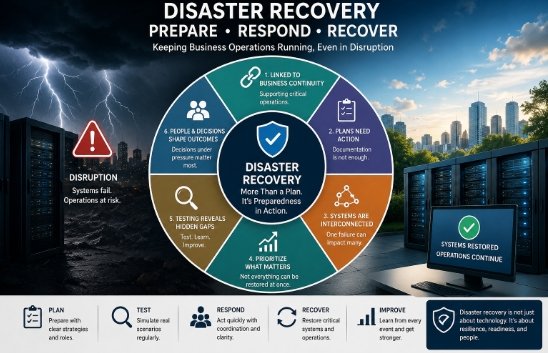
Disaster recovery is often treated as a technical requirement.
Systems are backed up, recovery plans are documented, and protocols are put in place. On paper, this creates a sense of preparedness.
In practice, the situation is not always that clear.
Plans that exist in documentation do not always translate into effective response during disruption. The gap between what is planned and what actually works tends to become visible only when systems are under pressure.
This is where disaster recovery frameworks become more than a checklist. They begin to reflect how well an organization understands its own systems, dependencies, and response capabilities in real conditions.
- Disaster Recovery Is Closely Linked to Business Continuity
Disaster recovery is often discussed as a technical function, focused on restoring systems after disruption.
However, in practice, it is closely tied to IT business continuity. Restoring systems is only one part of the process. The larger question is whether critical operations can continue, even in a limited capacity, while recovery is underway.
When disaster recovery is planned in isolation, it may overlook how different systems support core business functions. Aligning recovery planning with business continuity helps ensure that efforts are directed toward what matters most during disruption.
- Plans Do Not Always Translate into Action
Disaster recovery plans are often detailed and well-documented.
At first glance, this suggests that organizations are prepared for disruption. However, the ability to execute these plans in real situations is not always tested to the same extent.
In some cases, teams may be familiar with the documentation but not with how it applies under pressure. This can create delays or confusion at the point when response needs to be immediate.
Regular testing and simulation can help bridge this gap. Without that, disaster recovery risks remaining more of a documented process than a functional one.
- Systems Do Not Fail in Isolation
Disruptions are often discussed as if they affect a single system at a time.
In practice, systems are interconnected. A failure in one area can quickly impact others, especially when dependencies are not fully visible during planning.
This can include anything from shared infrastructure to data flows that support multiple functions. When these links are not accounted for, recovery efforts may address one issue while others continue to affect operations.
Recognizing these dependencies makes disaster recovery planning more realistic. It shifts the focus from isolated fixes to understanding how systems interact under stress.
- Not All Systems Can Be Restored at the Same Time
Disaster recovery plans often assume that systems will be brought back online in a structured sequence.
In reality, recovery tends to involve trade-offs. Limited resources, time constraints, and technical complexity can make it difficult to restore everything at once.
This makes prioritization important. Identifying which systems support critical operations allows recovery efforts to focus on what is immediately necessary, rather than trying to address everything simultaneously.
Clear prioritization does not simplify the process, but it can make it more manageable when disruptions occur.
- Testing Reveals Gaps That Planning Often Misses
Disaster recovery frameworks are usually designed with careful consideration.
Even so, certain gaps only become visible when plans are tested in conditions that resemble real disruptions. What appears clear in documentation may not translate as easily during execution.
Testing, whether through simulations or controlled drills, allows teams to identify these gaps before they become critical. It also helps clarify roles, timing, and coordination between different functions.
Without this step, disaster recovery remains partially unverified, even if the planning itself appears complete.
- Decision-Making Under Pressure Shapes Outcomes
Disaster recovery plans often assume that actions will be carried out as defined.
In reality, decisions are made under pressure, sometimes with incomplete information and limited time. This can affect how plans are interpreted and executed.
Even well-designed frameworks may not account for how people respond in these situations. Uncertainty, urgency, and communication gaps can influence outcomes in ways that are difficult to predict in advance.
Recognizing this makes recovery planning more grounded. It highlights the need to support not just systems, but also the people responsible for managing them during disruption.
Conclusion
Disaster recovery frameworks are often designed to create a sense of control over unexpected events.
In practice, their effectiveness depends on how well they account for real conditions. This includes system dependencies, operational priorities, and the way decisions are made under pressure.
When disaster recovery is aligned with IT business continuity, it becomes less about restoring systems in isolation and more about maintaining essential functions. This shift does not remove uncertainty, but it can make disruption easier to manage.
Frequently Asked Questions
What is disaster recovery?
Disaster recovery is the process of restoring IT systems and data after a disruption or disaster.
How is disaster recovery related to business continuity?
Disaster recovery restores systems, while business continuity ensures essential business operations continue during recovery.
Why are disaster recovery plans tested regularly?
Testing identifies weaknesses and ensures teams can respond effectively during real emergencies.
. Why is system prioritization important during recovery?
Limited resources make it necessary to restore the most critical systems first.
What are system dependencies?
They are connections between systems where one system relies on another to function properly.
Why can documented plans fail during real disruptions?
Teams may face pressure, unclear communication, or unexpected situations that were not considered in the plan.
How do simulations improve disaster recovery?
Simulations help teams practice responses, clarify roles, and improve coordination.
Why is decision-making important during disaster recovery?
Quick and informed decisions help reduce downtime and improve recovery outcomes.
Can all systems be restored at the same time?
No. Organizations usually restore critical systems first due to limited time and resources.
What is the main goal of a disaster recovery framework?
To minimize downtime, restore critical systems, and help maintain essential business operations during disruptions.
Statutory Citations & References
[1] National Institute of Standards and Technology (NIST), “Contingency Planning Guide for Federal Information Systems,” 2022. [Online]. Available: https://www.nist.gov/
[2] International Organization for Standardization, “ISO 22301: Business Continuity Management Systems,” 2019.
[3] IBM, “The Importance of Disaster Recovery and Business Continuity,” 2023. [Online]. Available: https://www.ibm.com/
[4] Microsoft, “Disaster Recovery and Business Continuity in Cloud Computing,” 2023. [Online]. Available: https://learn.microsoft.com/
Transform your brand
Drive massive brand engagement with over 10 million college students across 3,000+ premier institutions, both online and offline. EvePaper is India’s leading youth marketing consultancy, connecting brands with the next generation of consumers through innovative, engagement-driven campaigns.
Mail us at: collaborate@evepaper.com
Maximize Your Business Potential
Looking for a partner to advise on GST, ITR, Business Registration, or Financial Strategy? Our experts ensure your compliance is seamless and your solutions are optimized.
Book a Strategy ConsultationEve Finance: Your Daily Financial Eve-olution!
Finance made simple, fast, and fun! 🏦💡 Sign up for your daily dose of financial insights delivered in plain English. In just 5 minutes, you’ll be smarter and better!