
6 Smart Trends in Deglobalisation of Supply Chains: Reshoring, Nearshoring and What’s Next
Published: Jul 16, 2026
Key Highlights
- • Deglobalisation shifts focus from global to local supply chains
- • Reshoring improves control over production
- • Nearshoring manufacturing trend reduces risks and delays
- • Stability is becoming more important than cost savings
- • Hybrid supply chain models are the future
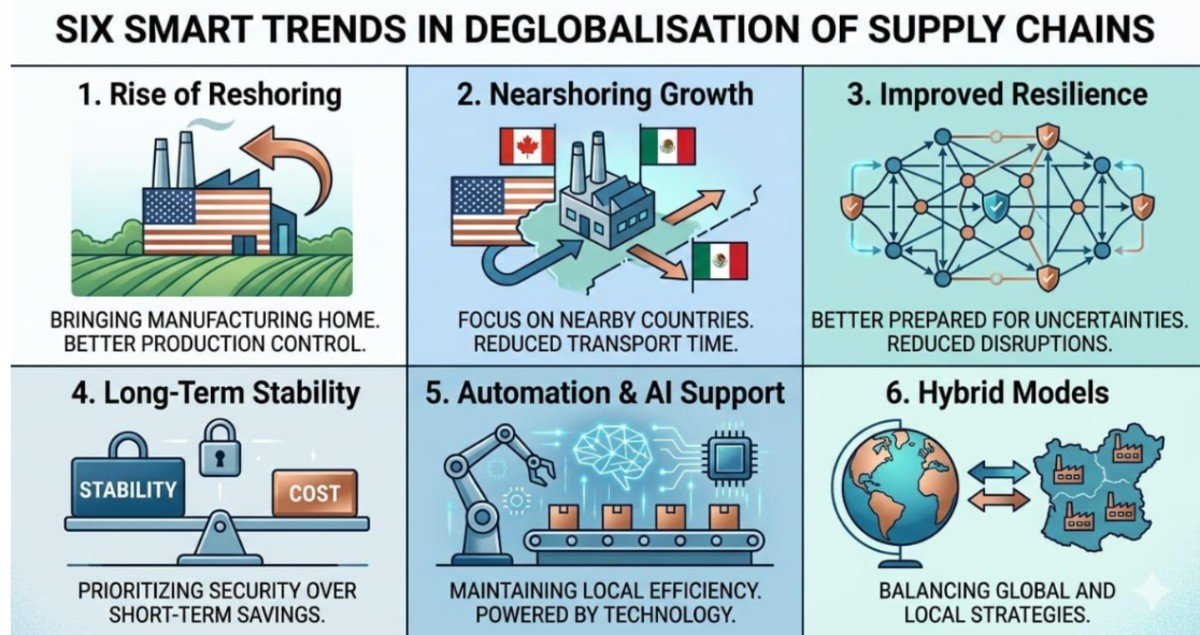
In recent years, global supply chains have undergone significant changes. The concept of deglobalisation supply chain reshoring is gaining attention as companies rethink their strategies. Businesses are now focusing on nearshoring manufacturing trends to improve efficiency and reduce risks.
What is Deglobalisation?
Deglobalisation refers to the shift from global supply chains to more localized or regional systems. Companies are reducing dependence on distant countries and focusing on domestic or nearby production.
Rise of Reshoring
Reshoring involves bringing manufacturing back to the home country. This strategy helps companies gain better control over production and reduce dependency on foreign suppliers.
Growth of Nearshoring Manufacturing Trend
Nearshoring manufacturing trend focuses on shifting production to nearby countries instead of distant ones. This reduces transportation time, costs, and risks associated with global disruptions.
Impact of Global Disruptions
Events like pandemics and geopolitical conflicts have exposed weaknesses in global supply chains. Deglobalisation supply chain reshoring helps businesses become more resilient and prepared for uncertainties.
Cost vs Stability
While reshoring and nearshoring may increase production costs, they offer better stability and reliability. Companies are now prioritizing long-term security over short-term savings.
Technological Support
Advanced technologies such as automation and AI are supporting deglobalisation efforts. These tools help maintain efficiency even when production is localized.
Future of Supply Chains
The future lies in hybrid models where companies balance global and local strategies. Nearshoring manufacturing trends will continue to grow as businesses seek flexibility and resilience.
Conclusion
Deglobalisation supply chain reshoring is reshaping the way businesses operate globally. With the rise of nearshoring manufacturing trends, companies are focusing on stability, efficiency, and risk management. This shift marks a new era in global trade and production strategies.
Frequently Asked Questions
What is deglobalisation supply chain reshoring?
Deglobalisation supply chain reshoring is the process of moving manufacturing and supply chain operations closer to a company’s home country. It helps businesses reduce dependence on overseas suppliers, improve resilience, and respond more quickly to market changes.
Why is deglobalisation supply chain reshoring becoming more popular?
Deglobalisation supply chain reshoring is gaining popularity because global disruptions, geopolitical tensions, and rising transportation costs have exposed the risks of long international supply chains. Companies are seeking greater stability, reliability, and control over production.
How does deglobalisation supply chain reshoring benefit businesses?
Deglobalisation supply chain reshoring offers several benefits, including faster delivery times, improved quality control, lower supply chain risks, better compliance with local regulations, and increased flexibility during unexpected disruptions.
What is the difference between deglobalisation supply chain reshoring and nearshoring?
Deglobalisation supply chain reshoring involves bringing production back to the company’s home country, while nearshoring shifts manufacturing to nearby countries. Both strategies aim to strengthen supply chains, but reshoring focuses on domestic production whereas nearshoring emphasizes regional manufacturing.
What is the future of deglobalisation supply chain reshoring?
The future of deglobalisation supply chain reshoring is expected to involve hybrid supply chain models that combine local, regional, and global production. Advances in automation, AI, and digital technologies will continue to make reshoring more cost-effective and sustainable for businesses.
What is reshoring in manufacturing?
Reshoring is the process of bringing manufacturing operations back to a company’s home country to improve supply chain control, reduce overseas dependence, and enhance operational resilience.
What is nearshoring, and how does it differ from reshoring?
Nearshoring involves moving production to neighboring or nearby countries, while reshoring brings manufacturing back to the home country. Both strategies aim to improve supply chain efficiency and reduce risks.
Statutory Citations & References
[1] “Global Supply Chain Trends,” McKinsey & Company. [Online]. Available: https://www.mckinsey.com
[2] “Reshoring and Nearshoring Strategies,” World Bank Reports. [Online]. Available: https://www.worldbank.org
[3] “Supply Chain Transformation,” Harvard Business Review. [Online].
Simplfy your Business
Eve Consultancy is your trusted partner for end-to-end compliance services, including Company Incorporation, GST Registration, Income Tax Filing, MSME Registration, and more. With a quick and hassle-free process, expert guidance, and affordable pricing, we help businesses stay compliant while they focus on growth. Backed by experienced professionals, we ensure smooth handling of all your legal and financial requirements. WhatsApp us today at +91 9711469884 to get started.
Maximize Your Business Potential
Looking for a partner to advise on GST, ITR, Business Registration, or Financial Strategy? Our experts ensure your compliance is seamless and your solutions are optimized.
Book a Strategy ConsultationEve Finance: Your Daily Financial Eve-olution!
Finance made simple, fast, and fun! 🏦💡 Sign up for your daily dose of financial insights delivered in plain English. In just 5 minutes, you’ll be smarter and better!