
How Businesses Can Use Data Analytics to Improve Commerce Decision-Making
Published: Oct 10, 2026
Key Highlights
- Data analytics business practices help SMEs make informed decisions about sales, pricing, inventory, and customer behaviour.
- Businesses should collect and process customer data responsibly and comply with applicable data protection and privacy regulations.
- SMEs should maintain accurate records and implement appropriate data security measures to protect sensitive business and customer information.
- Data analytics can improve forecasting, operational efficiency, strategic planning, and resource allocation.
- Small businesses can begin with spreadsheets and basic dashboards before investing in advanced analytics tools.
Trend
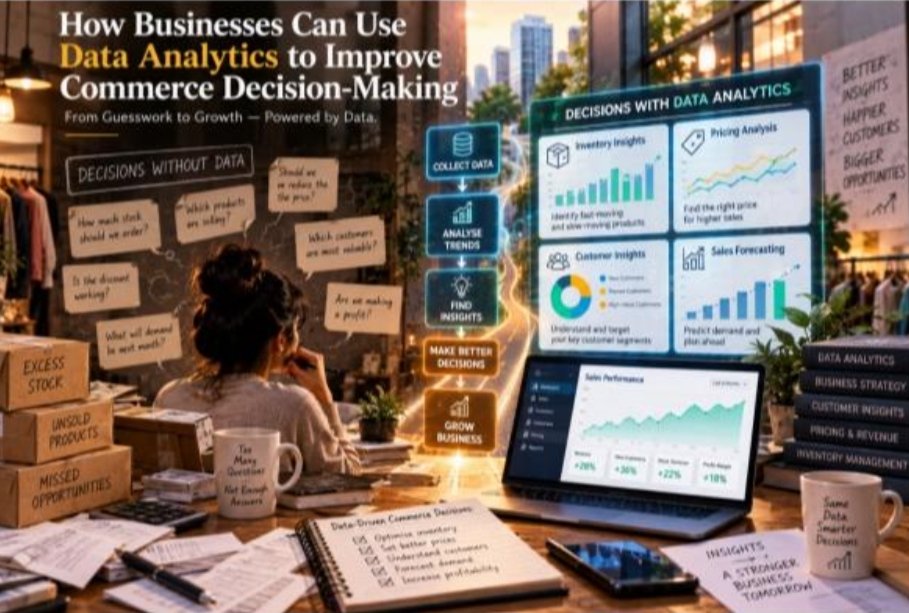
Data analytics business strategies are helping small and medium-sized businesses make smarter everyday decisions instead of relying entirely on intuition. Businesses can use sales records, inventory reports, customer transactions, and simple dashboards to identify useful patterns without investing in sophisticated AI systems. According to the OECD’s 2024 D4SME survey, data-driven decision-making was used by 72% of surveyed enterprises, rising to 76% among small and medium-sized businesses.
Data Analytics in Business
Data analytics in business means collecting and examining information to identify patterns that can support decisions. For an SME, this could be as simple as analysing monthly sales in Excel or using a dashboard to compare products, customers and revenue.
The value lies in turning scattered business records into usable information. Instead of simply knowing that sales increased, a business can examine which products drove the increase, when demand was highest and which customer segments contributed most. OECD research notes that data analytics can support efficiency in decision-making, strategic planning, production, logistics, marketing and commercialisation.
Using Data for Inventory Decisions
Inventory is one area where basic analytics can have an immediate commercial use. Businesses can compare historical sales with current stock levels to identify fast-moving and slow-moving products. If a product consistently sells faster during a particular period, past sales data can help the business plan its purchases before demand rises.
This can reduce two common problems: holding excessive stock that ties up working capital and running out of products when customers want them. More advanced analytics can also combine sales history with seasonal patterns and other demand signals to improve forecasting.
Using Data for Pricing Decisions
Pricing decisions can also become more evidence-based. Businesses can compare sales volumes at different price points and examine whether discounts actually increase total revenue. Customer purchasing patterns can reveal which products are more price-sensitive and where promotions may have a stronger effect.
Data can also help businesses understand product combinations. For example, if customers who purchase one product frequently buy another, the business could consider bundles or targeted offers rather than applying the same discount across its entire product range. OECD research highlights that data analysis can help businesses understand demand and make strategic inventory and product-placement decisions
Starting Small with Data Analytics
SMEs do not necessarily need expensive analytics systems to begin. A practical approach is to start with a few measurable questions: Which products sell fastest? When does demand peak? Which customers generate the most revenue? Which discounts work?
Businesses can begin with spreadsheets and gradually move to dashboards or specialised analytics tools as their data and requirements grow. The OECD notes that smaller firms often begin their digitalisation journey with more basic tools, while barriers such as skills, resources and costs can make advanced technologies harder to adopt.
Conclusion
Data analytics does not replace business judgement. It gives that judgement better evidence. For SMEs, even basic analysis of sales, inventory and customer information can make everyday commerce decisions more structured and measurable. Starting with a few important questions and reliable data can create a practical foundation for more advanced analytics later.
Core Regulatory Takeaways-
Data analytics business practices help SMEs make informed decisions about sales, pricing, inventory, and customer behaviour.
Businesses should collect and process customer data responsibly and comply with applicable data protection and privacy regulations.
SMEs should maintain accurate records and implement appropriate data security measures to protect sensitive business and customer information.
Data analytics can improve forecasting, operational efficiency, strategic planning, and resource allocation.
Small businesses can begin with spreadsheets and basic dashboards before investing in advanced analytics tools.
FAQs
What is a data analytics business?
A data analytics business uses data to identify patterns, understand trends, and support better business decisions related to sales, pricing, inventory, and customer behaviour.
How can data analytics business practices help SMEs?
Data analytics business practices help small and medium-sized enterprises improve operational efficiency, manage inventory, forecast demand, understand customers, and make informed decisions.
Statutory Citations & References
[1] OECD, “SME Digitalisation to manage shocks and transitions: 2024 OECD D4SME Survey,” OECD SME and Entrepreneurship Papers, No. 62, 2024. Link
[2] M. Bianchini and V. Michalkova, “Data Analytics in SMEs: Trends and Policies,” OECD SME and Entrepreneurship Papers, No. 15, OECD Publishing, 2019.
[3] OECD, “The Digital Transformation of SMEs,” OECD Studies on SMEs and Entrepreneurship, 2021.
Maximize Your Business Potential
Looking for a partner to advise on GST, ITR, Business Registration, or Financial Strategy? Our experts ensure your compliance is seamless and your solutions are optimized.
Book a Strategy ConsultationEve Finance: Your Daily Financial Eve-olution!
Finance made simple, fast, and fun! 🏦💡 Sign up for your daily dose of financial insights delivered in plain English. In just 5 minutes, you’ll be smarter and better!