
GROWTH AT WHAT COST? THE HIDDEN PRICE INDIA PAYS WHEN RBI PRIORITISES CURRENCY STABILITY
Published: Aug 10, 2026
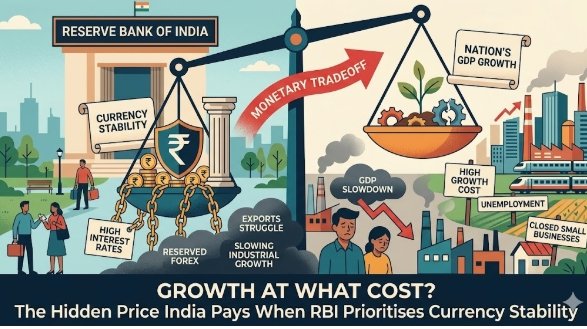
In the scene of developing markets, the interest of a steady rupee regularly veils a more profound monetary tradeoff that can incidentally trigger a GDP lull. As the Reserve Bank of India (RBI) seeks to anticipate instability, the economy often as possible faces a financial trade-off where short-term cost stability comes at the cost of long-term economic competitiveness. If these mediations lead to an exaggerated cash flow, the coming GDP lull can smother the exceptional sectors—like manufacturing and exports—that the government looks for to win through activities like “Make in India.”
1. The Mechanics of Intercession: Why Solidness Isn’t Free
The Reserve Bank of India works beneath an “overseen coast” administration. Whereas the central bank keeps up that it, as it were, mediates to control “intemperate instability,” the reality is frequently a determined exertion to keep the rupee within a mental or competitive bracket. To anticipate the rupee from devaluing as well quickly against the US dollar, the RBI offers its remote trade services and sucks up rupee liquidity.
While this anticipates a “decrease fit” fashion freeze, it makes a critical money-related tradeoff. By fixing household liquidity to bolster the cash, the RBI accidentally keeps interest rates higher than they might otherwise be. For a creating economy, high borrowing costs are a coordinating grinding point for capital use (CAPEX), frequently acting as a noiseless forerunner to a broader GDP slowdown.
2. The Send Out Catch 22: Genuine Successful Trade Rate (REER)
A steady, ostensible trade rate does not fundamentally create a competitive one. Financial specialists frequently see the Real Effective Exchange Rate (REER), which adjusts for swelling differentials between India and its trading partners. When the RBI keeps the rupee steady, whereas India’s swelling remains higher than that of the US or Europe, the rupee gets to be “increasing in value in genuine terms.”
This makes Indian exports—from materials to software—more costly for worldwide buyers. When sendouts lose their edge, the exchange shortfall broadens. A broadening shortfall, coupled with stagnating manufacturing output, makes an auxiliary GDP lull. The covered-up toll here is the misfortune of the worldwide showcase share to competitors like Vietnam or Bangladesh, who may permit their monetary forms to reflect financial substances more flexibly.
3. Remote Trade Saves: A Costly Protection Policy
India’s remote trade savings have often as possible touched the $600 billion mark. Whereas these saves give a “war chest” against worldwide stuns, holding them is not cost-free. These reserves are generally invested in low-yielding US Treasuries.
The opportunity taken is stunning. If the capital utilised to construct these savings were in step circulating inside the household economy to finance foundation or innovation, the multiplier impact on development would be altogether higher. By prioritising the “optics” of a gigantic save over the stream of household credit, the central bank partakes in a money-related tradeoff that prioritises outside discernment over inner expansion.
4. Affect on the Common Man: Expansion vs. Employment
The RBI’s essential order is expansion, focusing on keeping up a 4% CPI with a 2% edge. A weaker rupee is regularly dreaded since it makes imports (like crude oil) more costly, hypothetically fueling “imported expansion.” In any case, by fixating on this side of the condition, the approach may neglect the business side.
A GDP lull driven by high interest rates and uncompetitive trades leads to lower work creation in the private segment. For the normal Indian, the advantage of marginally lower swelling on imported merchandise is frequently exceeded by the need for wage development or business opportunities. This pressure speaks to the most human component of the financial tradeoff—choosing between the cost of a bushel of merchandise nowadays and the accessibility of a career tomorrow.
5. Recalibrating the Scale for Future Growth
As India aims to become a $5 trillion economy, the methodology of “steadiness at all costs” requires a return to. Worldwide instability is the modern norm; endeavouring to shield the rupee from each worldwide swell requires a depletion of approach devices that may be better utilised to fortify growth.
To maintain a strategic distance from a drawn-out GDP lull, the RBI may require permission for more prominent cash adaptability. Grasping a more normal deterioration may act as a programmed stabiliser for the economy, making send-outs cheaper and disheartening pointless imports without the requirement for high-interest-rate intervention.
Conclusion
The way to becoming a worldwide financial powerhouse is clear with troublesome choices. Whereas cash instability can be unsettling, the basic money-related tradeoff required to stifle it frequently saps the economy of its common vigour. If India is to maintain a strategic distance from a tireless GDP lull, it must discover a centre way where money stability does not end up a cage for mechanical development. Eventually, a somewhat weaker, more competitive rupee may be a little cost to pay to maintain a strategic distance from a critical GDP lull and resolve the characteristic monetary tradeoff in favour of national prosperity.
Frequently Asked Questions
Why does the RBI intervene in the foreign exchange market?
The RBI intervenes to reduce excessive currency volatility and maintain financial stability.
What is the monetary trade-off in currency management?
It is the balance between maintaining a stable currency and supporting economic growth and competitiveness.
How does a strong rupee affect exports?
A stronger rupee makes Indian goods more expensive in global markets, reducing export competitiveness.
What is the Real Effective Exchange Rate (REER)?
REER measures a currency’s value against trading partners after adjusting for inflation differences.
5. Why are foreign exchange reserves important?
They help protect the economy from external financial shocks and support currency stability.
6. How can high interest rates slow economic growth?
Higher borrowing costs reduce business investment, consumer spending, and overall economic activity.
7. What impact can a GDP slowdown have on employment?
A slower economy often creates fewer jobs and limits income growth across industries
Why is inflation control important for the RBI?
Keeping inflation under control helps maintain purchasing power and overall economic stability.
How can a flexible exchange rate benefit the economy?
It can improve export competitiveness and help the economy adjust to global market changes.
Why is balancing currency stability and growth important?
A balanced approach supports both financial stability and long-term economic development.
Statutory Citations & References
[1] V. Acharya, Journey for Reestablishing Monetary Soundness in India, 1st ed. Modern Delhi: SAGE Distributions, 2020.
[2] R. Rajan, The Third Column: How Markets and the State Take off the Community Behind, Unused York: Penguin Press, 2019.
[3] Save Bank of India, “Report on Cash and Fund,” RBI, Mumbai, Yearly Report 2022-23.
[4] Universal Money related Finance, “India: Article IV Consultation-Press Discharge; Staff Report; and Explanation by the Official Chief for India,” IMF Nation Report No. 23/434, Dec. 2023.
Maximize Your Business Potential
Looking for a partner to advise on GST, ITR, Business Registration, or Financial Strategy? Our experts ensure your compliance is seamless and your solutions are optimized.
Book a Strategy ConsultationEve Finance: Your Daily Financial Eve-olution!
Finance made simple, fast, and fun! 🏦💡 Sign up for your daily dose of financial insights delivered in plain English. In just 5 minutes, you’ll be smarter and better!