
FPI Outflows oil prices and a strong dollar: why the rupee is caught in a perfect storm
Published: Jun 25, 2026
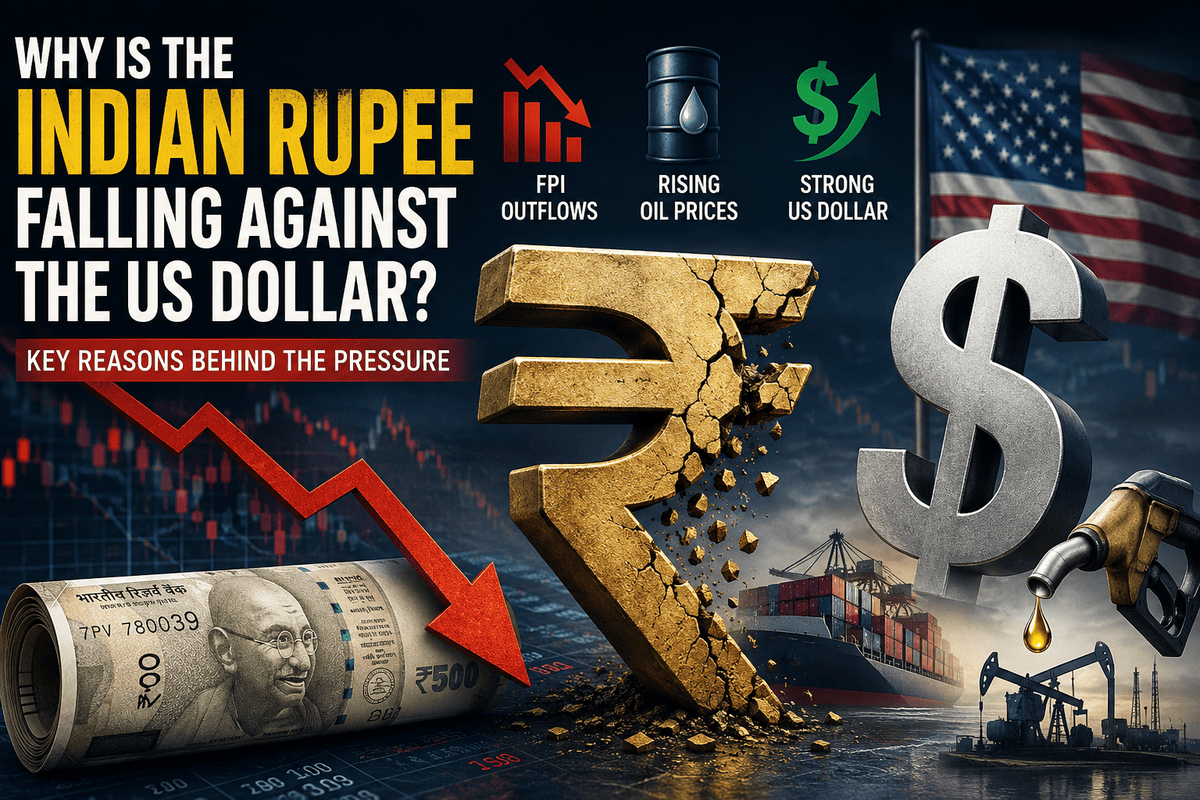
The rupee falling against the dollar is something people hear about almost every few months. Sometimes it becomes breaking news, sometimes it quietly happens in the background. But recently, the pressure on the rupee has become difficult to ignore.
There is not one single reason behind it.
Foreign investors are taking money out of Indian markets, oil prices are creating uncertainty again, and the US dollar has become very strong globally. When all these things happen together, currencies like the rupee naturally start feeling pressure.
And that is exactly what India is dealing with right now.
Currency Depreciation
Currency depreciation simply means the value of a currency is falling compared to another currency.
In India’s case, it means more rupees are needed to buy one US dollar. A few years ago, the exchange rate looked very different. Now, every time the dollar becomes stronger, the rupee weakens further.
For common people, this may sound like just financial news, but it slowly affects everyday life too. Imported products become expensive, foreign travel costs more, and fuel prices often rise because India imports most of its crude oil.
One major reason behind the falling rupee is FPI outflow.
FPIs, or Foreign Portfolio Investors, invest money in Indian stock markets and bonds. But when global markets become uncertain, these investors often pull their money out and move it to safer places like the United States.
When they take money out of India, they convert rupees into dollars. Naturally, demand for dollars increases and pressure on the rupee rises.
At the same time, oil prices also create problems for India.
India buys a large amount of crude oil from other countries, and these payments are mostly made in dollars. So when oil prices rise, India needs even more dollars for imports. This again increases demand for the US currency.
So on one side, dollars are leaving because foreign investors are pulling out money, and on the other side, India needs more dollars to buy oil. The rupee gets trapped between both pressures.
Dollar Strength
Another important reason is the strength of the US dollar itself.
Whenever the American economy performs better than expected or US interest rates remain high, investors across the world start putting more money into dollar-based assets. The dollar then becomes stronger compared to many global currencies.
This is not happening only with India. Many countries have seen their currencies weaken against the dollar in recent years.
But developing countries feel the pressure more because they depend heavily on imports and foreign investments.
For India, a strong dollar creates multiple difficulties at the same time. Oil imports become expensive, companies paying in dollars face higher costs, and foreign investors become more interested in US markets than emerging economies.
There is also a fear factor in markets.
Once people believe the rupee may weaken further, many investors become more cautious. Some start withdrawing money earlier to avoid losses later. That itself creates even more pressure on the currency.
Sometimes markets move more on expectations than reality.
Why FPI Outflows Matter So Much
Foreign investors play a huge role in Indian financial markets.
When global conditions are stable, foreign money flows into India because investors see growth opportunities here. But when uncertainty increases globally, that same money can leave very quickly.
This creates instability in markets.
Heavy FPI selling affects stock markets, weakens investor confidence, and indirectly puts more pressure on the rupee. Even if India’s economy remains strong in the long term, short-term global fears can still create problems.
That is why every major FPI outflow gets so much attention in financial news.
RBI and the Pressure on the Rupee
Whenever the rupee weakens sharply, people start looking toward the Reserve Bank of India.
The RBI often steps in to reduce panic in currency markets. It can sell dollars from its foreign exchange reserves to control sudden volatility and support the rupee for some time.
But no central bank can completely stop global pressures forever.
If oil prices remain high and foreign money keeps leaving emerging markets, defending the currency becomes difficult. Usually, the RBI focuses more on preventing sudden shocks rather than fixing the rupee at one exact level.
It becomes a balancing game.
Conclusion
The pressure on the rupee right now is not coming from one direction. It is the combined effect of rising oil prices, foreign investor outflows, and a very strong US dollar.
What makes the situation harder is that many of these reasons are global. India can manage some internal factors, but it cannot fully control international oil prices or investor behaviour across world markets.
And that is why the rupee often ends up caught in the middle whenever global uncertainty increases.
Frequently Asked Questions
How do currency depreciation and dollar strength affect the Indian rupee?
Currency depreciation occurs when the Indian rupee loses value against the US dollar. Dollar strength increases this pressure because a stronger dollar makes imports, especially crude oil, more expensive and raises demand for US currency, leading to a weaker rupee.
Why does dollar strength lead to currency depreciation in emerging economies?
When the US dollar gains strength due to higher interest rates or strong economic performance, global investors often shift their funds to US assets. This reduces capital inflows into emerging markets like India, contributing to currency depreciation and increased exchange rate volatility.
Can the RBI control currency depreciation caused by dollar strength?
The Reserve Bank of India (RBI) can reduce excessive market volatility by using its foreign exchange reserves and other monetary tools. However, if dollar strength remains high and global factors continue to drive currency depreciation, the RBI can only moderate the impact rather than completely stop the rupee from weakening.
Statutory Citations & References
1.The Economic Times
2.The Times of India
3.[https://www.livemint.com]
4. [Business Standard](https://www.business-standard.com)
5.[Reserve Bank of India](https://www.rbi.org.in
Simplify your Business
Eve Consultancy is your trusted partner for end-to-end compliance services, including Company Incorporation, GST Registration, Income Tax Filing, MSME Registration, and more. With a quick and hassle-free process, expert guidance, and affordable pricing, we help businesses stay compliant while they focus on growth. Backed by experienced professionals, we ensure smooth handling of all your legal and financial requirements. WhatsApp us today at +91 9711469884 to get started.
Maximize Your Business Potential
Looking for a partner to advise on GST, ITR, Business Registration, or Financial Strategy? Our experts ensure your compliance is seamless and your solutions are optimized.
Book a Strategy ConsultationEve Finance: Your Daily Financial Eve-olution!
Finance made simple, fast, and fun! 🏦💡 Sign up for your daily dose of financial insights delivered in plain English. In just 5 minutes, you’ll be smarter and better!