
How Commerce Education Is Evolving to Include Fintech and Digital Trade
Published: Oct 11, 2026
Key Highlights
- Commerce education helps students understand essential business laws, financial regulations, and compliance requirements in India.
- Commerce education builds awareness of taxation systems, including GST, income tax, and tax filing procedures.
- Commerce education explains the importance of accounting standards, accurate bookkeeping, auditing, and financial reporting.
- Commerce education helps learners understand business registration, company law, and legal responsibilities for entrepreneurs.
- Commerce education develops knowledge of consumer protection, ethical business practices, and corporate governance.
- Commerce education prepares students to adapt to changing government policies, regulatory updates, and financial compliance requirements.
Abstract
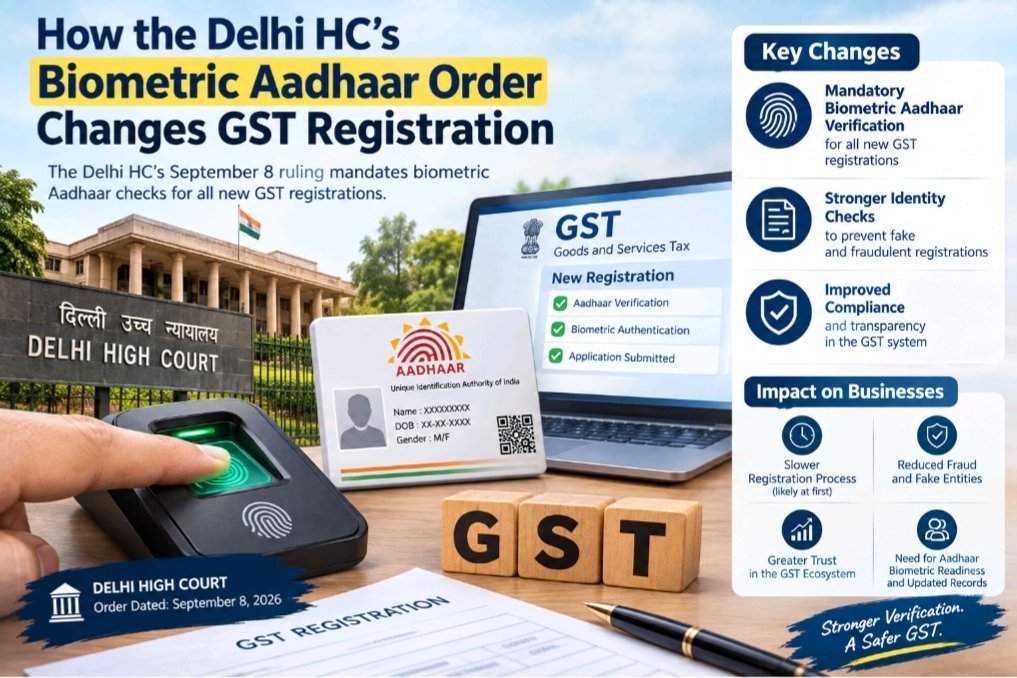
Commerce education helps students understand business, finance, accounting, and taxation, including the regulatory requirements that affect businesses in India. The Delhi High Court’s September 8, 2026 order on GST registration highlights the importance of understanding business compliance and legal procedures. The Court directed authorities, for the time being, not to allow GST registration without biometric-based Aadhaar authentication. The direction arose from cases involving allegedly fraudulent GST registrations using the PAN and Aadhaar details of individuals unconnected with the businesses. This article explains the order, its impact on GST registration, and its implications for fraud prevention, compliance, privacy, and business registration in India.
Index Terms— Biometric Aadhaar GST, GST registration, GST fraud prevention, GSTN, Aadhaar authentication, business compliance.
I. INTRODUCTION
GST registration is the gateway through which a taxable business becomes part of India’s indirect-tax system. Applicants submit information through the GST portal, including PAN, contact details, business information, and details of promoters, partners, or authorised signatories. The GST system already provides for Aadhaar authentication and, in specified cases, biometric authentication.
Against this background, the Delhi High Court passed an order on September 8, 2026 directing authorities across India not to allow any GST registration without biometric-based Aadhaar authentication, “for the time being.” The order was passed by a Division Bench of Justice Anil Kshetarpal and Justice Shail Jain in proceedings concerning alleged fraudulent GST registrations [1].
II. BACKGROUND OF THE DELHI HIGH COURT ORDER
The proceedings involved allegations that GST registrations had been obtained by third parties by using the PAN and Aadhaar details of individuals who were not connected with the businesses. The Court had previously asked for suggestions on measures that could reduce the misuse of identity documents.
The September 8 order recorded government data placed before the Court showing 2,800 fraudulent GST registrations in 2023–24 involving detected tax evasion of ₹15,085 crore. For 2024–25, the figures placed before the Court were 1,654 fraudulent registrations and ₹13,109 crore of detected tax evasion [1].
The Court also noted that biometric Aadhaar authentication had been stated to be mandatory for GST registration, but the system was being applied on a risk-based basis rather than universally. The Court therefore directed authorities across the country not to permit GST registration without biometric-based Aadhaar authentication, while allowing the authorities to raise objections regarding practical difficulties in implementation [1].
III. WHAT HAS CHANGED IN GST REGISTRATION?
The most important practical change is the move from a risk-based biometric requirement toward biometric authentication for every new GST registration, pursuant to the Court’s interim direction.
The GST Portal already describes a biometric authentication process for cases in which biometric verification is applicable. Under that process, an applicant may be required to book a slot at a designated GST Suvidha Kendra (GSK), complete biometric authentication, and undergo document verification. The GST Portal states that an application is not completed if required persons fail to complete the prescribed biometric and document-verification process [2].
The September 8 order therefore changes the significance of this existing capability: biometric authentication is no longer limited, for the time being, to applications selected through the earlier risk-based approach.
IV. HOW THE NEW PROCESS AFFECTS APPLICANTS
A. Additional Verification Step
A person applying for a new GST registration should expect an identity-verification stage involving biometric Aadhaar authentication. This adds a physical verification component to what has otherwise been a largely electronic registration process.
B. Greater Preparation Requirements
Applicants should ensure that the details submitted in the GST application are accurate and consistent with their identity documents. Differences in names, identification details, or other information can create verification issues.
C. Visit to a Designated Centre
Where biometric authentication is required, the GST Portal provides for slot booking and a visit to a designated GST Suvidha Kendra. Applicants should therefore account for this step when planning the registration timeline [2].
D. Impact on Registration Timing
A business that needs a GSTIN before starting taxable operations should not wait until the last moment to apply. Completion of biometric authentication and document verification may become an important practical part of the registration timeline.
V. WHY BIOMETRIC AADHAAR GST VERIFICATION MATTERS
The central objective of the order is identity verification. A GST registration connected to a real applicant should be harder to create using another person’s identity information when biometric verification is required.
The measure can also strengthen the connection between the person whose Aadhaar/PAN information is being used and the individual actually seeking GST registration. This is relevant because fraudulent registrations can create tax liabilities, compliance notices, and other difficulties for people whose identity documents were misused [1].
The Court’s direction therefore places greater emphasis on applicant authentication before a GSTIN is granted.
VI. IMPACT ON BUSINESSES
For legitimate businesses, the order creates an additional compliance step but also changes the registration workflow. Entrepreneurs, companies, partnerships, and other applicants should include identity verification in their registration planning.
Businesses should particularly focus on:
• Ensuring PAN, Aadhaar, business, promoter/partner, and authorised-signatory information is accurate.
• Keeping original supporting documents available when verification is required.
• Monitoring communications from the GST Portal.
• Completing biometric authentication within the prescribed process.
• Starting the registration process early enough to accommodate verification issues.
• Keeping records of the registration application and authentication status.
The GST Portal currently explains that Aadhaar authentication requirements vary according to the constitution of the business and identifies relevant promoters, partners, and authorised signatories for authentication [2].
VII. GST FRAUD PREVENTION AND DIGITAL COMPLIANCE
The order reflects a broader shift toward stronger identity verification in India’s digital tax administration. GST registration is increasingly connected with electronic records, PAN information, Aadhaar authentication, data analytics, and risk-management systems.
The GSTN’s existing functionality shows that Aadhaar authentication and biometric verification have been developed as part of the registration system for several years. Earlier GSTN materials also document the implementation of biometric-based Aadhaar authentication before registration in selected locations under Rule 8 of the CGST Rules [3].
The Delhi High Court’s direction seeks to make biometric authentication a universal prerequisite for GST registration rather than relying solely on risk-based selection.
VIII. PRACTICAL CHALLENGES
Universal biometric verification may create operational challenges. Applicants may face difficulties related to appointment availability, authentication failures, document mismatches, connectivity, or the need to travel to a designated centre.
The Court expressly gave authorities liberty to raise objections concerning practical difficulties in implementing the direction [1]. This means that the operational framework may continue to evolve as the matter is considered further.
Applicants should therefore rely on current GST Portal instructions and official communications when completing the registration process rather than assuming that the procedure will remain unchanged.
IX. PRIVACY AND DATA SECURITY CONSIDERATIONS
Biometric authentication involves highly sensitive identity information. As GST registration becomes more closely linked with biometric verification, data protection and secure handling of authentication information become important considerations.
The GST Portal indicates that Aadhaar numbers are masked in relevant interfaces and provides authentication through controlled digital workflows [2]. Businesses should avoid sharing Aadhaar credentials, OTPs, or authentication links with unauthorised persons and should use only the official GST registration process.
The objective of stronger authentication should be balanced with appropriate safeguards for the privacy and security of applicants’ identity information.
X. WHAT NEW GST APPLICANTS SHOULD DO
Applicants planning a new GST registration should:
1) Check whether GST registration is legally required for the proposed business.
2) Prepare accurate PAN, Aadhaar, business, promoter/partner, and authorised-signatory information.
3) Submit the application through the official GST registration process.
4) Monitor the Aadhaar authentication status and any communication from the GST Portal.
5) Complete biometric verification at the designated centre when required.
6) Carry the documents needed for verification.
7) Resolve authentication or document mismatches promptly.
8) Keep the acknowledgement and registration records for future compliance purposes.
These steps can help reduce avoidable delays while the nationwide biometric requirement is being implemented.
XI. CONCLUSION
The Delhi High Court’s September 8, 2026 order represents a significant development in GST registration procedure. By directing authorities across India, for the time being, not to permit GST registration without biometric-based Aadhaar authentication, the Court has placed identity verification at the centre of the registration process [1].
For genuine businesses, the immediate practical effect is an additional verification step and a greater need for accurate documentation and timely planning. For the tax administration, the measure is intended to address fraudulent registrations and misuse of PAN and Aadhaar details.
The long-term effectiveness of the measure will depend on implementation, administrative capacity, data security, and the outcome of further proceedings. Applicants should follow the latest official GST Portal instructions as the framework develops.
Core Regulatory Takeaways-
Commerce education helps students understand essential business laws, financial regulations, and compliance requirements in India.
Commerce education builds awareness of taxation systems, including GST, income tax, and tax filing procedures.
Commerce education explains the importance of accounting standards, accurate bookkeeping, auditing, and financial reporting.
Commerce education helps learners understand business registration, company law, and legal responsibilities for entrepreneurs.
Commerce education develops knowledge of consumer protection, ethical business practices, and corporate governance.
FAQs
What is commerce education?
Commerce education is the study of business, accounting, finance, economics, taxation, and management. It helps students develop the knowledge and skills required for careers in business and finance.
Why is commerce education important for students?
Commerce education helps students understand financial transactions, business operations, economic principles, and regulatory requirements. It also prepares them for professional careers and entrepreneurship.
Statutory Citations & References
[1] Delhi High Court, Neha v. Union of India & Ors., W.P.(C) No. 12210/2026 with connected matter, Order dated Sep. 8, 2026. [Online]. Available: Link
[2] Goods and Services Tax Network (GSTN), “Apply for Registration—Normal Taxpayer,” GST Portal User Guide, accessed Sep. 28, 2026. [Online]. Available: Link
[3] Goods and Services Tax Network (GSTN), “New Functionalities Made Available for Taxpayers on GST Portal During April 2023 to March 2024,” official GST Portal publication. [Online]. Available: Link
[4] Central Board of Indirect Taxes and Customs (CBIC), “Goods and Services Tax—Registration Rules,” Government of India. [Online]. Available: Link
Maximize Your Business Potential
Looking for a partner to advise on GST, ITR, Business Registration, or Financial Strategy? Our experts ensure your compliance is seamless and your solutions are optimized.
Book a Strategy ConsultationEve Finance: Your Daily Financial Eve-olution!
Finance made simple, fast, and fun! 🏦💡 Sign up for your daily dose of financial insights delivered in plain English. In just 5 minutes, you’ll be smarter and better!