
Rs 26.97 Lakh Crore and What It Means: Reading India’s Direct Tax Collection Target for FY27
Published: Sep 13, 2026
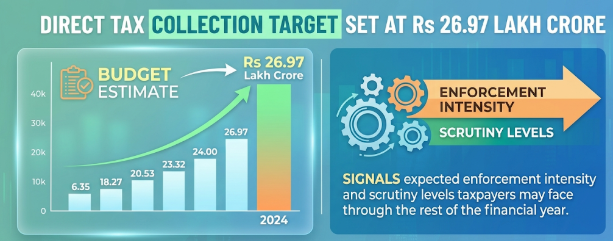
Every Union Budget sets a direct tax collection target, and that number tends to be read as a fiscal arithmetic exercise: government needs X to fund its expenditure plans, so it targets X in revenue. That reading is correct but incomplete.
The target also tells you something about how aggressively the Income Tax Department is likely to operate through the year, because meeting an ambitious budget estimate requires active enforcement, not just passive collection.
For FY27, the government has set the direct tax collection target at Rs 26.97 lakh crore. To understand what that number means in practice, you need to look at where it has come from and what it implies for the rest of the financial year.
The Gap the Target Has to Bridge
FY26 ended with net direct tax collections of Rs 23.40 lakh crore, a 5.12 percent increase over FY25 but below both the original budget estimate of Rs 25.20 lakh crore and the revised estimate of Rs 24.21 lakh crore that the government lowered to mid-year.
The shortfall in FY26 was largely a consequence of the income tax rate cuts announced in the February 2025 budget, which raised the rebate threshold to Rs 12 lakh and restructured slabs, leaving more money in taxpayers’ hands but producing lower personal income tax receipts than initially projected.
The FY27 budget estimate of Rs 26.97 lakh crore represents a jump of roughly 15 percent over what was actually collected in FY26.
That is a meaningful ask. Income tax collections are budgeted to grow 11.7 percent to Rs 14.38 lakh crore for FY27, even after accounting for revenue foregone due to the previous year’s rate cuts. Corporate tax is expected to contribute the remainder. The government is essentially projecting that economic activity and compliance improvement together will offset the structural revenue reduction from the FY26 tax cuts and still deliver double-digit growth.
What the Budget Estimate Signals for Enforcement
This is where the number becomes directly relevant to taxpayers rather than just to fiscal analysts.
When the government sets a collection target that requires meaningfully higher growth than the previous year delivered, the CBDT has to find that growth somewhere. Organic growth from economic expansion contributes, but it rarely closes a 15 percent gap on its own when the prior year only grew 5 percent. The rest comes from three sources: better compliance from existing taxpayers, widening the taxpayer base by bringing in people or businesses not currently filing, and scrutiny of assessments where the department believes income has been understated.
What drives corporate tax movement now is largely profit growth, which tracks economic activity, and compliance quality, which the department influences through transfer pricing scrutiny, scrutiny of deductions claimed, and examination of MAT applicability.
For FY27, the corporate tax target implies the department expects profit growth to remain solid enough to support continued expansion in corporate collections. Given that private sector project announcements rose 70 percent year-on-year in Q1 FY27 and credit growth remains healthy, that expectation is not unreasonable. But it does mean corporate taxpayers with complex structures, large related-party transactions, or significant deductions claimed should anticipate that those positions will get closer attention through the year than they might in a softer enforcement environment.
What Taxpayers Should Take From This
The Rs 26.97 lakh crore budget estimate is not just a government accounting target. It is a signal about the operating environment for the rest of FY27.
For individuals, the practical implication is straightforward: the AIS is now comprehensive enough that inconsistencies between declared income and information available to the department are detectable and will be acted on.
Rental income not reported, capital gains from mutual fund redemptions omitted, TDS credits not matching declared income, all of these generate notices when the system flags a mismatch.
The frequency of those notices correlates with enforcement intensity, and enforcement intensity correlates with how far the actual collections are running behind the budget estimate at any given point in the year.
For businesses, particularly smaller ones that have historically operated with more informal arrangements, the GST-to-direct-tax data matching that CBDT now runs makes it harder to report significantly different income figures across the two systems without that difference prompting questions.
None of this means the department will necessarily be unreasonable or that taxpayers who have complied honestly have anything to worry about. It means the environment through the rest of FY27 is likely to be one where the department is actively working to close the gap between what the budget estimate requires and what organic growth alone will deliver.
Reading the target that way, as a signal about enforcement intensity rather than just a fiscal number, gives taxpayers a more accurate picture of what the year is likely to involve.
Frequently Asked Questions
What is the FY27 direct tax target?
₹26.97 lakh crore.
How much was collected in FY26?
₹23.40 lakh crore.
Why is the FY27 target significant?
It requires much faster growth in tax collections.
How could the government meet the target?
Through better compliance, a wider tax base, and stronger scrutiny.
What is AIS?
Annual Information Statement, which shows taxpayers’ reported financial information.
What data does AIS include?
Information from banks, mutual funds, GST, foreign remittances, and other transactions.
Why might taxpayers receive more scrutiny?
Mismatches between declared income and available financial data can trigger checks.
What was FY26 corporate tax collection?
₹10.99 lakh crore.
Who may face greater corporate scrutiny?
Businesses with complex structures, related-party transactions, or large deductions.
What should taxpayers do in FY27?
Report income accurately and ensure tax filings match available financial data.
Statutory Citations & References
[1] Press Trust of India, “Net direct tax collection rises 5 pc to Rs 23.40 lakh cr in FY26, misses revised budget target,” The Print, May 4, 2026. [Online]. Available: https://theprint.in/economy/net-direct-tax-collection-rises-5-pc-to-rs-23-40-lakh-cr-in-fy26-misses-revised-budget-target/2922139
[2] Business Standard, “Net direct tax collection rises 5 percent to over Rs 23.40 trillion in FY26,” Business Standard, May 4, 2026. [Online]. Available: https://www.business-standard.com/economy/news/net-direct-tax-collection-rises-5-pc-to-rs-23-40-lakh-cr-fy26-126050401551_1.html
[3] PRS Legislative Research, “Union Budget 2026-27 Analysis,” PRS India, 2026. [Online]. Available: https://prsindia.org/files/budget/budget_parliament/2026/Union_Budget_Analysis-2026-27.pdf
[4] Central Board of Direct Taxes, “Annual Information Statement,” CBDT, Income Tax Department of India. [Online]. Available: https://www.incometax.gov.in
[5] Ministry of Finance, Government of India, “Union Budget 2026-27 Receipt Budget,” Ministry of Finance, July 2026. [Online]. Available: https://www.indiabudget.gov.in
Transform your brand
Drive massive brand engagement with over 10 million college students across 3,000+ premier institutions, both online and offline. EvePaper is India’s leading youth marketing consultancy, connecting brands with the next generation of consumers through innovative, engagement-driven campaigns.
Mail us at: collaborate@evepaper.com
About us
Maximize Your Business Potential
Looking for a partner to advise on GST, ITR, Business Registration, or Financial Strategy? Our experts ensure your compliance is seamless and your solutions are optimized.
Book a Strategy ConsultationEve Finance: Your Daily Financial Eve-olution!
Finance made simple, fast, and fun! 🏦💡 Sign up for your daily dose of financial insights delivered in plain English. In just 5 minutes, you’ll be smarter and better!