
BRICS 2026: How Local-Currency Trade Could Change Cross-Border Payments
Published: Oct 8, 2026
Key Highlights
- BRICS local currency settlements can reduce dependence on the US dollar in cross-border trade and payments.
- BRICS local currency mechanisms can strengthen financial resilience by providing alternative payment channels.
- Greater use of BRICS local currency could support de-dollarization while promoting a more multipolar global financial system.
- Regulators may need stronger frameworks for BRICS local currency transactions, including currency-conversion, payment, and settlement mechanisms.
- BRICS local currency trade can encourage intra-BRICS investment in infrastructure, energy, and critical sectors.
SEO-Optimized Article Opening
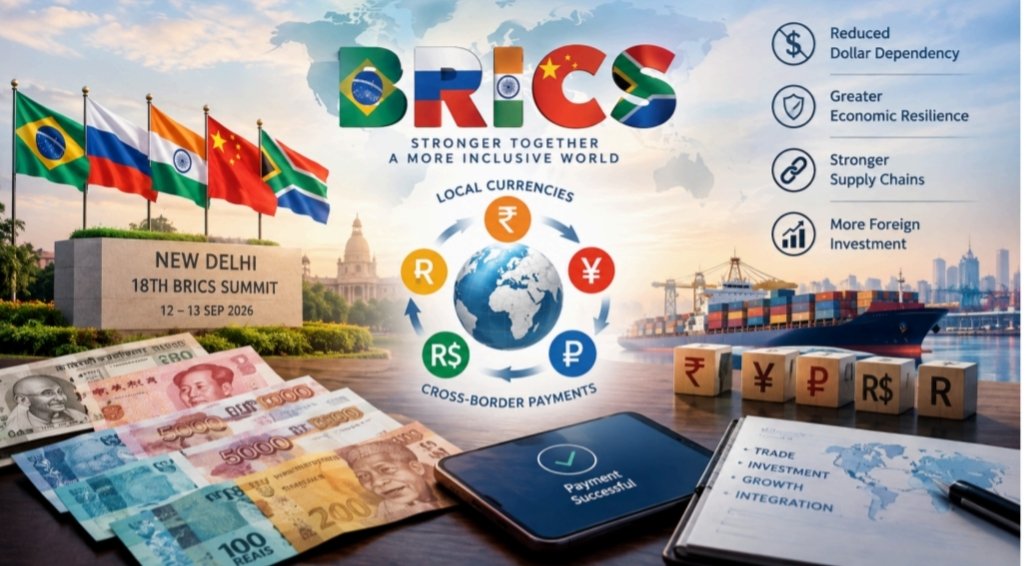
BRICS local currency is emerging as an important issue in international trade and financial reform. The 18th BRICS Summit was held in New Delhi from 12 to 13 September 2026 under India’s chairmanship. BRICS is strategically important because its members represent a substantial share of the world’s population and economy. A key concern among BRICS countries is their continued dependence on the US dollar for international trade, finance, and payment reserves. Greater use of local currencies could provide alternative mechanisms for cross-border transactions while supporting financial diversification and economic cooperation among member states.
Because of this dependency, countries have to suffer from various sanctions and delays in transactions, so India has urged member countries to replace the transactions based on bilateral trading in local currency rather than common currency shifting global dominance to economic integration. India advocated the maximum use of BRICS local currency.
Reasons for adoption of local currency—
1. De-dollarization—This is the core idea to adopt local currency, as trade in local currencies means settling cross-border payments and transactions directly rather than depending on dollars. This will not only help in economic integration but also promote multilateralism, inverting the unipolar world power by the US.
2. Unipolar-cum-multipolar world—As the unprecedented West Asia crisis is ongoing with the global world order under threat, the USA has an upper hand in the economic world order, creating a tense situation for developing countries, and the imposition of local currencies would enable countries to have bilateral trade without the fear of sanctions and protection from Western financial transactions.
3. Greater resilience—Alternative payment channeling can reduce vulnerability to external financial disruption and boost INTRA BRICS TRADE as easily settlements can be settled. This can be paralleled with the European Union, where countries can trade easily with a common currency.
4. Supply chain weaponization—With the rise of geopolitics and supply chain weaponization by developed countries such as China, which manufactured goods domestically, and with dumping disrupting industrialization in developing countries, hence the intertrade in local currency can break the barriers and help to trade bilaterally, which will not only facilitate trade in critical minerals, raw materials, and manufactured goods but also promise service exchange.
5. Rise of foreign investment—With the rise of unilateral tariffs and other trade-restrictive measures, multilateral trading would enable proliferation of trade and become a key source of financing for infrastructure and energy projects through local currency. For example, with these two countries, they can invest directly, such as Nepal and India, and can undergo their seasonal hydropower trade easily without any restrictions. It will also help many small countries to invite investors who often subjugate under the burden of the dominant euro or dollar.
The BRICS 2026 challenged the dominance of American hegemony of the dollar that had persisted for years. With dollar dominance in the international market, countries have to face multiple challenges, such as delays in transactions and charges by correspondent banks for converting the currency. For example, if the merchant wants to import goods in Cape Town from a farmer in India, then it has to undergo multiple correspondents, such as the transaction of Randa to Ruppe and then Ruppe to Dollar, creating delays managed by the Western institution of Swift, which acts as an intermediary mechanism by providing messaging infrastructure through which banks communicate.
The New Delhi declaration of having local currency rather than a single currency can have certain implications. Firstly, the reaction of the US, as Trump has warned, is that building an alternate system of transaction would lead him to put 100% tariffs and affect world trade. Secondly, it will give an opportunity to China to have yuan dominance, and more than that, it can be demonstrated through the theory of Kindleberger, where reversal of dominance of the USA would create instability in the political world, as China’s rising power doesn’t assure the public. Good will can also create trade imbalances. But overall it will help in economic integration and cross-border transactions, which have become quite restrictive.
Hence, the 18th BRICS summit facilitated multilateralism reforms with the multipolar world and urged countries to be self-reliant, transparent, fair, and inclusive. It affirmed the idea of the reform of the World Trade Organization and advocated the idea of globalization, thus creating a global village.
Key Regulatory Highlights-
BRICS local currency settlements can reduce dependence on the US dollar in cross-border trade and payments.
BRICS local currency mechanisms can strengthen financial resilience by providing alternative payment channels.
Greater use of BRICS local currency could support de-dollarization while promoting a more multipolar global financial system.
Regulators may need stronger frameworks for BRICS local currency transactions, including currency-conversion, payment, and settlement mechanisms.
BRICS local currency trade can encourage intra-BRICS investment in infrastructure, energy, and critical sectors.
FAQs
What is BRICS local currency?
BRICS local currency refers to the use of member countries’ national currencies for settling cross-border trade and financial transactions instead of relying primarily on the US dollar.
Why is BRICS promoting local currency?
BRICS local currency can reduce dependence on the US dollar, lower transaction costs, improve financial resilience, and support greater economic cooperation among member countries.
Statutory Citations & References
1] BRICS nations should link payment systems, trade in local currencies, The Hindu Article [ Online ]
Available:
Link
2] BRICS can boost local-currency trade with deeper financial markets, stronger banking links , The Economic Times Article [ Online ]
Available:
Link
Maximize Your Business Potential
Looking for a partner to advise on GST, ITR, Business Registration, or Financial Strategy? Our experts ensure your compliance is seamless and your solutions are optimized.
Book a Strategy ConsultationEve Finance: Your Daily Financial Eve-olution!
Finance made simple, fast, and fun! 🏦💡 Sign up for your daily dose of financial insights delivered in plain English. In just 5 minutes, you’ll be smarter and better!