
AI in Chemistry: Revolutionizing Molecular Design and Drug Discovery
Published: Jun 16, 2026
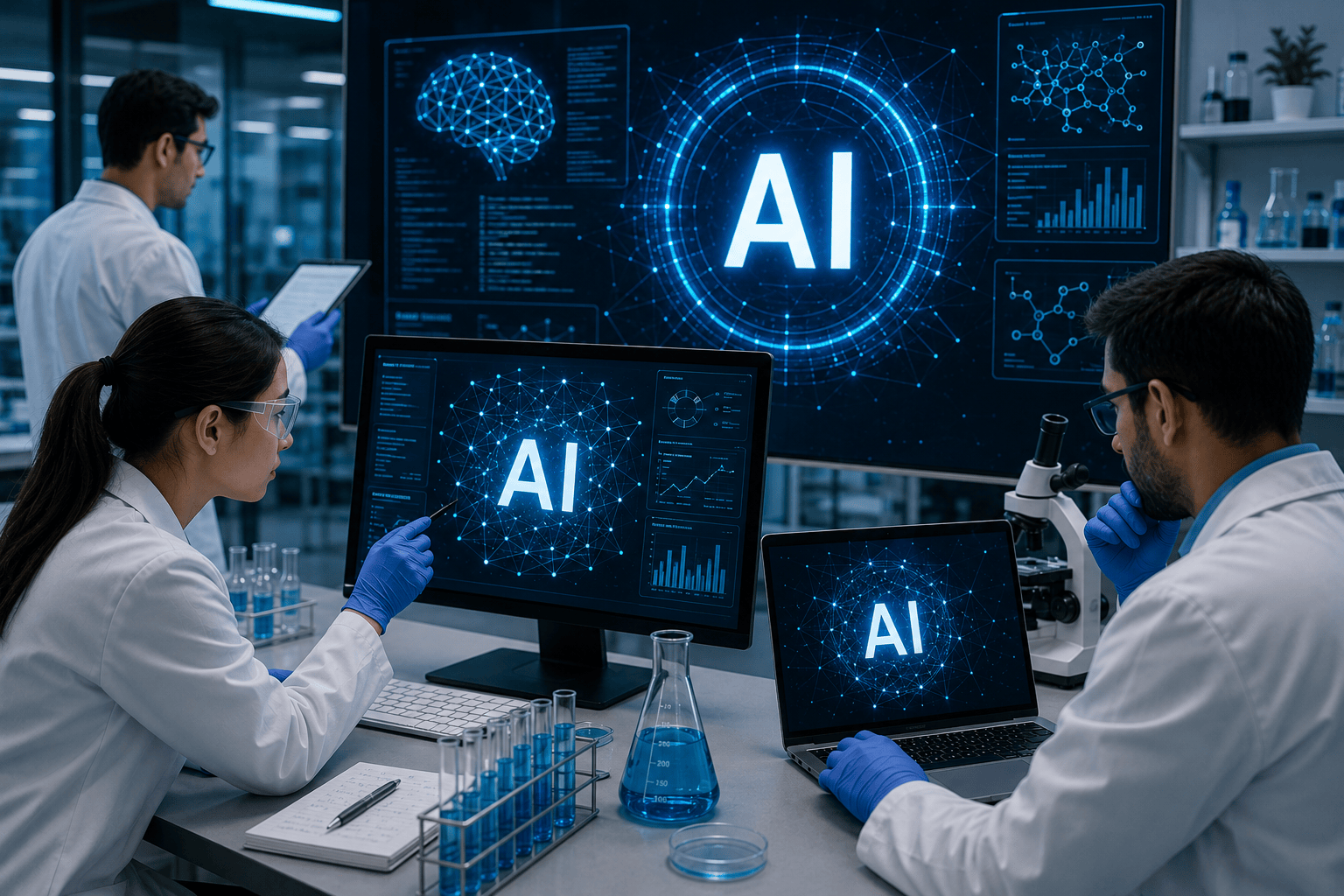
AI is changing the face of scientific research in various industries, with one of the major changes being the chemistry field. AI in Chemistry is assisting scientists to handle intricate scientific information in a more efficient and precise way than ever before. For any progress that was to be made in chemical research and drug development, years of hard laboratory work, experiments, and repeated analysis were required.
In the present day, Artificial Intelligence-based systems can analyze vast amounts of information in a brief amount of time, making scientific research more efficient and cost-effective. From pharmaceuticals to biotechnology and material science, AI’s impact on the scientific world is reshaping the landscape of various fields by optimizing research processes and speeding up the innovation cycle. AI applications in chemistry are revolutionizing sectors like biotechnology, pharmaceuticals, and material science, with a greater impact on research speed and innovation timelines.
The Role of AI in Modern ChemistryThe power of AI to identify patterns and relationships in scientific data that may be difficult for human scientists to find on their own can be invaluable for chemists. Machine learning algorithms are used to analyse chemical reactions, to predict properties of molecules, and to determine the possible properties of various molecules without physically testing them. This will help researchers to make better research choices, reduce wasteful research tests, and reduce the cost of research resources.
AI systems also enable automation of repetitive calculations and enhance the accuracy of experiments carried out in laboratories. Hence, medical research firms and universities are now starting to embrace solutions that use AI to propel scientific research and improve their productivity
The Role of AI in Modern Chemistry
The power of AI to identify patterns and relationships in scientific data that may be difficult for human scientists to find on their own can be invaluable for chemists. Machine learning algorithms are used to analyse chemical reactions, to predict properties of molecules, and to determine the possible properties of various molecules without physically testing them. This will help researchers to make better research choices, reduce wasteful research tests, and reduce the cost of research resources. AI systems also enable automation of repetitive calculations and enhance the accuracy of experiments carried out in laboratories. Hence, medical research firms and universities are now starting to embrace solutions that use AI to propel scientific research and improve their productivity.
AI and Molecular Design
Molecular Design is one of the key applications of AI in Chemistry, in which artificial intelligence is employed to design and test molecular structures in virtual space before engaging in experimental testing. AI models can predict the interaction between molecules and which combinations are more likely to give a positive result – this eliminates the need to test a large number of combinations in the laboratory.
This procedure can save a considerable amount of time and development costs and increase the accuracy of the chemical design process. The use of AI in molecular modeling is leading to the creation of more robust industrial materials, eco-friendly chemicals, and more effective pharmaceuticals. With AI, molecular analysis is becoming more efficient, enabling scientists to be confident and timely in developing new and innovative products.
Drug Discovery and Pharmaceutical Research
Artificial intelligence is also a big player in today’s drug discovery process, as it enables pharmaceutical researchers to find potential medicines sooner than the conventional drug development process. In the past, the development of a novel medication typically involved a long series of research, testing, and clinical trials, which could span several years and be costly. Using AI, biological and chemical information can be analyzed in a matter of seconds to forecast the impact various compounds could have on the human body and pinpoint treatment options more quickly.
AI in drug research has enabled speeding up the drug development process and vaccine creation during global health disasters like COVID-19 and disease outbreaks. There is also an increasing interest in the technology for personalized medicine, in which every patient is treated according to their own unique biological profile, and, as a result, there will be a more effective treatment of the patient and fewer undesired side effects.
Benefits and Challenges of AI in Chemistry
There are several significant benefits of artificial intelligence for chemistry research, such as aiding in quicker research processes, lower development costs, improved prediction accuracy, and better data management. AI can solve complex calculations and aid researchers in making decisions based on scientific evidence instead of their observations. Yet, while the technology has several benefits, it also has a number of drawbacks.
The scientific data is crucial for AI models, as inaccuracies and low-quality data will result in inaccurate predictions and conclusions. Ethical issues and scientific substantiation are also significant, as scientists need to guarantee that AI results are accurate and tested in the lab. The contributions of human expertise are therefore also important with regard to the interpretation of findings and assurance of safe and reliable scientific discoveries.
The Future of AI-Driven Chemical Research
The future of AI in Chemistry will be even more advanced with the continuous evolution of AI technologies and computers. Scientists are trying to develop a system that utilizes artificial intelligence to simulate very complex chemical reactions and generate brand new chemical configurations that couldn’t be discovered with conventional methods.
AI can also play a role in creating sustainable materials, environmentally friendly manufacturing processes, and innovative energy solutions that minimize environmental footprint. The need for closer collaboration between chemists, computer scientists, and tech experts will increase as chemistry starts to increase its use of data-driven science for scientific progress and innovation. The future of chemical research is likely to become significantly different as AI technologies evolve, and they will play a major role in the health industry and the development of industries in other countries.
AI has revolutionized modern chemistry, enhancing its research efficiency, driving innovation, and changing the way molecular design and pharmaceutical development are approached. Thanks to the advent of AI technologies, chemists are now able to process information more efficiently, forecast results more precisely, and expend less time on experimentation and discovery. While there are still some data quality, data validation, and ethical issues that need to be addressed, the impact of AI in chemistry is overall positive. AI is not here to supplant scientists—it’s here to complement their knowledge and power to ensure scientific research can go faster, smarter, and more innovative.
Frequently Asked Questions
How is AI in Chemistry improving Molecular Design and accelerating scientific research?
AI in Chemistry improves Molecular Design by analyzing complex chemical data, predicting molecular behavior, and identifying promising molecular structures before laboratory testing. This helps scientists accelerate research, reduce costs, and develop innovative materials and medicines more efficiently.
What role does AI in Chemistry play in Molecular Design and drug discovery?
AI in Chemistry plays a crucial role in Molecular Design by helping researchers create and optimize molecular structures with greater accuracy. In drug discovery, AI can predict how molecules interact with biological targets, enabling faster identification of potential medicines and reducing development timelines.
What are the main challenges of using AI in chemistry?
The biggest challenges include ensuring high-quality scientific data, validating AI-generated predictions through experiments, and addressing ethical and reliability concerns in research.
Statutory Citations & References
[1] Nature Materials, “Artificial Intelligence for Materials Discovery,” Nature Publishing Group, 2024. Available: Nature Materials
[2] American Chemical Society, “Machine Learning in Materials Science,” ACS Publications, 2023. Available: ACS Publications
[3] Elsevier ScienceDirect, “AI Applications in Advanced Material Research,” Computational Materials Science Journal, 2024. Available: ScienceDirect
[4] National Renewable Energy Laboratory, “Artificial Intelligence in Sustainable Energy Materials,” NREL Reports, 2023. Available: National Renewable Energy Laboratory
[5] G. Ceder and K. A. Persson, “The Future of Materials Discovery,” Scientific American, vol. 309, no. 1, pp. 36–40, 2013. Available: Scientific American
Simplify your Business
Eve Consultancy is your trusted partner for end-to-end compliance services, including Company Incorporation, GST Registration, Income Tax Filing, MSME Registration, and more. With a quick and hassle-free process, expert guidance, and affordable pricing, we help businesses stay compliant while they focus on growth. Backed by experienced professionals, we ensure smooth handling of all your legal and financial requirements. WhatsApp us today at +91 9711469884 to get started.
Maximize Your Business Potential
Looking for a partner to advise on GST, ITR, Business Registration, or Financial Strategy? Our experts ensure your compliance is seamless and your solutions are optimized.
Book a Strategy ConsultationEve Finance: Your Daily Financial Eve-olution!
Finance made simple, fast, and fun! 🏦💡 Sign up for your daily dose of financial insights delivered in plain English. In just 5 minutes, you’ll be smarter and better!