
GST compliance for cloud kitchens and quick commerce businesses becomes especially important during the festive season, when higher order volumes, refunds, and expenses require accurate billing and tax records.
The festive season is one of the busiest times of the year for businesses in India. During festivals like Diwali, Dussehra and Christmas, people order groceries, food, sweets and other essentials online instead of visiting stores. This creates a great opportunity for quick commerce platforms and cloud kitchens to increase their sales. However, with more orders comes more responsibility, especially when it comes to following GST rules.
For businesses, managing customer orders is not the only priority during this period. They also need to ensure that their billing, tax calculations and financial records are properly maintained.
1. GST Compliance for Cloud Kitchens and Quick Commerce: Five Festive Season Essentials
Quick commerce platforms deliver products such as groceries, snacks and household essentials, often within a few minutes. Cloud kitchens, on the other hand, prepare food specifically for delivery and takeaway. Both types of businesses need to understand the GST rules that apply to their operations.
The GST rate depends on the type of product or service being sold. For example, different grocery items may attract different tax rates, while restaurant services provided by cloud kitchens generally attract 5% GST, subject to applicable conditions.
Therefore, businesses should check the correct tax rate for their products and services rather than applying the same rate to every order.
2. Managing a Large Number of Orders
During the festive season, order volumes can increase rapidly. A business that usually handles a manageable number of orders may suddenly receive hundreds of orders in a single day. When everything moves so quickly, mistakes in billing and tax calculations can happen.
For instance, a quick commerce platform might record a refund incorrectly or apply the wrong GST rate to a product. Even small mistakes can create differences between sales records and GST returns.
To avoid such problems, businesses can use billing software that calculates GST automatically and keeps track of orders, cancellations and refunds. Checking these records regularly can help identify errors before they become bigger issues.
3. GST Rules for Online Platforms
Quick commerce businesses and cloud kitchens often sell through e-commerce platforms, which means their GST responsibilities may differ from those of traditional businesses.
For certain online sales, e-commerce operators are required to collect tax at source (TCS) under GST law. Restaurant services supplied through e-commerce operators also have special rules. Under Section 9(5) of the CGST Act, the platform is generally responsible for paying GST on covered restaurant services.
This makes it important for both platforms and cloud kitchens to understand their individual responsibilities. Clear records of orders, payments and taxes can help prevent confusion while filing returns.
4. Keeping Track of Expenses and Input Tax Credit
Festivals usually mean higher expenses for businesses. Cloud kitchens may need to purchase extra ingredients and packaging materials, while quick commerce companies may spend more on delivery arrangements, storage and promotional activities.
Keeping proper bills and purchase records helps businesses understand where their money is going and maintain accurate financial statements.
However, businesses should also be careful when claiming input tax credit (ITC). For example, restaurant services taxed at 5% generally do not allow input tax credit. Therefore, a cloud kitchen cannot simply claim credit for all the GST it pays on its purchases. It must follow the applicable GST provisions.
5. Filing Returns on Time
With so much work during the festive season, GST filing deadlines can easily be overlooked. However, businesses must continue to file their applicable returns and pay taxes within the prescribed time limits.
Maintaining digital copies of invoices, purchase bills, refund records and other financial documents can make this process easier. Businesses should also compare their sales records with the information reported by e-commerce platforms to identify any differences.
Taking care of these tasks in advance can reduce last-minute pressure and help businesses avoid unnecessary compliance issues.
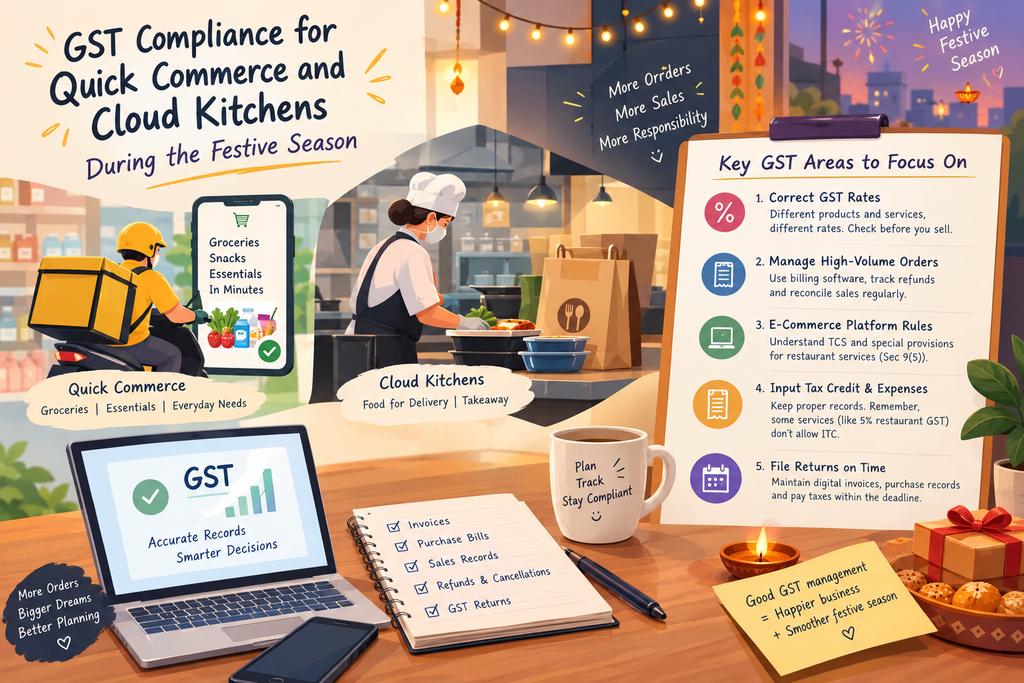
Source: ChatGpt
Conclusion
The festive season brings plenty of opportunities for quick commerce platforms and cloud kitchens, but it also makes managing GST compliance more challenging. With a large number of orders, increased expenses and frequent refunds, even small accounting mistakes can create problems later.
By maintaining proper records, using reliable billing systems, applying the correct GST rates and filing returns on time, businesses can handle the festive rush more smoothly. Good GST management not only helps businesses meet their legal responsibilities but also allows them to focus on serving customers and making the most of the festive season.
Following a GST compliance checklist can help cloud kitchens and quick commerce businesses verify tax rates, reconcile orders, review input tax credit eligibility, and meet filing deadlines.
AI Report:
1. GST Portal — https://www.gst.gov.in/
Suggested anchor text: official GST portal
2. CBIC GST — Assessment, Audit and Rules — https://cbic-gst.gov.in/assessment-audit-rules.html
Suggested anchor text: GST rules and compliance guidance
3. CGST Act, Section 9(5) — https://www.indiacode.nic.in/
Suggested anchor text: Section 9(5) of the CGST Act
Note: Search India Code for the Central Goods and Services Tax Act, 2017 and link directly to the relevant section if available.
4. GST Portal User Guides — https://tutorial.gst.gov.in/
Suggested anchor text: GST return filing guides

Grammar Report:

Plagiarism Report:
