
Introduction
GST audit preparation helps businesses organise tax records, reconcile returns, verify input tax credit claims, and respond confidently to departmental inquiries.
For businesses operating in India, GST compliance involves more than filing returns and paying taxes on time. Companies must also maintain accurate records, reconcile financial data, and ensure that every reported transaction can be supported by proper documentation. When these records are incomplete or inconsistent, responding to a GST audit or departmental inquiry can become time-consuming and stressful.
As GST compliance continues to evolve, businesses need to pay closer attention to the practical side of tax administration. The challenge is not only understanding the rules but also maintaining records that can be produced and explained when required. Preparing documents in advance helps businesses identify errors early, respond to official notices more efficiently, and reduce avoidable compliance risks.
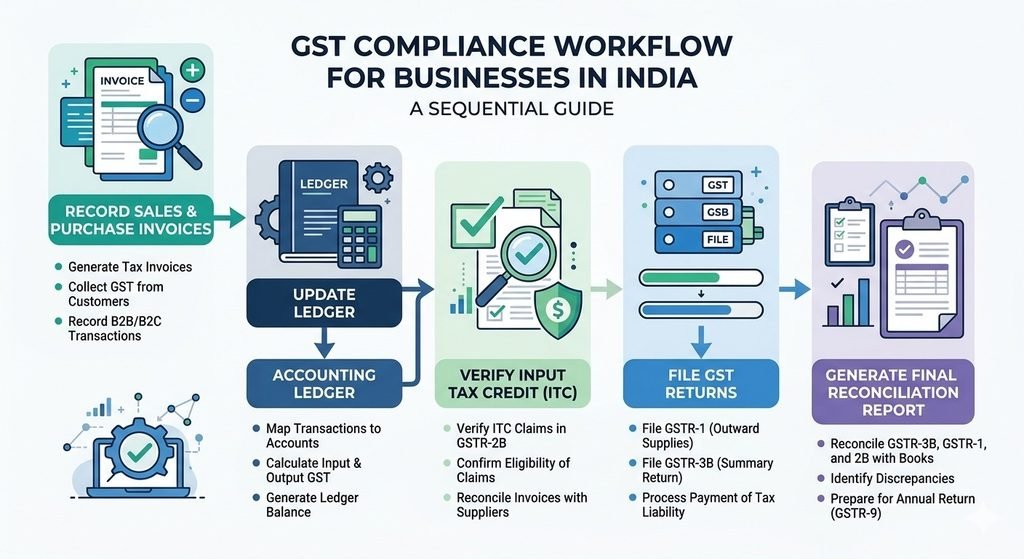
SOURCE: GEMINI AI
1. GST Audit Preparation: Seven Essential Steps for Businesses
A GST audit is an examination of a registered taxpayer’s records, returns, and related documents to verify compliance with applicable GST provisions. Under Section 65 of the Central Goods and Services Tax (CGST) Act, authorised tax officers may conduct an audit at the taxpayer’s place of business or in their office. The law generally requires at least 15 working days’ prior notice for an audit under this section.[1]
During the process, officers may examine turnover, tax rates, exemptions, input tax credit (ITC), refunds, and the accuracy of information reported in GST returns. Businesses should therefore understand the period covered by the audit and the specific records requested in the notice.
A departmental inquiry is not necessarily the same as a formal audit. Depending on the circumstances, the department may seek explanations, supporting documents, or attendance through an official communication or summons. The response should match the nature and scope of the communication received.
2. Maintain a Complete GST Documentation File
One of the most effective ways to prepare for a GST audit is to organise records throughout the financial year rather than collecting them at the last minute.
A well-maintained documentation file should generally include:
- Sales invoices, purchase invoices, debit notes, and credit notes.
- GST returns, including GSTR-1 and GSTR-3B, as applicable.
- Purchase registers, sales registers, and general ledgers.
- E-way bills and transport documents, where applicable.
- Bank statements and payment records.
- Input tax credit workings and supporting invoices.
- Refund applications and related correspondence, where relevant.
- Previous GST notices, replies, and departmental communications.
The exact documents required will depend on the business, the period being examined, and the questions raised by the department. Keeping digital copies in clearly labelled folders makes it easier to retrieve information quickly.
3. Reconcile Returns With Accounting Records
Differences between GST returns and accounting records can create questions during an audit or departmental inquiry. Businesses should regularly compare their books of accounts with the returns they have filed.
For example, sales recorded in the accounting system should be reviewed against the outward-supply details reported in GSTR-1 and the corresponding tax liability reported in GSTR-3B. Purchase records and ITC claims should also be checked against available supplier data and applicable eligibility conditions.
Any difference should be investigated rather than ignored. Common reasons include timing differences, credit notes, amendments, data-entry errors, and transactions recorded in different reporting periods.
Businesses should maintain a reconciliation statement explaining material differences and documenting any corrections made. This provides a clear record of how reported figures were verified.
4. Review Input Tax Credit Carefully
Input tax credit is an important area of GST compliance because an incorrect claim may lead to questions, adjustments, or further proceedings.
Before an audit, businesses should verify that ITC claims are supported by the necessary documents and meet the applicable conditions under GST law. They should also review whether credits have been reversed wherever required and whether any restricted or ineligible credit has been claimed.
A practical ITC review should include checking purchase invoices, matching relevant records, reviewing supplier-related discrepancies, and confirming that the credit claimed agrees with the books and filed returns.
If a mismatch is identified, the business should determine its cause and maintain supporting evidence. A discrepancy should not automatically be treated as wrongdoing; however, it should be properly examined and addressed.
5. Prepare a Clear Response to a Departmental Inquiry
When a departmental inquiry begins, businesses should first read the notice or communication carefully. Identify the issuing authority, relevant tax period, legal provision, documents requested, response deadline, and any requirement to attend a hearing or provide a statement.
The response should be factual, organised, and supported by evidence. Instead of submitting a large collection of unrelated files, prepare a point-by-point reply with relevant invoices, reconciliations, ledgers, and return acknowledgements.
Maintain a copy of everything submitted, together with proof of submission and a record of subsequent communication. If a summons is issued under Section 70 of the CGST Act, take it seriously and obtain professional advice where necessary. A qualified tax professional can help clarify the scope of the request and prepare an appropriate response.
Businesses should never alter records, create unsupported explanations, or ignore official communications. If information is unavailable or more time is genuinely required, the appropriate course is to address the issue transparently through the prescribed process.
6. Use Digital Systems to Reduce Compliance Friction
The growing importance of data-based compliance makes organised digital records increasingly valuable. Accounting software, document-management systems, and GST reconciliation tools can help businesses identify inconsistencies and retrieve supporting information.
Useful practices include maintaining standard file names, restricting access to authorised employees, creating regular backups, and preserving records for the legally required period. Businesses should also assign responsibility for GST filings, invoice verification, reconciliations, and responding to notices.
These measures are especially useful for companies handling high transaction volumes or operating across multiple locations. Digital tools cannot guarantee that every filing is correct, but they can make errors easier to identify and records easier to verify.
7. Build a Regular GST Compliance Checklist
Preparing for an audit should be an ongoing activity, not an emergency response. A monthly or quarterly checklist can help a business monitor its compliance position.
The checklist may cover:
- Verification of GST returns and payment records.
- Reconciliation of sales and purchase data.
- Review of input tax credit claims and reversals.
- Checking invoice details and supporting documents.
- Review of pending notices and response deadlines.
- Secure storage of records and correspondence.
- Periodic review by an accountant or GST professional.
The checklist should be adapted to the size and nature of the business. Regular internal reviews can help management detect issues earlier and reduce the effort required when information is requested by tax authorities.
Conclusion
Preparing for a GST audit or departmental inquiry starts with accurate records, consistent reconciliations, and a clear process for responding to official communications. Businesses that organise invoices, returns, ITC workings, and financial records throughout the year are better positioned to explain their transactions when questions arise.
As GST compliance processes evolve, documentation and timely responses remain essential parts of responsible tax management. The most practical approach is to make compliance a routine business function rather than a task undertaken only after receiving a notice. Where the matter involves disputed tax, significant ITC differences, or a formal summons, professional advice can help ensure that the response is appropriate and supported by the relevant law.
Using a GST compliance checklist can help businesses track filing deadlines, verify tax records, review input tax credit claims, and prepare for potential audits.
References
[1] Central Board of Indirect Taxes and Customs, “The Central Goods and Services Tax Act, 2017 — Section 65: Audit by tax authorities.” [Online]. Available: https://taxinformation.cbic.gov.in/content-page/explore-act/1000339/1000001
[2] Central Board of Indirect Taxes and Customs, “Central Goods and Services Tax Rules, 2017 — Rule 101: Audit.” [Online]. Available: https://taxinformation.cbic.gov.in/content-page/explore-rules/1000501/1000001
[3] Central Board of Indirect Taxes and Customs, “Assessment, Audit and Rules.” [Online]. Available: https://cbic-gst.gov.in/assessment-audit-rules.html
[4] Goods and Services Tax Council, “Model All India GST Audit Manual, 2023.” [Online]. Available: https://gstcouncil.gov.in/sites/default/files/2024-03/model-all-india-gst-audit-manual_final.pdf
REPORTS
1. Proofreading

2. Plagiarism
3. AI Detection