
GST 2.0 rate cuts create new opportunities for Indian MSMEs to reduce input costs, improve working capital, simplify tax compliance, and attract more customers.
Let’s be honest. For most small business owners, the word “GST” used to bring on a mild headache. Four slabs, endless classification arguments, and that sinking feeling when a product got reclassified and your price list was suddenly wrong.
Then 22 September 2025 arrived. <br>
The GST Council cut the old four-slab system down to two main rates, 5% and 18%, with a 40% rate kept only for luxury and sin goods. Around 99% of items taxed at 12% moved to 5%, and roughly 90% of items at 28% moved to 18%.
Big news for big companies? Sure. But the real story is what it means for the shop owner, the small manufacturer and the local service provider. If you run an MSME, this is your window. Here’s how to use it.
7 Powerful Ways MSMEs Can Benefit From GST 2.0 Rate Cuts
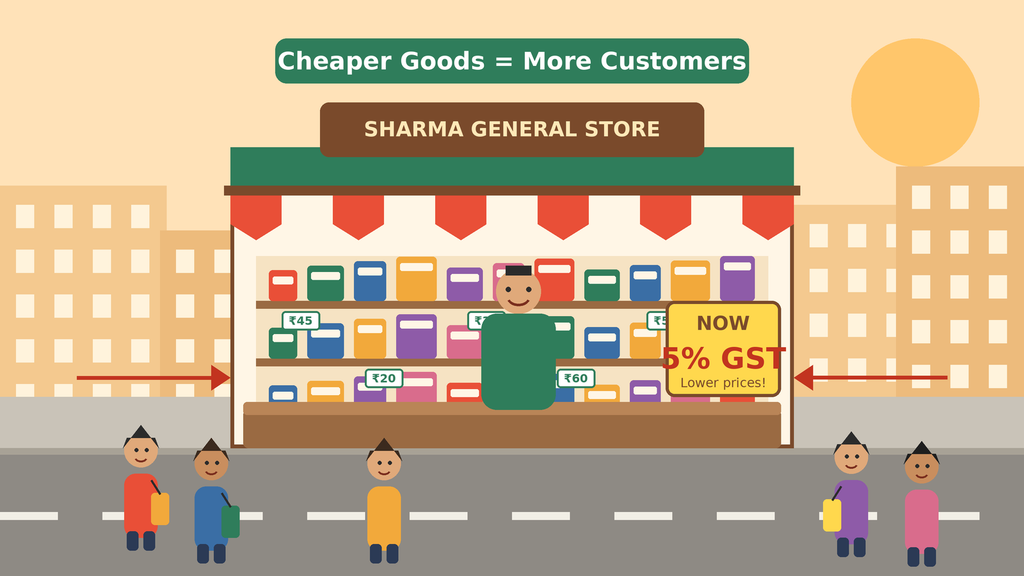
Start with the simplest effect. When prices fall, people buy more.
Clothing and footwear up to a set price, soaps, toothpaste, biscuits and ice cream all moved into the 5% bracket. Finance Minister Nirmala Sitharaman said the cuts could leave about Rs 2 lakh crore with consumers. That money doesn’t vanish. It gets spent at neighbourhood stores, small workshops and local eateries. If you sell everyday goods, expect more footfall.
2. Your Cash Isn’t Stuck as Long
Tax is paid up front, and small businesses feel that in their bank balance. A lower rate means less money tied up in every purchase and every invoice. Laghu Udyog Bharati pointed to lower working capital needs and cheaper raw materials as the big gains for small industry.
Picture a small garment unit buying yarn. Yarn dropped from 12% to 5% and man-made fibre from 18% to 5%. The same raw material now ties up noticeably less cash. That cash can go into stock, wages or a second machine.
3. Two Slabs, Far Fewer Headaches
Remember the classification fights? A product sat between two rates and nobody was sure which applied.
With just two main slabs, there is far less room for confusion. Analysts expect simpler HSN mapping, cleaner invoices and fewer surprise reclassifications. For an owner who also does the accounts, that saves real hours every month.
4. Pass the Cut On. Loudly.
Here’s the part many businesses miss. A rate cut only boosts demand if customers actually see it.
If your product got cheaper, say so. Put it on the board, on the invoice, on your WhatsApp status. Customers remember who dropped prices first, and that trust sticks around longer than any discount.
5. Lower Rates Make Honest Billing Easier
This is the compliance side of the trend. When the tax on a sale is high, some buyers and sellers are tempted to skip the bill. When the rate is lower, the pull to dodge it weakens.
For a small business, formal billing is also what opens doors to bank loans, bigger buyers and government schemes. Lenders are more comfortable with MSMEs when tax disputes don’t make their cash flow jumpy. A clean paper trail is an asset, and lower rates make it easier to build one.
6. Check Your Own Numbers, Because Not Everyone Wins Equally
Let me be straight about this one. Not every MSME gains the same amount.
Some sectors still struggle with inverted duty structures, where tax on inputs is higher than tax on the finished product. Procedural friction and pending litigation haven’t disappeared either. So don’t assume the benefit arrives automatically. Sit down with your accountant, list your top five inputs and top five products, and see where the new rates actually leave you.
7. So, How Do You Start?
You don’t need a consultant to begin. Try this:
- Re-map your products. Check every item against the new two-slab grid and update your price lists and invoices.
- Talk to your suppliers. If their costs fell, your purchase prices should too. Renegotiate credit terms while you’re at it.
- Look at new customers. Services like gyms and salons dropped to 5%, and appliances like ACs and TVs moved to 18%. If you supply or service these, demand may be shifting your way.
- Sell the saving. Make the price drop part of your pitch.
GST 2.0 is not a magic switch. But for a small business willing to read the fine print and act quickly, it is a real chance to sell more, hold more cash and run a cleaner shop.
MSMEs can make the most of GST 2.0 by strengthening GST compliance for SMEs, updating product classifications, reviewing input costs, and maintaining accurate invoices.
References
[1] “GST Council Rationalises Rates: MSMEs, E-Commerce, and Logistics to Benefit From Lower Taxes,” All India Radio News, Sep. 7, 2025. [Online]. Available: https://www.newsonair.gov.in/gst-council-rationalises-rates-msmes-e-commerce-and-logistics-to-benefit-from-lower-taxes
[2] “GST rate cuts to result in Rs 2 lakh crore saving for consumers: Sitharaman,” IANS / Greater Kashmir, Sep. 17, 2025. [Online]. Available: https://m.greaterkashmir.com/article/gst-rate-cuts-to-result-in-rs-2-lakh-crore-saving-for-consumers-sitharaman/434405
[3] “Resetting the tax landscape: Inside India’s GST 2.0,” Thomson Reuters ONESOURCE, Oct. 14, 2025. [Online]. Available: https://www.thomsonreuters.com/en-us/help/onesource-global-trade/regulatory-insights/2025/october-14th/resetting-the-tax-landscape-inside-india-gst-2-0
[4] “Bharatiya Mazdoor Sangh, Laghu Udyog Bharati wholeheartedly support Centre’s GST reforms,” The Tribune. [Online]. Available: https://www.tribuneindia.com/news/business/bharatiya-mazdoor-sangh-laghu-udyog-bharati-wholeheartedly-support-centres-gst-reforms
[5] “GST 2.0 Reforms: New Two-Slab Structure and Key Rate Cuts Explained,” Vajiram & Ravi. [Online]. Available: https://vajiramandravi.com/current-affairs/?p=61936
REPORT
AI REPORT

GRAMMERLY
PLAGIARISM
