
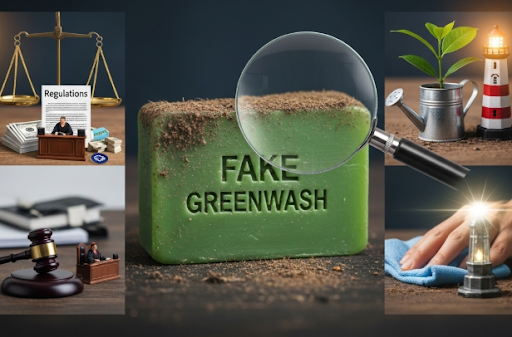
Greenwashing New Regulatory Risks and Remedies is a tactic employed by corporations that misrepresents or exaggerates their environmental impacts. Whereas once this was a reputational error, it has now, due to societal outcry and regulatory scrutiny, assumed serious forms of legal threat. Regulatory authorities internationally, through alliance systems, have become more stringent; companies now risk financial penalties and lawsuits, are losing their credibility, and facing reluctance in adopting new technologies-giving the credit crunch.
Growing Regulatory Tsunami
The draft of the Empowering Consumers Directive (EU 2024/825) is a measure in the EU against eco-lies-allegations such as ‘eco-friendly’ or ‘carbon-neutral’ which are not supported by facts or clearer messages reaching the consumers. As of March 2026, all member states are required to domesticate it into their antler laws, starting enforcement in September 2026.
Heavy penalties, including fines of up to four percent of global turnover, a prohibition from public procurement, and confiscation of profits, are possible. However, political quarrels have caused a major hold-up: for now, the EU’s Green Claims Directive is in limbo, a bad sign for the region’s green credibility.
At the same time, the obligations of the CSDDD-Corporate Sustainability Due Diligence Directive-are applicable and, starting in 2027, large companies must understand their environmental and human rights impacts across their supply chains in order to minimize such effects. Going further north, by May 2024, the Financial Conduct Authority (FCA) of the UK will come into effect with its new anti-greenwashing rule that prohibits misleading sustainability claims concerning investment products. Similarly, unlawful green marketing may incur penalties of up to 10% of global turnover under the Digital Markets, Competition, and Consumers Act, enforced by the CMA.
Moving further south, ASIC in Australia heavily enforces regulations through multi-million-dollar fines imposed on financial firms due to misleading ESG allegations, and is set to prioritize greenwashing enforcement by 2025.
In India, the Central Consumer Protection Authority (CCPA) has drafted guidelines regarding environmental claims verifiable as to their sources. Labels like “eco-friendly,” “green,” or “sustainable” must have documentary support, and punishment could be as high as ₹50 lakh or imprisonment for offenders.
Enforcement in Action
The crackdown is well underway. Shein was recently fined by Italy’s Competition Authority €1 million for misleading sustainability claims—falsely suggesting that major collections were recyclable or environmentally conscious.
Across Europe, financial managers have reported being easily misled by flashy but unverified green labels—adding urgency to the push for the standardization of credible certifications.
Additionally, a report from the London School of Economics finds a sharp increase in global litigation against carbon offset schemes that lack effective governance—casting serious doubt on voluntary programs that were once billed as easy fixes to climate claims.
Mitigating Greenwashing Risks: Business Remediation
Getting alignment between internal workings and external claims has now become a non-negotiable requirement. Some best practices include:
- Evidence-backed claims: Only make green statements substantiated by data and third-party verification.
- Solid governance: Set up internal review processes that include legal and sustainability teams and marketing in the scrutiny of claims before publication.
- Clear messaging: Be specific—a phrase like ‘made from 60% recycled materials’, unlike generic or sweeping terms.
Concluding Observations
As enforcement intensifies across jurisdictions, hollow green messaging is fast losing its credibility. Governments are pushing tough new standards, penalties, and due diligence obligations—so that greenwashing is becoming a concrete risk.
For companies, the path ahead is very clear – it involves transparency, verification, and ensuring that sustainability claims are matched by environmental intent. Today, integrity speaks like never before, and it is no longer an option that is simply ethical; it is being made strategic.
IEEE References:
[1] A. Haacke, “EU Greenwashing Rules Set for 2026: Interim Legal Steps,” Haacke Compliance & Legal Solutions, Jun. 25, 2025. [Online]. Available: https://www.haackecls.com/2025/06/eu-greenwashing-rules-2026-interim-legal/
[2] S. Jordans, “EU’s green claims directive stalls amid political backpedaling,” Associated Press (AP), Jun. 17, 2025. [Online]. Available: https://apnews.com/article/48ab6e435b27cfd740df8bb8d7af34f1
[3] ”Corporate Sustainability Due Diligence Directive,” Wikipedia, 2025. [Online]. Available: https://en.wikipedia.org/wiki/Corporate_Sustainability_Due_Diligence_Directive
[4] ”Managing Greenwashing Risk: In-House Counsel Tips,” Chambers & Partners, Jun. 2025. [Online]. Available: https://chambers.com/legal-trends/managing-greenwashing-risk-in-house-counsel
[5] ”Greenwashing and Sustainability: A Clear Enforcement Focus for Regulators,” White & Case LLP, Apr. 2025. [Online]. Available: https://www.whitecase.com/insight-our-thinking/greenwashing-and-sustainability-clear-enforcement-focus-regulators
[6] J. Longo, “ASIC Targets ESG Misconduct in Financial Sector,” TIME Magazine, Apr. 9, 2025. [Online]. Available: https://time.com/7172497/joseph-longo/
[7] ”What Is Greenwashing? Why Do Sustainability Claims Need Regulation and Transparency?” Legal Wires, Apr. 2024. [Online]. Available: https://legal-wires.com/lex-o-pedia/what-is-greenwashing-why-do-sustainability-claims-need-regulation-and-transparency/
FAQ’S
Q1. What does Greenwashing mean under New Regulatory Risks and Remedies?
Greenwashing is when companies exaggerate sustainability claims, a focus area in New Regulatory Risks and Remedies.
Q2. Why are New Regulatory Risks and Remedies important?
They protect consumers and investors from misleading environmental claims.
Q3. How do New Regulatory Risks and Remedies affect corporate governance?
They introduce stronger accountability rules for green disclosures.
Q4. Which industries are most impacted by New Regulatory Risks and Remedies?
Fashion, finance, and energy are heavily influenced.
Q5. Do New Regulatory Risks and Remedies include penalties for false claims?
Yes, fines and reputational damage are part of enforcement.
Q6. How should companies prepare for New Regulatory Risks and Remedies?
By improving data transparency and compliance frameworks.
Q7. Do New Regulatory Risks and Remedies apply to advertising?
Yes, sustainability marketing must meet compliance standards.
Q8. How do New Regulatory Risks and Remedies shape ESG reporting?
They demand detailed and verifiable disclosures.
Q9. Are small businesses affected by New Regulatory Risks and Remedies?
Yes, both SMEs and large corporations must comply.
Q10. What are the global trends in New Regulatory Risks and Remedies?
Governments worldwide are aligning environmental laws.
Q11. How do consumers benefit from New Regulatory Risks and Remedies?
They gain access to reliable, authentic sustainability claims.
Q12. Can technology help with New Regulatory Risks and Remedies?
Yes, digital tools verify data and prevent Greenwashing.
Q13. How do New Regulatory Risks and Remedies influence investors?
They improve trust in ESG-linked financial decisions.
Q14. What is the role of lawsuits in New Regulatory Risks and Remedies?
They enforce legal consequences for deceptive claims.
Q15. Do New Regulatory Risks and Remedies vary by sector?
Yes, rules differ depending on environmental impact.
Q16. How are banks adapting to New Regulatory Risks and Remedies?
By screening investments for sustainability compliance.
Q17. What challenges come with New Regulatory Risks and Remedies?
Data collection, reporting costs, and training are common issues.
Q18. How does employee training help with New Regulatory Risks and Remedies?
It ensures staff understand compliance obligations.
Q19. What are the risks of ignoring New Regulatory Risks and Remedies?
Non-compliance can result in fines and lawsuits.
Q20. How do New Regulatory Risks and Remedies connect to climate policies?
They align with global sustainability and carbon goals.
Q21. How are regulators enforcing New Regulatory Risks and Remedies?
Through audits, investigations, and compliance checks.
Q22. Can third-party audits support New Regulatory Risks and Remedies?
Yes, they add credibility to sustainability reports.
Q23. What is the future outlook of New Regulatory Risks and Remedies?
Stricter monitoring and higher accountability are expected.
Q24. How do New Regulatory Risks and Remedies encourage sustainability?
They push firms toward authentic environmental actions.
Q25. Are global companies required to follow New Regulatory Risks and Remedies?
Yes, international firms must adapt to cross-border rules.
Penned by Tanjal Kapoor
Edited by Reeya kumari, Research Analyst
For any feedback mail us at info@eveconsultancy.in
Finance made simple, fast, and fun! 🏦💡 Sign up for your daily dose of financial insights delivered in plain English. In just 5 minutes, you’ll be smarter already!
Simplify Your Business Compliance with Eve Consultancy
Eve Consultancy is your trusted partner for end-to-end compliance services, including Company Incorporation, GST Registration, Income Tax Filing, MSME Registration, and more. With a quick and hassle-free process, expert guidance, and affordable pricing, we help businesses stay compliant while they focus on growth. Backed by experienced professionals, we ensure smooth handling of all your legal and financial requirements. WhatsApp us today at +91 9711469884 to get started.