

India is one of the oldest civilizations in the world, with a kaleidoscopic variety and rich cultural heritage. The Indus Valley Civilization was widely known for its trade and bullion. Trade and commerce were instrumental in fostering economic prosperity and social relationships. This openness to the global world reflects the ancient Indian philosophy of “Vasudevaya Kutumbakam,” “The world is one family.” Even in today’s globalized digital world, our trade policy reflects the same vision of Vasudevaya Kutumbakam, advocating sustainable trade policy while navigating modern challenges like exchange rate fluctuations and AUD fluctuations, which affect global trade dynamics.
WHAT DO WE EXPORT?
India imports more than it exports, resulting in a trade deficit with nations like the USA, UAE, Netherlands, and China. These countries consistently rank high in India’s export statistics, with the USA being the largest export market. Other significant export destinations include Singapore, the United Kingdom, Saudi Arabia, Bangladesh, Germany, and Italy. Exporters increasingly face the impact of exchange rate fluctuations, especially when trading with regions affected by AUD fluctuations and volatile currency markets.
Indians Around The World
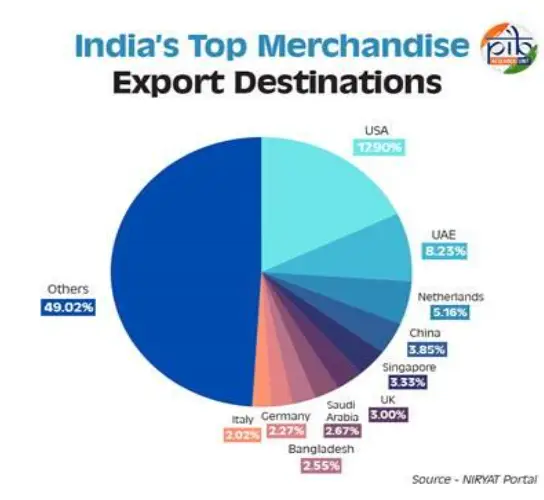
Source – PIB Delhi (Ministry of Commerce & Industry)
FINANCIAL YEAR | EXPORTS OF MAJOR COMMODITY (IN US$ MILLION) |
2020-21 | 291808.5 |
2021-22 | 422004.4 |
2022-23 | 451070.0 |
2023-24 | 437072.0 |
Source: Handbook of Statistics on Indian Economy, RBI
Exchange rates fluctuations play an important role in trade. It represents the price of one country’s currency in relation to another country’s currency. This indicator is measured in terms of national currency per US dollar. Over 60% of global forex reserves are held in USD. The US has deep capital markets and global influence, making USD widely accepted. Here is the data of average exchange Rate and year end exchange Rate of INR with respect to $.
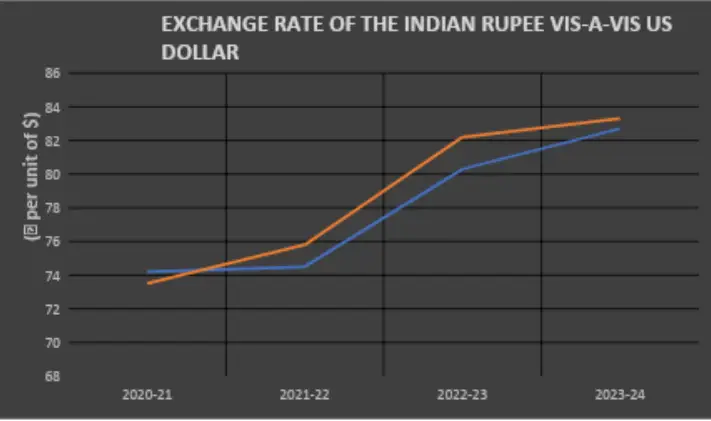
Source: Handbook of Statistics on Indian Economy, RBI
The average exchange rate is the mean value of a currency’s exchange rate over the year. It reflects the general trend of currency performance over time.
The year-end exchange rate is the official exchange rate on the last working day of the calendar or financial year, typically December 31 (calendar year) or March 31 (fiscal year in India). It is often used for closing balance sheets, tax calculations, and government reporting.
IS EXCHANGE RATE FLUCTUATIONS TRULY A CAUSE OF CONCERN?
When a currency gains or loses its value against the current it is being traded it is known as appreciation (depreciation). Our currency has depreciated against $ from a long time back. Depreciation makes our products reasonable in the global market, but since the foreign exchange market is a perfectly competitive market, it is market driven hence the Exchange Rate fluctuates daily. Even small fluctuations can significantly impact costs and revenues in international trade. It impacts exporters significantly. While large scale exporters have ample support, knowledge, and resources they hedge the price fluctuations easily. It’s the small exporters who face losses from these fluctuations.
Small Exporters, Big Risks: How AUD Fluctuations Impact Indian MSMEs
Small Indian exporters (MSME) are vital for India’s economic growth. They form a large part of the manufacturing sector and contribute significantly to the GDP and job creation in the country. MSMEs are a significant source of employment, generating over 120 million jobs across various sectors in India, particularly in rural and semi-Urban areas. Through resilience, innovation, and adaptability, MSMEs have consistently driven the nation’s growth.
When currency swings and export pressure arise, these MSMEs felt to be on the edge. Exporters price their commodity in $. When the rupee appreciates (gains value), exporters receive fewer rupees per dollar, reducing their revenue and profit. This directly cut their earnings turning them on the loss side. Similarly, when currency depreciates the import becomes expensive. The exporters who depend on the imported raw material or capital goods for the production of goods and services make losses. Also Large exporters often use financial instruments (like forward contracts or options) to hedge currency risk which is not available to all the small exporters. They lack awareness about these hedging financial instruments.
PATHWAY TO RESOLUTION
The ECGC Ltd. (Export Credit Guarantee Corporation of India Ltd.) wholly owned by the Government of India, was set up in 1957 with the objective of promoting exports from the country by providing credit risk insurance and related services for exports. Over the years it has designed different export credit risk insurance products to suit the requirements of Indian exporters. ECGC is essentially an export promotion organisation, seeking to improve the competitiveness of the Indian exports by providing them with credit insurance covers. It provides a range of insurance covers to Indian exporters against the risk of non-realization of export proceeds due to commercial or political risks, different types of credit insurance covers to banks and other financial institutions to enable them to extend credit facilities to exporters and Export Factoring facility for MSME sector which is a package of financial products consisting of working capital financing, credit risk protection, maintenance of sales ledger and collection of export receivables from the buyer located in overseas country. For small businesses this reduces financial stress.
RBI also backs exporters FOREX RISK MITIGATION SCHEMES. Foreign exchange interventions, both spot and forward, effectively counter capital flows volatility, with symmetric effects of purchases and sales. A spot rate is the current market price at which a stock, bond, commodity, or currency can be purchased or sold. A forward rate or forward price is a price set in advance between a buyer and a seller for execution on a future date. Banks and various trade bodies also provides training in hedging tools to mitigate loses.
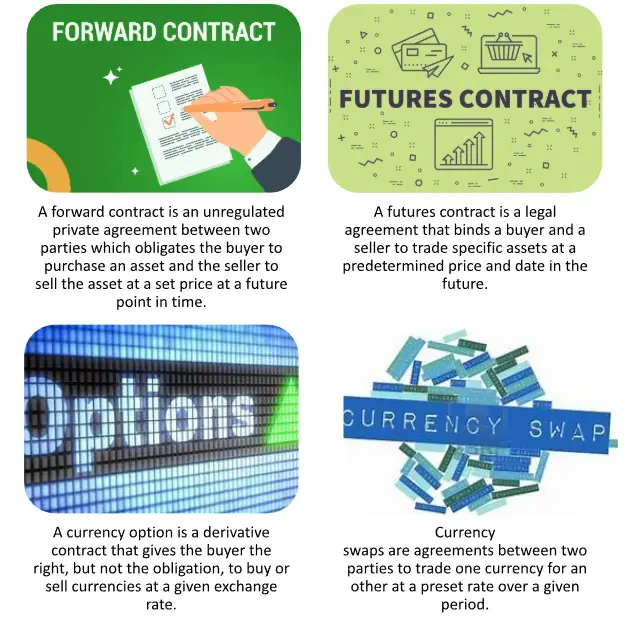
BASIC HEDGING TOOLS
REFERENCE:-
- PIB Delhi ( India’s Exports Reach Historic Heights)
- Handbook of Statistics on Indian Economy, RBI
- E-Commerce Exports Handbook for MSMEs, Directorate General of Foreign Trade Ministry of Commerce and Industry Government of India
FAQs: Understanding Exchange Rate Fluctuations and Their Impact on Indian Exporters
1. What are exchange rate fluctuations?
Exchange rate fluctuations refer to the changes in the value of one currency relative to another. These can impact international trade by making exports or imports more or less expensive over time.
2. Why do exchange rate fluctuations matter to small Indian exporters?
Small Indian exporters often operate on thin margins. Even slight exchange rate fluctuations can affect their earnings, either reducing profits or causing unexpected losses.
3. How does a falling rupee help exporters?
When the rupee depreciates due to exchange rate fluctuations, Indian goods become cheaper for foreign buyers. This can increase export demand and earnings when invoiced in foreign currencies.
4. Can exchange rate fluctuations cause losses for exporters?
Yes. If the rupee strengthens unexpectedly, exporters receive fewer rupees per dollar, reducing their profits. This makes them vulnerable to currency appreciation.
5. How are exchange rate fluctuations measured?
They are typically tracked by comparing the average and year-end values of the rupee against major currencies, especially the U.S. dollar, which is dominant in global trade.
6. Do large companies handle exchange rate fluctuations better than MSMEs?
Yes. Larger exporters often use hedging instruments like forward contracts to shield themselves from exchange rate fluctuations. MSMEs typically lack this access and knowledge.
7. What financial instruments help mitigate exchange rate fluctuations?
Forward contracts, options, and futures are popular hedging tools that allow exporters to lock in currency rates, protecting them from future exchange rate fluctuations.
8. How does import dependence affect MSMEs during currency depreciation?
If MSMEs rely on imported raw materials, exchange rate fluctuations that weaken the rupee make inputs costlier, increasing production costs and lowering profitability.
9. What role does the Export Credit Guarantee Corporation (ECGC) play?
ECGC offers insurance and factoring solutions to protect exporters from payment failures and market risks, helping manage some effects of exchange rate fluctuations.
10. Are government programs available to protect against exchange rate fluctuations?
Yes. RBI-backed Forex Risk Mitigation Schemes and training by trade bodies aim to educate and support exporters in dealing with currency risks.
11. What is the difference between spot and forward rates?
A spot rate is the current market exchange rate. A forward rate is a predetermined rate agreed for a future transaction, used to mitigate future exchange rate fluctuations.
12. How can MSMEs build resilience to exchange rate fluctuations?
By learning basic hedging strategies, diversifying markets, and using services like ECGC and government schemes, MSMEs can reduce exposure to exchange rate fluctuations.
13. Why do exchange rate fluctuations occur daily?
Exchange rates are driven by market supply and demand, economic indicators, interest rates, geopolitical events, and trade flows — causing daily fluctuations.
14. How do exchange rate fluctuations affect India’s trade balance?
A weaker rupee may improve exports but raises the import bill. A stronger rupee reduces export competitiveness, worsening the trade balance if not carefully managed.
15. What are key sources to monitor exchange rate fluctuations?
The RBI’s Handbook of Statistics, international financial websites, and forex platforms provide updated data to track exchange rate fluctuations and trends.
Penned by Reeya Kumari
Edited by Somewrit Sekhar Maiti , Research Analyst
For any feedback mail us at info@eveconsultancy.in
Finance made simple, fast, and fun! 🏦💡 Sign up for your daily dose of financial insights delivered in plain English. In just 5 minutes, you’ll be smarter already!
Simplify Your Business Compliance with Eve Consultancy
Eve Consultancy is your trusted partner for end-to-end compliance services, including Company Incorporation, GST Registration, Income Tax Filing, MSME Registration, and more. With a quick and hassle-free process, expert guidance, and affordable pricing, we help businesses stay compliant while they focus on growth. Backed by experienced professionals, we ensure smooth handling of all your legal and financial requirements. WhatsApp us today at +91 9711469884 to get started.