
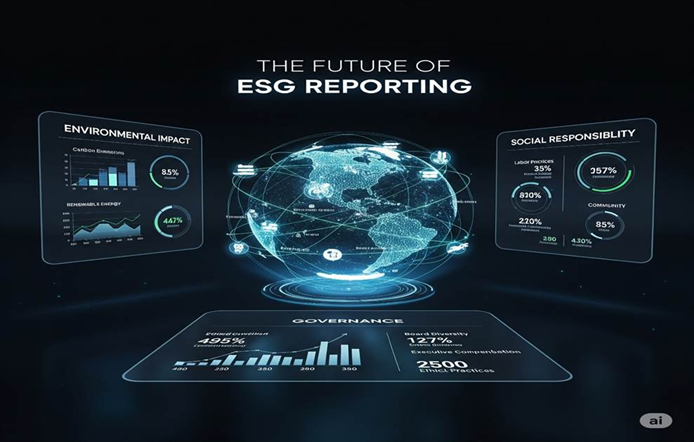
Topics: ESG Reporting Trends, Sustainability disclosure
ESG (Environment, Social, and Governance) is no longer a niche topic. The awareness of ESG has increased rapidly, and it is evident through asset flow. Investment funds are the most popular method for ESG investing, with ESG ETFs reaching over 640 billion U.S. dollars in assets in 2024.
ESG reporting trends among today’s traders, and they are focused on targeting goals beyond maximising profits and minimising risks. ESG stands for:
- Environmental: To align companies’ objectives with sustainable goals and promote environmentally friendly practices.
- Social: Ensure that the company is not violating any human rights and promoting any unethical or immoral actions like inequality or discrimination against caste, race, and gender.
- Governance: Limiting corruption, protecting whistleblowers, and fairly incentivising schemes for executives.
ESG Reporting Trends
- According to Bloomberg Intelligence, total global ESG assets doubled from 2016 and are expected to rise to 50 trillion in 2025. This ESG trend shows future prospects in the business, which are solving problems related to the environment.
- If we observe ESG trends across regions, then Europe is ahead of other region by over $2 trillion in ESG assets under management, according to Bankrate. In Europe 94% are convinced by ESG investing, whereas in North America 20% of people are still sceptical about ESG investing.
- ESG funds have a greater survival rate than non-ESG funds. It is found that 77% of ESG funds that were exited 10 years ago are still exits compared to 46% of traditional funds. This shows ESG funds are less risky compared to traditional funds.
- 90% of companies listed on the S&P 500 now issue ESG reports to improve their reputation and attract socially conscious investors.
- 83% of consumers believe companies should actively engage in and shape ESG practices. This investor’s growing expectation for companies to operate responsibly.
- Global ESG asset management is expected to rise to $56.1 trillion in the next few years, as stated by Grand View Research. So, investors should keep a close watch on sustainable business, as it can be a great investment opportunity.
- The global businesses are getting more interested in clean energy. It is stated in the Allied Market Research report that the renewable energy market is expected to rise to $2.17 trillion by 2026.
- Eco-friendly packing, like cornstarch packaging, recycled cardboard and paper, seaweed packaging, etc., is getting noticed as a huge business opportunity. Eco-friendly packaging is expected to grow at 9.2% from 2023 to 2028.
IFRS Sustainability Disclosure Standards
The IFRS Foundation established the International Sustainability Standards Board (ISSB) in 2021 to create a global baseline of sustainability standards.
Reasons behind ISSB
- Increased awareness of sustainability risk and their financial impact.
- Investors demand for reliable, high-quality sustainability information.
The ISSB issued its first two sustainability disclosure standards in 2023.
- IFRS S1 General Requirement for sustainability disclosure-related financial information.
- IFRS S2 Climate-related disclosure.
IFRS S1 is guidance about sustainability disclosure-related financial information in ESG reports.
Core elements of the report

The ESG report should be structured around these core elements.
- Governance: In a board meeting, sustainability-related risk and a roadmap to mitigate the risk should be discussed and mentioned in reports.
- Strategy: The company should mention ESG risk and impact on the business model. For example, the company shifted to EV vehicles for logistics. So, its impact on business should be mentioned in reports.
- Risk Management: Sustainability-related risks like water scarcity, poverty, etc., should be identified and integrated with company risk management. For example, a company to eradicate poverty is planning to start a program in certain regions. So, this should be mentioned in reports.
- Metrics & Targets: Quantitative data regarding ESG performance should be properly disclosed in reports along with the next target and a progress report against the set target.
- Material Information: Just like IFRS accounting standards, follow the materiality principle.
- Comparative Information: Facts and figures should match financial statements.
- Error Correction: Use IAS 8 to correct errors in reports. Errors must be corrected retrospectively.
Conclusion
ESG investing is becoming an important investing factor, and businesses should operate responsibly and ethically. Companies should annually publish ESG reports complying with IFRS sustainability disclosure standards to attract socially conscious investors and build a good reputation in the market. Recent ESG reporting trends show sustainable issues as potential business opportunities, so young entrepreneurs should focus on finding solutions to environment-related problem
References
- https://www.bankrate.com/investing/esg-investing-statistics/#global
- https://www.finder.com/ca/stock-trading/esg-investing-statistics
- https://investingintheweb.com/education/esg-investing-statistics/
- https://digitaldefynd.com/IQ/surprising-esg-statistics/
- https://www.navex.com/en-us/blog/article/the-future-of-esg-navigating-a-fragmented-landscape/
- https://www.statista.com/statistics/1269643/s-p-500-esg-normal-index-comparison/
- https://www.keyesg.com/article/50-esg-statistics-you-need-to-know-in-2024
- https://www.accaglobal.com/in/en/student/exam-support-resources/professional-exams-study-resources/strategic-business-reporting/technical-articles/sustainability-disclosure-standards.html
FAQ section: Future of ESG Reporting
1. What are ESG reporting trends?
ESG reporting trends are the latest methods companies use to share their environmental, social, and governance performance with stakeholders.
2. Why are they important for investors?
They matter because they highlight how sustainable and ethical a business is, helping investors evaluate long-term value and risk.
3. What does sustainability disclosure mean?
Sustainability disclosure is the process of reporting a company’s non-financial impact, including climate action, social responsibility, and governance practices.
4. Which global standards guide this reporting?
The International Sustainability Standards Board (ISSB) has introduced IFRS S1 and IFRS S2, which set consistent global frameworks.
5. How does governance influence ESG reporting?
Governance ensures companies remain transparent and accountable, protect whistleblowers, and promote fair management practices.
6. What are the latest developments in 2025?
Emerging updates include climate-related reporting, growth in clean energy adoption, eco-friendly packaging, and stricter international standards.
7. How does this differ from traditional financial reporting?
Financial reports focus on profits and losses, while ESG reporting highlights environmental impact, workforce ethics, and long-term sustainability.
8. Why should businesses care about sustainability disclosure?
It builds trust, attracts conscious investors, improves reputation, and ensures compliance with evolving global policies.
9. How do reporting practices vary by region?
Europe leads with the highest adoption, while North America still faces some skepticism. Regional factors strongly influence adoption rates.
10. What impact does this have on consumers?
Studies show consumers increasingly prefer brands that share transparent environmental and social practices, boosting customer loyalty.
11. Which industries benefit the most?
Renewable energy, logistics, and packaging industries benefit greatly, as they directly align with sustainable growth practices.
12. How does reporting improve risk management?
By identifying climate risks, inequality, and resource scarcity, companies can better integrate sustainability into their risk strategies.
13. What metrics are often disclosed?
Commonly reported data includes carbon emissions, diversity ratios, renewable energy use, ethical governance policies, and compliance efforts.
14. How does this affect long-term investments?
Funds that integrate sustainability often have stronger survival rates, proving that ethical investing is more resilient over time.
15. What does the future hold?
Future reporting will likely move toward harmonized global standards, stronger investor demand for accountability, and broader adoption across industries.
Penned by Manshika
Edited by Sneha Seth, Research Analyst
For any feedback mail us at info@eveconsultancy.in
Finance made simple, fast, and fun! 🏦💡 Sign up for your daily dose of financial insights delivered in plain English. In just 5 minutes, you’ll be smarter already!
Simplify Your Business Compliance with Eve Consultancy
Eve Consultancy is your trusted partner for end-to-end compliance services, including Company Incorporation, GST Registration, Income Tax Filing, MSME Registration, and more. With a quick and hassle-free process, expert guidance, and affordable pricing, we help businesses stay compliant while they focus on growth. Backed by experienced professionals, we ensure smooth handling of all your legal and financial requirements. WhatsApp us today at +91 9711469884 to get started.