
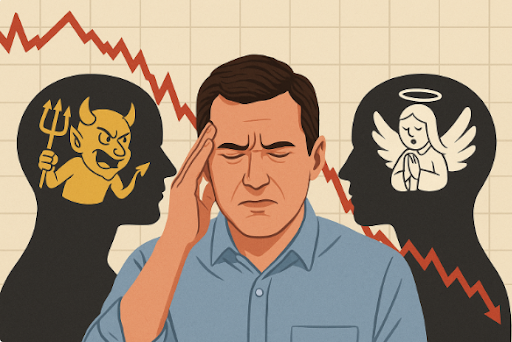
The Stock Market Isn’t Rational, And Neither Are You
The minute you open your investment app and see red, your mind doesn’t instantly go to ‘Oh, this is a market correction”
Rather it goes “Panic. Sell. Now”
Regardless of what the textbooks suggest, most people don’t usually make financial decisions based on logic. We are driven by greed, fear, overconfidence and sometimes even peer pressure.
Fear vs. Greed
- Greed makes you buy stocks you barely understand.
- Fear makes you take all your money out after a minor dip.
Behavioral finance decisions says that these emotions are not gaps in the system, rather THEY ARE THE SYSTEM.
Meet Your Inner Biases: Why you are failing at making maximum profits
Loss Aversion
Loss Aversion can be understood as “A loss of $100 would hurt more than a gain of $100.” This is the very important concept in behavioural finance decisions that basically explains why people often make irrational decisions because of their emotions.
This is a prime reason why most people like to hold on to under-performing stocks. Selling the stock means accepting a loss which is too painful for them, so they hold on to these in hopes. On the other hand some people may choose to sell the star in their portfolio just to lock in the small profit that they made out of it in fear of losing it.
Overconfidence Bias
Just because that one investment that you made worked out, the next thought? You might be the next Warren Buffet. Turns out you are probably not.
Over-confidence bias makes us less afraid of taking risks, which isn’t always bad, but if left unchecked, it might lead to some serious losses.
Confirmation Bias in financial decisions
You Google “Is this stock good to buy?” and only click on articles that say yes. Sound familiar?
This is confirmation bias. We tend to only look at information that validates our actions while ignoring the things that contradict it.
Why Smart People Still Make Dumb Money Decisions
You may have a degree in finance, read the Economic Times every morning, and consistently buy high/sell low.
Why?
Because knowledge does not kill emotion. The emotional centers of the brain are faster than our logical centers. So long before logic in the brain has had an opportunity to exercise authority, your money is already headed for the door.
Herd Mentality
In a market crash people don’t act based on logic, they act based on their instincts. Where the crowd runs, you run. Even if they are jumping off a cliff.
This is survival mode. Herd mentality kicks in when fear spreads faster than facts, and investors follow what everyone else is doing rather than taking their own rational decisions. One of the big reasons for a market spiral- Panic leads to more panic.
In the End, Money is Emotional, and That’s Okay
Your relationship with money is emotional finance decisions, messy and complicated and that is completely justified because to be honest Behavioral finance decisions doesn’t want you to completely avoid these emotions, it just wants you to understand it better, so that random emotional surges do not stop you from making smart decisions or missing out on easy profit.
FAQ: Mind Over Money? How Emotions Secretly Shape Your Financial Decisions
Q1: What role do emotions play in financial decisions?
Emotions like fear, greed, and overconfidence significantly influence financial decisions, often overriding logical thinking and leading to irrational choices.
Q2: How does behavioral finance relate to financial decisions?
Behavioral finance studies how psychological factors affect financial decisions, helping investors understand the emotional triggers behind money habits.
Q3: What is loss aversion in financial decisions?
Loss aversion is the tendency to fear losses more than we value gains, often causing poor financial decisions like holding onto underperforming assets.
Q4: How does overconfidence impact financial decisions?
Overconfidence can lead individuals to overestimate their financial knowledge, resulting in risky financial decisions and unexpected losses.
Q5: What is confirmation bias in financial decisions?
Confirmation bias occurs when people seek out only the information that supports their beliefs, which can misguide financial decisions and hinder objectivity.
Q6: Why do smart people still make emotional financial decisions?
Even financially educated individuals make emotional financial decisions because the emotional brain often acts faster than the logical part of the brain.
Q7: How can I avoid emotional financial decisions?
Avoid emotional financial decisions by creating a solid plan, setting long-term goals, and regularly reviewing your investments with a clear head.
Q8: What is herd mentality in financial decisions?
Herd mentality drives people to follow the crowd during market fluctuations, often leading to rushed and regrettable financial decisions.
Q9: Are financial decisions always based on logic?
No, financial decisions are often driven by emotion, especially during stressful situations like market crashes or sudden losses.
Q10: How do fear and greed affect financial decisions?
Fear makes investors sell during downturns, while greed pushes them to chase returns, both of which can lead to impulsive financial decisions.
Q11: Can behavioral biases be eliminated from financial decisions?
Biases can’t be completely eliminated, but awareness and self-discipline can reduce their impact on financial decisions.
Q12: How does past experience influence financial decisions?
People often base current financial decisions on past wins or losses, which may not align with market realities or rational analysis.
Q13: Do emotions affect short-term or long-term financial decisions more?
Emotions mostly affect short-term financial decisions, as impulsive reactions override well-thought-out long-term strategies.
Q14: How can behavioral finance improve financial decisions?
Behavioral finance provides tools and insights that help investors recognize and manage emotional patterns in their financial decisions.
Q15: Why is self-awareness important in financial decisions?
Self-awareness helps identify emotional triggers and prevents those feelings from dictating financial decisions that could harm long-term goals.
Penned by Stuti Modi
Edited by Shashank Khandelwal, Research Analyst
For any feedback mail us at info@eveconsultancy.in
Finance made simple, fast, and fun! 🏦💡 Sign up for your daily dose of financial insights delivered in plain English. In just 5 minutes, you’ll be smarter already!
Simplify Your Business Compliance with Eve Consultancy
Eve Consultancy is your trusted partner for end-to-end compliance services, including Company Incorporation, GST Registration, Income Tax Filing, MSME Registration, and more. With a quick and hassle-free process, expert guidance, and affordable pricing, we help businesses stay compliant while they focus on growth. Backed by experienced professionals, we ensure smooth handling of all your legal and financial requirements. WhatsApp us today at +91 9711469884 to get started.