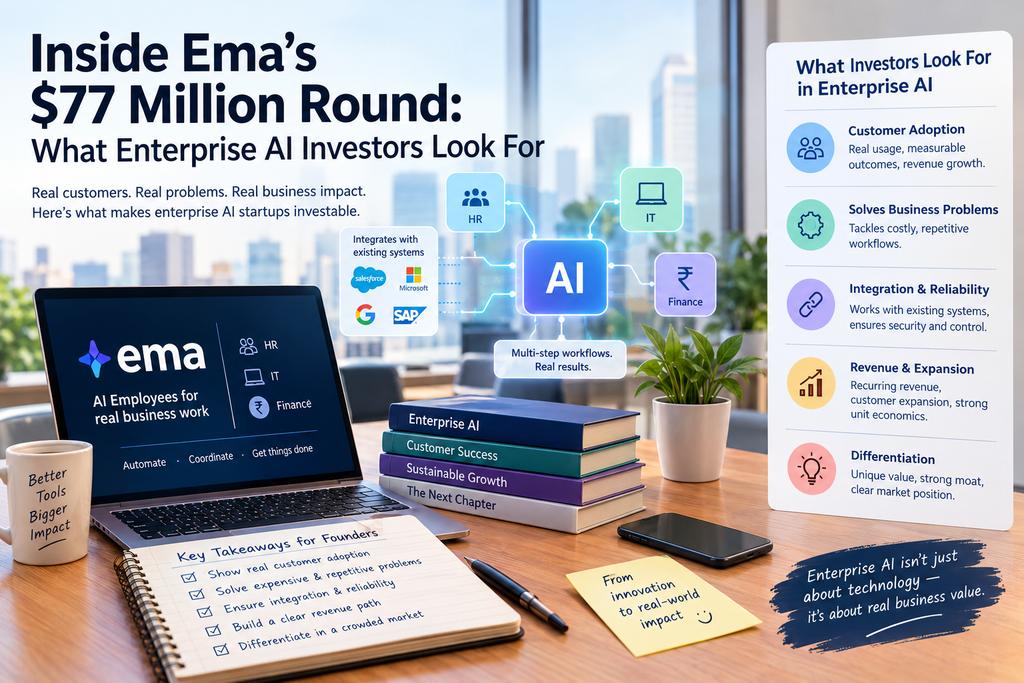
Source: Ai Generated Image
5 Key Lessons From Ema’s $77M Funding for Enterprise AI Startups
Ema $77M funding highlights five key factors enterprise AI investors look for, including measurable customer value, reliable integrations, competitive differentiation, and sustainable revenue growth.
The realm of enterprise AI is quickly revolutionizing the way businesses operate, serve their customers and improve their productivity. As more and more organisations are adopting AI-based solutions, investors are increasingly paying the attention to start-ups that can leverage this technological innovation into definite business results. For instance, an enterprise AI startup has raised $77 million in a funding round last week from September 21-25, 2026; this is called Ema. It highlights the growing enterprise AI spending trend and offers guidance to the startups looking to develop investment-ready and scalable business.
Ema, founded in 2023 by Surojit Chatterjee and Souvik Sen, is an AI-powered business solution that prioritizes automating business processes. It is called AI Employees and allows businesses to automate tasks across different areas such as human resources (HR), information technology (IT) and finance using AI agents. The platform is not intended for answering questions, it’s intended for people to complete multi-step processes; coordinating different sets of tasks, which we already have in different enterprise applications. This is a key challenge that organisations face: implementing AI that can have an impact in existing business systems.
Existing investor Accel, Section 32 (S32) and Prosus joined Ema in the $77 million round, led by the investor Creaegis. Ema’s total funding is now around $140 million, thanks to the investment, according to the company’s announcements. The money would be used to enhance its artificial intelligence platform, expand its “go-to-market” capabilities, and further diversify its international business. The company’s valuation has also increased considerably in the round as compared to the previous round, although the company has not yet announced its valuation for the round.
A crucial part of the Ema fundraising saga is that they had to show that customers were using the product. With a myriad of similar enterprise AI products on the market promising to enhance productivity, investors want to see the impact of AI in the real world of business. Organisations should continue to pay for the service, companies should demonstrate that customers are using its product regularly, and companies should demonstrate that there is measurable benefit to the implementations. Ema showcased impressive growth in the number of enterprises using its platform and its revenue, which helped to build a broader understanding of the commercial potential of its approach. Regarding the other founders, the call to action is to keep an eye on customer validation, successful pilot programs, paid contracts and renewals rather than take the word on board for product demonstrations and big plans.
Another crucial benefit of enterprise AI investments is the ability to solve expensive, repetitive enterprise problems. For a large organisation, employees can request a significant amount of time and resources to process, documents may be large and require a lot of processing time, and approvals may have to be coordinated across various software applications and systems. Ema is dedicated to automating these kinds of workflows, which can lessen manual work and boost operational effectiveness. Other founders can do the same by finding problems that they think their customers would want them to pay for solutions for. A financial technology company could streamline its invoice management or a human resources technology company could facilitate employee onboarding. The easier you can quantify the benefits (such as cost reduction, accuracy and speed of processing etc.) the more easily you can sell these solutions as a business investment.
Integration and reliability is also a key factor. It’s rare that an enterprise customer runs exclusively on one software platform. They are reliant on interdependent systems with critical data and on critical business processes. An AI product that doesn’t resonate with these existing application can make things more complicated as opposed to solving them. Ema’s emphasis on enterprise workflow optimisation is a testament to the need to integrate AI into the existing business landscape. Therefore, it is essential that the founders pay attention to the reliability of their integrations, data protection, access control and how they handle any errors that occur. When employees have a clear understanding of its functionality, data security, and when human effort is needed, businesses are more likely to embrace AI.
Investors want a smooth path from adoption to a sustainable revenue stream as well. The customer needs to be ready to use the product, and also be ready to renew the contract and broaden the scope of the product, so as to demonstrate the success of enterprise AI startups. Ema has reported positive customer outcomes with regards to growth and retention, thus some companies may be using its platform for other purposes than initially intended. This will make it very apparent that it is better to have a product that may be able to solve a problem and then expand to other aspects of the product. But founders need to make sure that their growth is driven by real customer demand. Revenue growth should be assessed along with the cost of customer acquisition, operating costs, gross margins, and costs of long term services delivery.
In a competitive market, technological differentiation may be a factor influencing investment. Established software vendors, vendors of AI models and new startups offering similar automation products are competitors. Ema’s solution emphasizes orchestration, integration and collaboration of AI agents and business applications, rather than the reliance on a single AI model. This is one of those instances where it’s crucial to develop a niche market. Through the industry expertise, proprietary workflows, powerfully integrated solutions, performance, and customer insights, founders can build competitive edge. It’s not always enough to give an existing product a long-term edge by making a few tweaks with the help of artificial intelligence.
The investment round also highlights the significance of capital allocation. Once the start-up has successfully generated interest in their product, additional capital can be raised to support their sales, implementation, and product development and expansion into other countries. But just because you have a lot of money, it doesn’t mean you will succeed. The founders should link up their fundraising to milestones and also define their business metrics. This could be getting enterprise customers, enhancing customer retention, going into new markets, or boosting product reliability.
As a start-up changes and evolves, it is sometimes crucial to be disciplined in your spending to prevent the loss of danger associated with profitability and operational effectiveness.
Ema’s story is a general cautionary tale for the other founders considering AI enterprise investment. Big market isn’t enough for a great business; it needs innovative technology as well. It needs to solve a problem, have evidence that customers want the solution, be a unique product, have a potential revenue stream that can grow, and have a realistic growth path. The founding team’s understanding of their market and ability to execute on their plans is also crucial for the investors’ confidence.
To wrap up, Ema’s $77 million funding round demonstrates the increasing relevance of real-world applications of AI in the business context. It highlights features that make AI startups appealing to investors, such as workflow automation, enterprise integration, and business productivity. The main thing to understand for the founders is to create solutions that have measurable value, establish trust with users or customers, and show sustainable commercial potential. With enterprise AI adoption now on the rise, startups that deliver a blend of innovation and grounded execution could be more appealing to investors and have the potential for sustainable growth.
Founders can strengthen their investment readiness by applying startup fundraising strategies that demonstrate customer traction, measurable business value, and a clear path to sustainable growth.
References
[1] Ema, “Ema raises $77M Series B to put AI employees to work across the enterprise,” GlobeNewswire, Sep. 23, 2026. [Online]. Available: https://www.globenewswire.com/news-release/2026/09/23/3367506/0/en/ema-raises-77m-series-b-to-put-ai-employees-to-work-across-the-enterprise.html
[2] J. Singh, “Ema raises $77M as AI starts eating into enterprise software and services,” TechCrunch, Sep. 23, 2026. [Online]. Available: https://techcrunch.com/2026/09/23/ema-raises-77m-as-ai-starts-eating-into-enterprise-software-and-services/
[3] Ema, “Ema raises $77M Series B to put AI employees to work at enterprises,” Sep. 23, 2026. [Online]. Available: https://www.ema.ai/blog/funding-announcement/ema-raises-series-b
[4] Moneycontrol News, “AI startup Ema raises $77 million in funding led by Creaegis,” Moneycontrol, Sep. 23, 2026. [Online]. Available: https://www.moneycontrol.com/news/business/funding/ai-startup-ema-raises-77-million-in-funding-led-by-creaegis-14036593.html
[5] YourStory, “Enterprise AI startup Ema raises $77M in Series B round led by Creaegis,” Sep. 24, 2026. [Online]. Available: https://yourstory.com/2026/09/enterprise-ai-startup-ema-raises-series-b-round-led-by-creaegis