
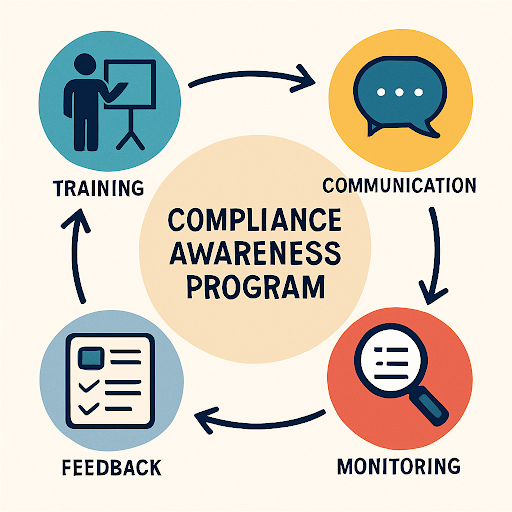
Introduction:
Compliance awareness campaigns are generally introduced by the compliance department in a firm and are initiatives aimed at educating employees about the importance of adhering to company policies and laws, industry standards, and legal regulations that an employees must follow. These campaigns use various communication methods in order to inform and remind employees from time to time about their compliance obligations.
Read the article to know more about the aspects of awareness program design and implementing a successful compliance awareness program, outlining its key components, best practices, and methods for measuring its actual effectiveness, while also focusing on employee engagement.
Purpose:
The main purpose of an effective compliance programme is to ensure that an organization is working in a properly regulated manner, since an organization’s reputation is a fragile asset.
The most important reason for an effective compliance program is to mitigate risk. Ignoring such rules can lead to various fines and charges against the employees of the organization. And it is not even about mitigating these fines; it is to ensure that there exists a strong ethical culture within an organization. A sense of shared responsibility and accountability is promoted within an organization when the employees are well-informed about ethical guidelines and compliance policies.
The compliance programme not only focuses on the ethical working of employees in an organization, but it also enhances the operational functioning of a company, as well, as the employees will be clear about policies and procedures, and it will reduce errors, streamline workflows, and minimize the need for corrective actions.
Key components of effective compliance programmes are as follows:
Understandable policies:
The main crux of a compliance programme is its easily understandable policies, as these documents serve as the main source for employees to understand what is expected of them. Policies should be written in clear, concise language and should be regularly updated to reflect any changes in the regulations or organizational practices. The availability of these policy documents through a centralized, user-friendly platform is essential for their effectiveness.
Training programmes:
Compliance training should be a continuous process rather than a one-time event, with annual changes, and unplanned meetings should be conducted regularly to address new regulations or incidents happening. To ensure effectiveness, the content should be relevant to employees’ daily work, as it will be easier for them to engage and retain information. Interactive and engaging formats, tailored to different learning styles, can further enhance participation.
Proper reporting mechanisms:
An environment should be created where employees do not hesitate to report any problems or raise any concerns. Open communication channels should be created for the employees, and they should be trained properly on how to use them without any problems, as open communication fosters an environment of transparency and allows for early detection and resolution of compliance issues.
Continuous monitoring:
There should be continuous monitoring of compliance strategies; they should not be implemented once and then forgotten, but they should be checked regularly to see whether the employees are following the rules and regulations for a proper and smooth functioning of the organization.
Disciplinary action and enforcement:
If any employee is found violating the company rules, proper disciplinary action should be taken against them without any delay. If no action won’t be taken, then nobody will be serious about following the company rules and regulations. Thus, actions should be taken and should not remain just as words to scare the employees in the beginning.
Conclusion:
In short, one compliance program maintains consistency and transparency in a company, keeps processes streamlined, and avoids data silos, which are necessary for a strong compliance culture. A compliance program is also necessary to keep the company’s correct work culture and ethics intact so that the employees work in a regulated way, such that the organization’s reputation is not brought low in any shape or form.
As a result, following these guidelines will help improve the company’s image only in the public, which will benefit the company and help attract many more customers.
References:
[1] The University of Texas at Dallas Institutional Compliance, “Seven Elements of an Effective Compliance Program,” The University of Texas at Dallas, 2025. [Online]. Available: https://institutional-compliance.utdallas.edu/compliance/resources/seven-elements-of-an-effective-compliance-program/. [Accessed: Aug. 12, 2025].
[2] U.S. Department of Justice, “Evaluation of Corporate Compliance Programs,” Criminal Division, June 2020. [Online]. Available: https://www.justice.gov/criminal-fraud/page/file/937501/download. [Accessed: Aug. 12, 2025].
[3] Ethics & Compliance Initiative, “Principles and Practices of High-Quality Ethics & Compliance Programs,” ECI, 2023. [Online]. Available: https://www.ethics.org/resources/free-toolkit/. [Accessed: Aug. 12, 2025].
[4] Deloitte, “Designing an Effective Compliance Program,” Deloitte Insights, 2024. [Online]. Available: https://www2.deloitte.com. [Accessed: Aug. 12, 2025].
FAQ : Designing an effective compliance awareness program
Q1. What is compliance awareness program design?
Compliance awareness program design involves creating structured policies, training, and reporting systems to ensure employees follow regulations.
Q2. Why is awareness program design important for companies?
It minimizes risks, maintains ethical culture, and ensures smooth business operations.
Q3. How does awareness program design improve employee engagement?
By making policies clear, training interactive, and communication open, employees feel valued and engaged.
Q4. What are the key elements of compliance awareness program design?
Understandable policies, regular training, reporting mechanisms, continuous monitoring, and fair enforcement.
Q5. How often should compliance awareness training be conducted?
Training should be continuous with annual updates and additional sessions when new regulations arise.
Q6. How can awareness program design reduce organizational risks?
It prevents violations, reduces fines, and promotes accountability within the company.
Q7. What role does employee engagement play in compliance programs?
Engaged employees are more likely to follow policies, report issues, and uphold company values.
Q8. What methods make compliance training effective?
Interactive formats, real-life scenarios, and tailored content based on employee roles.
Q9. How can reporting mechanisms improve compliance awareness?
They encourage transparency, allow early issue detection, and foster trust among employees.
Q10. What happens if compliance violations go unchecked?
It weakens company reputation, increases legal risks, and reduces employee accountability.
Q11. How does continuous monitoring support awareness program design?
Monitoring ensures compliance strategies remain updated, relevant, and consistently applied.
Q12. Can disciplinary action strengthen compliance awareness programs?
Yes, enforcing rules fairly emphasizes seriousness and encourages accountability.
Q13. How does awareness program design impact company reputation?
It builds public trust, shows ethical responsibility, and attracts customers.
Q14. What challenges arise in employee engagement for compliance programs?
Challenges include lack of interest, poor communication, and unrelatable training sessions.
Q15. How can businesses measure the success of compliance awareness program design?
Through feedback surveys, monitoring reports, reduced violations, and employee participation levels.
Penned by Mehak Behl
Edited by Seema Acharya, Research Analyst
For any feedback mail us at info@eveconsultancy.in
Finance made simple, fast, and fun! 🏦💡 Sign up for your daily dose of financial insights delivered in plain English. In just 5 minutes, you’ll be smarter already!
Simplify Your Business Compliance with Eve Consultancy
Eve Consultancy is your trusted partner for end-to-end compliance services, including Company Incorporation, GST Registration, Income Tax Filing, MSME Registration, and more. With a quick and hassle-free process, expert guidance, and affordable pricing, we help businesses stay compliant while they focus on growth. Backed by experienced professionals, we ensure smooth handling of all your legal and financial requirements. WhatsApp us today at +91 9711469884 to get started.