
The Geopolitical Economy of Digital Currencies: CBDCs, Stablecoins, and the Future of International Finance
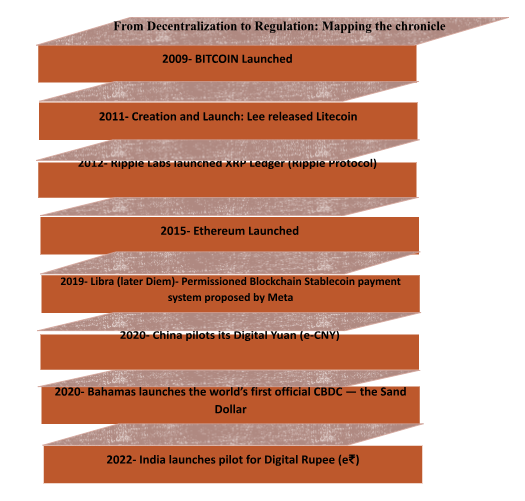
Digital currency geopolitical impact is reshaping the global economic landscape, especially in the payment sector. From barter to bills and now blockchain, the evolution of financial systems has accelerated in the 21st century. Digital payments and blockchain technology have transformed traditional finance, moving from centralized control to decentralized ecosystems. The introduction of cryptocurrencies like Bitcoin in 2009 demonstrated the potential of decentralized transactions, pushing central banks worldwide to develop their own digital currencies for transparency, inclusion, and efficiency.
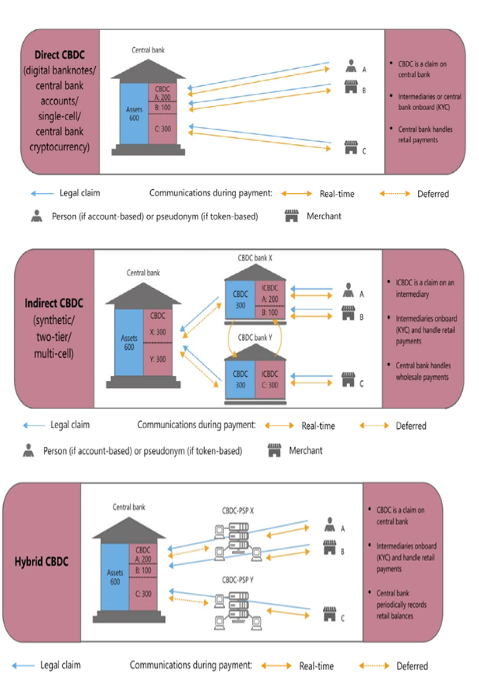
Central banks around the globe are also working on their digital currency, promoting inclusion, transparency, and offering greater transactional convenience. Central bank digital currencies are a digital form of fiat currencies issued and regulated by central banks. Digital currency geopolitical impact has legal tender and is exchangeable for one another. A CBDC is a safe, government-backed medium of exchange that eliminates intermediaries during transactions.
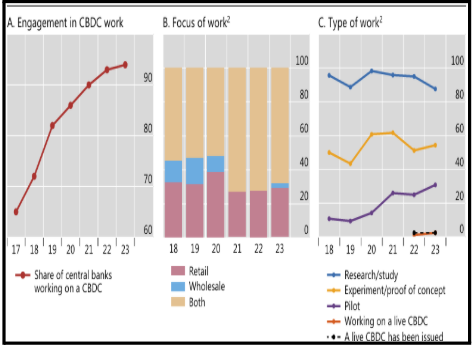
As per the results of the 2024 Bank for International Settlements (BIS) survey on CBDCs, conducted on 86 central banks that represent 81% of the world’s population and 94% of global economic output. Out of these, 94% of central banks are engaged in some form of CBDC work. (Source: Embracing diversity, advancing together – results of the 2023 BIS survey on central bank digital currencies and crypto)
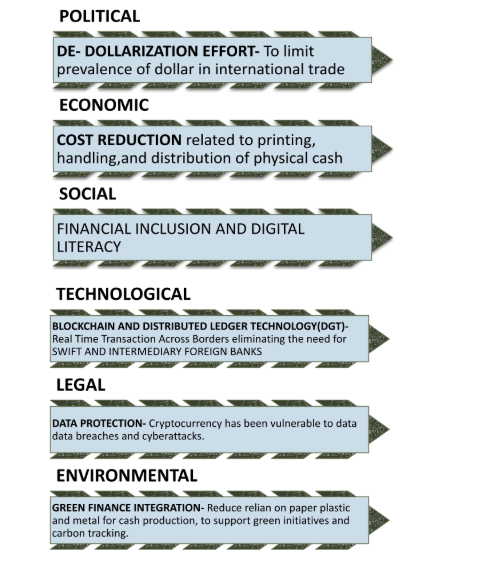
From Paper to Protocol: Why the Future Demands CBDCs – A PESTLE
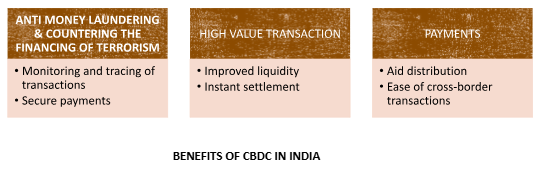
Digital Currency Geopolitical Impact on Digital Rupee (e₹)
The Government of India announced the launch of the Digital Rupee — a Central Bank Digital Currency (CBDC) from FY 2022-23 onwards in the Union Budget placed in the Parliament on February 01, 2022. Through a gazette notification dated March 30, 2022, the Government of India amended the Reserve Bank of India Act, 1934, thereby empowering the RBI to conduct pilot projects and issue a Central Bank Digital Currency (CBDC). The indirect CBDC model was adopted for the introduction of CBDC in India. In this model, the RBI will create and issue tokens to authorised entities of Digital currency geopolitical impact called Token Service Providers (TSPs), who in turn will distribute these to end-users who take part in retail transactions.
Digital Currency Geopolitical Impact on Total Value of e-₹ Retail CBDC per Month
India introduced its wholesale CBDC pilot project in November 2022 to focus on settling secondary government bond market transactions. In October 2023, the Reserve Bank of India introduced a new use case for the e₹-W (wholesale CBDC) pilot by enabling the settlement of interbank call money trades. This innovation enabled banks to conduct real-time settlements via the e-Kuber platform, offering an alternative to the traditional interbank RTGS system.
The Rise of Stable Coins
Stablecoin is a type of cryptocurrency designed to address the volatile nature of cryptocurrencies by pegging its value to a real-world asset, such as a fiat currency, Commodities like gold, or other cryptocurrencies. This feature makes it favourable to be used for transactional purposes. Since World War II, the U.S. dollar has held hegemonic status as the dominant currency for global trade. However, the Trump administration executed a scheme to revive the dollar’s hegemony with advancing digital financial technology, and the growing context of geopolitical tensions around de-dollarisation, by pushing a dollar-backed stablecoin. Dollar-backed stablecoins emerged (in 2014 for example) such as Tether (USDT) which was not created by design from the U.S. government. The Trump administration did not create stablecoins, but the position of regulatory flexibility toward creating an innovative digital dollar and fintech indirectly aided in creating the environment for stablecoins to grow. The stablecoin notion of dollar dominance has also been widely discussed by U.S. think tanks and policymakers in 2019, at the time China was actively engaged in developing its Digital Yuan.
Key Differences
PARAMETERS | FIAT-BACKED STABLECOIN | CRYPTO-BACKED STABLECOIN | COMMODITY-BACKED STABLECOIN | ALGORITH-BACKED STABLECOIN | |
🔗 Backed By | Fiat currency | Cryptocurrency | Physical assets | Algorithm (codes) | |
🏦 Collateral Storage | Held in banks or custodians | Locked in smart contracts | Stored in vaults or reserves | No collateral | |
🔁 Peg Mechanism | 1:1 backing with fiat reserves | Over-collateralized to absorb volatility | Backed by the value of a commodity | Supply-demand, managed by algorithms | |
⚖️ Regulatory Risk | Subject to regulation and audits | Less regulated, decentralized | Depends on Jurisdiction | High-risk often lack clear legal backing | |
💳 Examples | USDT(Tether), USDC | DAI, sUSD | PAXG (gold), Tether Gold (XAUT) | TerraUST (collapsed 2022) | |
The Next Frontier of Global Finance
As the world’s finances go digital, SWIFT, the Bank for International Settlements (BIS), and central banks, all have different roles in managing cross-border transactions. But, with the introduction of digital currencies, cryptocurrencies, and decentralized finance (DeFi), we must ask.
Will these innovations render cash and traditional financial intermediaries obsolete?
Who will regulate a decentralized financial ecosystem with no borders?
Can CBDCs (Central Bank Digital Currencies) — controlled and sovereign — coexist with stablecoins — often private and globally circulating, or will one replace the other? If each nation issues its digital currency, could this lead to a fragmented global economy, with limited bilateral trade and the era of closed economies? What global rules and standards will govern cross-border payments? Whose currency will be accepted internationally? How will exchange rates be determined in a digital, multipolar system?
These are important inquiries on digital currency geopolitical impact, and these are not just academic questions critical to the future of international finance. History repeats itself – either way there is no doubt (crises come from defects and defects seemingly don’t matter). The global financial crisis of 2008 came from subprime lending and mortgage-backed securities. We have already paid the price of complacent regulators. Again, to repeat just in early 2022, the crash of the algorithmic back stable coin TerraUSD has already made the world aware of the dangers of untested algorithmic monetary policy. In addition, just recently, on 12 February 2024, Binance (the largest cryptocurrency exchange – globally) announced they will not continue to support the stablecoin Binance USD (BUSD). The regulatory unknowns remain the main issue for Digital currency geopolitical impact. The evolution is happening – we just don’t know what it will look like. Who will win the day; only time will tell.
Conclusion
The digital currency geopolitical impact is more than a technological shift; it is a transformation of global economic power structures. CBDCs, stablecoins, and blockchain-driven systems are redefining how nations interact, trade, and compete. While CBDCs promise security, inclusion, and sovereign control, stablecoins introduce efficiency and global liquidity—but also regulatory risks. The challenge lies in striking a balance between innovation and regulation to prevent financial instability. As countries race to launch digital currencies, the world is entering an era where monetary policy, international trade, and geopolitics will converge like never before. The question remains: who will dominate this new financial order?
FAQs
✅ 1. What is the digital currency geopolitical impact on global finance?
The digital currency geopolitical impact refers to how CBDCs and stablecoins influence global trade, currency dominance, and financial sovereignty between nations.
✅ 2. How do CBDCs affect the digital currency geopolitical impact?
CBDCs strengthen national monetary control, reduce dependence on foreign currencies, and redefine the digital currency geopolitical impact on cross-border payments.
✅ 3. What role do stablecoins play in the digital currency geopolitical impact?
Stablecoins, often pegged to fiat currencies like the U.S. dollar, affect monetary policies and global currency power, shaping the digital currency geopolitical impact.
✅ 4. Why is the Digital Rupee important in the digital currency geopolitical impact?
The Digital Rupee enhances India’s financial sovereignty, boosts inclusion, and impacts global trade dynamics, contributing to the digital currency geopolitical impact
✅ 5. Can digital currencies replace traditional global payment systems?
Digital currencies could reduce reliance on SWIFT and traditional banks, creating a significant digital currency geopolitical impact on international transactions.
✅ 6. How does blockchain technology influence the digital currency geopolitical impact?
Blockchain decentralizes financial systems, allowing countries to bypass intermediaries, which intensifies the digital currency geopolitical impact worldwide.
✅ 7. What risks does the digital currency geopolitical impact pose to global stability?
Risks include currency wars, regulatory uncertainty, and economic fragmentation as nations compete for dominance in the digital currency geopolitical impact.
✅ 8. Are stablecoins a threat to CBDCs in terms of digital currency geopolitical impact?
Stablecoins may challenge CBDCs if widely adopted, potentially shifting power from governments to private entities, affecting the digital currency geopolitical impact.
✅ 9. How will cross-border trade be affected by the digital currency geopolitical impact?
Digital currencies can streamline cross-border payments, reducing transaction costs but also creating new trade alliances, altering the digital currency geopolitical impact.
✅ 10. What does the future hold for the digital currency geopolitical impact?
The future involves CBDCs, regulated stablecoins, and new global payment standards, which will continue shaping the digital currency geopolitical impact in finance.
Penned by Reeya Kumari
Edited by Zainab Shaikh, Research Analyst
For any feedback mail us at info@eveconsultancy.in
Finance made simple, fast, and fun! 🏦💡 Sign up for your daily dose of financial insights delivered in plain English. In just 5 minutes, you’ll be smarter already!
Simplify Your Business Compliance with Eve Consultancy
Eve Consultancy is your trusted partner for end-to-end compliance services, including Company Incorporation, GST Registration, Income Tax Filing, MSME Registration, and more. With a quick and hassle-free process, expert guidance, and affordable pricing, we help businesses stay compliant while they focus on growth. Backed by experienced professionals, we ensure smooth handling of all your legal and financial requirements. WhatsApp us today at +91 9711469884 to get started.