6 Powerful Steps to Build Effective Data Governance Programs and Frameworks
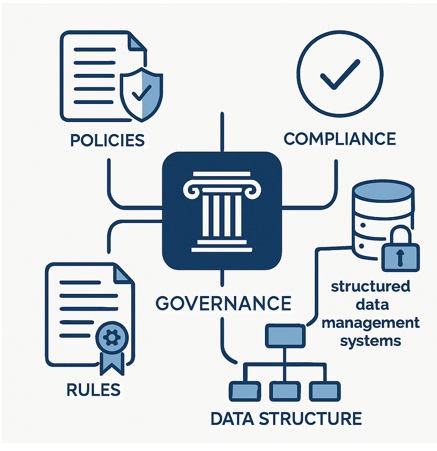
Data governance consulting has become a critical service for organizations aiming to manage their data as a trusted and strategic asset. With the explosion of digital transformation, businesses generate massive volumes of structured and unstructured data every day. Without proper governance, this data can quickly turn into a liability—leading to compliance risks, inefficiencies, and even reputational damage.
Read the article to know more about data governance programs and their frameworks, and how they impact data explosion and digital transformation.
The main focus of data governance is on maintaining and perfecting the data quality, ensuring data sequestration so that everyone’s sequestration is defended, and enabling decision-making through proper data, which helps in reducing pitfalls.
Objectives of data governance
- Ensures delicacy, thickness, absoluteness, and trustworthiness of data across the association.
- It protects the company’s sensitive information, such as combinations & accessions, so that it isn’t shared with everyone.
- It helps in making informed opinions that are informed by accurate data.
- It helps minimize pitfalls related to data misuse, data theft, duplication, and inefficiencies.
Steps to implement data governance strategies
- Step 1: Analyze current data maturity.
- Step 2:Define applicable pretensions and compass.
- Step 3: Establish governance structure (places, panels).
- Step 4: Develop programs, norms, and criteria.
- Step 5: Emplace enabling technologies.
- Step 6: Examine, measure, and continuously ameliorate.
There are various data management frameworks used, like DAMA-DMBOK, COBIT, EDM Council’s DCAM, ISO standards, and many more, with the main purpose of managing data.
Managing data also plays an important role in policy development for the company.
Challenges in data governance
- It at times becomes difficult and tedious to balance security and accessibility of data. As it requires time to access secured data.
- Data governance is an expensive process.
- Data governance, at times, lacks the ability to manage large and unstructured data.
Unborn trends in data governance
- Cloud-grounded Data Governance—These days, associations are espousing cloud platforms and distributed infrastructures like data mesh, taking flexible, scalable cloud-grounded governance fabrics that maintain data veracity, usability, and security across all environments. If any type of data is stolen, it can be recovered from cloud data easily.
- AI and Machine Learning Integration – with the advent of technology, AI/ML technologies are becoming central to data governance, as they can detect major changes easily, it can conduct data quality checks regularly, be used in data mapping, and prevent security breaches.
- Real-Time Data Governance—With the increase in streaming, the use of real-time data is being used to make informed decisions while ensuring compliance, along with security as well.
Conclusion
Eventually, data governance programs and structures are essential to guarantee that an organization’s information is accurate, secure, accessible, and handled in a harmonious manner throughout. They define unequivocal programs, places, and procedures that allow for the effective running of data as a precious asset. specially, good data governance isn’t a one-off design to be carried out but is a day-to-day organizational practice that requires harmonious commitment, shadowing, and rigidity to alter business requirements, and it’s nonstop.
Businesses must attack data governance as an enduring program, investing in chastened technologies and fabrics that allow sustainable data compliance and value creation. In this way, organizations will have the ability to facilitate improved decision-making, facilitate trust in data, and stay competitive in the data-driven economy.
FAQ
What is data governance consulting?
Data governance consulting is a professional service that helps organizations establish, manage, and optimize their data governance strategies. Consultants provide frameworks, policies, and best practices to ensure data quality, security, privacy, and compliance. They guide businesses in aligning governance structures with business goals while ensuring regulatory adherence.
Why is data governance consulting important?
Data governance consulting is essential because organizations today handle massive volumes of structured and unstructured data. Without governance, this data can become fragmented, unreliable, or vulnerable to security breaches. Consulting ensures that:
- Data remains accurate, consistent, and trustworthy.
- Sensitive data is protected from misuse or theft.
- Policies and procedures align with global standards like DAMA-DMBOK, COBIT, and ISO.
- Companies can make data-driven decisions that reduce risks and improve efficiency.
What steps do data governance consulting firms recommend?
Most consulting firms use a structured approach similar to the following six steps:
- Analyze Current Data Maturity – Assess how well data is currently managed.
- Define Goals and Scope – Identify governance objectives tailored to business needs.
- Establish Governance Structure – Assign roles, responsibilities, and decision-making bodies.
- Develop Policies and Standards – Set rules for data usage, security, and compliance.
- Deploy Technology Solutions – Implement tools for monitoring, cataloging, and securing data.
- Measure and Improve Continuously – Audit processes and refine strategies over time.
These steps provide a roadmap for building a sustainable governance framework.
What challenges does data governance consulting address?
Consultants help businesses overcome common challenges, including:
- Balancing Security and Accessibility – Ensuring data is secure but not overly restricted.
- Cost Management – Implementing governance without excessive expenses.
- Handling Big Data – Managing vast, unstructured data sets effectively.
- Cultural Resistance – Convincing teams that governance is not a burden but a business enabler.
By providing tailored strategies, consultants enable organizations to strike the right balance between protection and usability.
How does technology support data governance consulting?
Technology plays a vital role in consulting-led governance strategies. Tools like data catalogs, AI-driven monitoring systems, and real-time dashboards enhance visibility and security. Consultants often recommend cloud-based governance platforms, which provide scalability and resilience, ensuring that data remains compliant and recoverable even during breaches.
6. What are the future trends in data governance consulting?
Emerging trends shaping the consulting industry include:
- Cloud-Based Data Governance – Growing reliance on cloud platforms for scalability.
- AI and Machine Learning Integration – Automating data quality checks and anomaly detection.
- Real-Time Data Governance – Using streaming data for instant decision-making and compliance.
Consultants increasingly leverage these trends to future-proof governance programs for their clients.
How does data governance consulting add business value?
Consulting transforms data from a liability into a strategic asset. By ensuring accuracy, trust, and compliance, organizations can:
- Improve decision-making with reliable data.
- Strengthen stakeholder and investor confidence.
- Enhance compliance with regulations like GDPR and BRSR.
- Reduce risks associated with breaches or misuse.
Ultimately, consulting builds long-term competitiveness by aligning governance with digital transformation strategies.
References
- J. Holdsworth and M. Kosinski, “What Is Data Governance?” IBM Think, 20 Sept. 2024. [Online]. Available: https://www.ibm.com/think/topics/data-governance. [Accessed: 1 Sept. 2025].
- A. Anand and P. Suman, “Global and Industry Frameworks for Data Governance,” PwC India, [Online]. Available: https://www.pwc.in/consulting/technology/data-and-analytics/govern-your-data/insights/global-and-industry-frameworks-for-data-governance.html. [Accessed: 1 Sept. 2025].
- Informatica Inc., “4 Pillars of a Successful Data Governance Framework,” [Online]. Available: https://www.informatica.com/resources/articles/data-governance-framework.html. [Accessed: 1 Sept. 2025].
Penned by Mehak Behl
Edited by Seema Acharya, Research Analyst
For any feedback mail us at info@eveconsultancy.in
Finance made simple, fast, and fun! 🏦💡 Sign up for your daily dose of financial insights delivered in plain English. In just 5 minutes, you’ll be smarter already!
Simplify Your Business Compliance with Eve Consultancy
Eve Consultancy is your trusted partner for end-to-end compliance services, including Company Incorporation, GST Registration, Income Tax Filing, MSME Registration, and more. With a quick and hassle-free process, expert guidance, and affordable pricing, we help businesses stay compliant while they focus on growth. Backed by experienced professionals, we ensure smooth handling of all your legal and financial requirements. WhatsApp us today at +91 9711469884 to get started.