
Topic: Cyber Strategy Games, Risk Awareness
Introduction
Nowadays, where everything is interconnected to an extreme degree, the threats to cybersecurity have turned into a never-ending problem that organizations of any size have to deal with. The conventional awareness programs usually do not manage to involve the staff or the managers practically, thus there are always some understanding and preparation gaps. Cyber strategy simulation consulting and scenario-based training have become a big help in overcoming this problem, as they are now regarded as prominent instruments for the creation of awareness and the enhancement of resistance.
Traditionally, training uses methods like lectures or unchanging modules that usually have difficulty maintaining the interest of the participants and may also not adequately represent the intensity of a real-world situation. Consequently, the trainees might not remember important learning points or even recite the correct reaction during a real performance of a cyber attack.
6 Insights You Must Know about the Cyber Strategy Games for Risk Awareness
What Are Cyber Strategy Games?
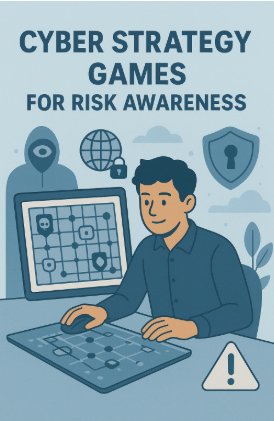
Cyber strategy games deeply engage players with lifelike situations in which they have to manage a cyberattack as it happens. Such games employ the techniques of role-playing, attack simulation, and collaborative decision-making to create the same crisis dynamics.
For the management and IT Department, the advantages have a double aspect: along with the technical knowledge on threat management, they also become familiar with the interaction, coordination and prioritization problems which are typical of a real incident. This helps to bring the two worlds of technical specialists and business leaders closer.
Role of Cyber Strategy Simulation Consulting
Organisations are usually looking for custom strategies and are becoming frequent clients of cyber strategy simulation consulting services. The consultants create bespoke simulations that are logical reflections of risks, rules, and the company’s structures related to particular industries.
Scenario-Based Training Approaches
Scenario-based training is one of the key features of these simulations. What distinguishes the new approach from the traditional one is that participants will not be taught in a generalized way, but rather be provided with specific situations like DDoS attacks, social engineering, or supply chain breaches to practice.
Advantages of Experiential Learning
Scenario-based methods will increase knowledge storage in the brain to a greater extent than regular teaching. The hands-on character of the tasks keeps the participants involved at all times, which not only improves memory but also enables coordination to be practised in a stressful situation.
Organizational Benefits of Cyber Strategy Games
Implementation of cybersecurity simulation games and simulation advisory can bring the organizations multiple measurable benefits. Among such benefits are enhanced resistance to threats, fostering a security culture that is more engaging and lowering the downtime and financial losses by revealing the weak points before the hackers take advantage of them.
Contribution to Long-Term Strategic Planning
Simulations not only support immediate readiness but also impact future planning. Through outcome analysis, organizations are able to enhance their policies, utilise their resources efficiently, and even make cybersecurity a part of their bigger risk management program.
Conclusion
With the increasing complexity of cyber threats, organizations need to move past the usual awareness programs to create genuine resilience. Cyber strategy simulation, consulting and scenario-based training provide an interactive and stimulating way to enhance the decision-making, collaboration, and readiness of the organization.
References
[1] K. L. Gutzwiller, C. J. Fugate, and J. P. Sawyer, ‘Designing cybersecurity exercises for critical infrastructure protection,’ IEEE Security & Privacy, vol. 18, no. 4, pp. 47–55, Jul.-Aug. 2020.
[2] N. Robinson, L. Valeri, and T. Walczak, ‘Cybersecurity training and awareness through serious games,’ Journal of Information Security, vol. 13, no. 2, pp. 77–92, 2019.
[3] R. Al-Shaer, ‘Security games for risk management,’ in Proc. IEEE Conf. Communications and Network Security (CNS), San Francisco, CA, USA, 2019, pp. 1–9.
FAQ Section: Cyber Strategy Games for Risk Awareness
1. What are cyber strategy games?
Cyber strategy games are interactive simulations where participants face lifelike cyberattacks, practicing response, coordination, and decision-making in real time.
2. How do cyber strategy games improve risk awareness?
They immerse employees in realistic attack scenarios, helping them understand threats better and react quickly during actual incidents.
3. Who should participate in cyber strategy games?
Both IT specialists and business leaders benefit, as the games bridge technical defense skills with executive decision-making.
4. How are cyber strategy games different from traditional training?
Unlike lectures or static modules, these games are dynamic, role-based, and scenario-driven, making learning more engaging and memorable.
5. What role does simulation consulting play in cyber strategy games?
Consultants design custom games aligned with industry risks, regulatory requirements, and organizational structures.
6. Can cyber strategy games cover different types of cyberattacks?
Yes, simulations can include DDoS, phishing, ransomware, insider threats, or supply chain breaches.
7. Why is experiential learning important in cyber strategy games?
Hands-on learning improves memory retention, boosts engagement, and helps participants stay calm under real-world pressure.
8. How do cyber strategy games benefit an organization?
They strengthen resilience, foster a strong security culture, reduce downtime, and help detect weak points before hackers exploit them.
9. Do cyber strategy games support teamwork?
Yes, they encourage collaboration, communication, and prioritization, which are critical during cyber crisis management.
10. Are cyber strategy games suitable for small organizations?
Absolutely. Simulations can be scaled to fit different business sizes and budgets, offering tailored risk preparedness.
11. How often should cyber strategy games be conducted?
Ideally, organizations should conduct them at least annually or whenever major risks, technologies, or policies change.
12. Do cyber strategy games provide measurable results?
Yes, outcome analysis identifies strengths, weaknesses, and areas for policy improvement, supporting data-driven decision-making.
13. How do cyber strategy games support long-term planning?
Insights from simulations help refine cybersecurity strategies, allocate resources, and integrate security into enterprise risk management.
14. Can cyber strategy games reduce compliance risks?
Yes, by preparing employees to follow correct protocols, they help organizations meet regulatory and legal requirements.
15. Why should organizations adopt cyber strategy games now?
With cyber threats growing more complex, these games offer an engaging, future-ready way to enhance readiness and protect business reputation.
Penned by Harshit Agarwal
Edited by Shashank Khandelwal, Research Analyst
For any feedback mail us at info@eveconsultancy.in
Finance made simple, fast, and fun! 🏦💡 Sign up for your daily dose of financial insights delivered in plain English. In just 5 minutes, you’ll be smarter already!
Simplify Your Business Compliance with Eve Consultancy
Eve Consultancy is your trusted partner for end-to-end compliance services, including Company Incorporation, GST Registration, Income Tax Filing, MSME Registration, and more. With a quick and hassle-free process, expert guidance, and affordable pricing, we help businesses stay compliant while they focus on growth. Backed by experienced professionals, we ensure smooth handling of all your legal and financial requirements. WhatsApp us today at +91 9711469884 to get started.