
Cross-Border Data Transfers: How to Remain Compliant without Being Treacherous to People’s Trust?
With the era of globalisation, data travels as far as we do. With one click, your data can be in Berlin, New York, or Singapore—while you are still stationed in Delhi. That is how businesses are run nowadays. However, when data is being transferred from one border to another, it does not travel along with information only. It travels with responsibility. That is where cross-border data compliance and world data privacy protection come in.
Wait a Minute, What in the World Is a Cross-Border Data Transfer?
Consider the following: your business gathers customer data in India but stores it on a U.S. cloud server. That’s cross-border data transfer. Sounds obvious—but beneath the surface, there are other countries with different privacy laws. Some are very strict (such as the EU’s GDPR), some are trying to develop them (such as India’s DPDP Act), and some are. Well, still working on it.
The question is: How is data secured after it leaves the country?
Legal Mechanisms to Keep It Clean (and Secure)
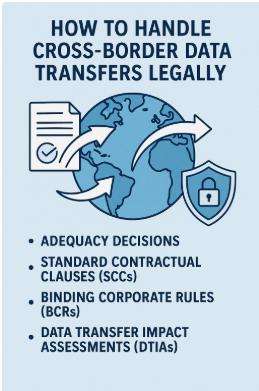
The good news is that we’re not working in a vacuum. There are some helpful legal mechanisms that get firms moving data both legally and securely. Here are the most common ones:
- Adequacy Decisions
Some states are deemed “safe” by data authorities, so you can send data there without further approvals.
- Standard Contractual Clauses (SCCs)
These are contracts between sender and receiver that read, “Hey, we vow to get our shoulders under this information-even if our country’s laws aren’t so great.”
- Binding Corporate Rules (BCRs)
Implemented by big companies with locations all over the globe, BCRs provide a single set of privacy protocols worldwide.
- Data Transfer Impact Assessments (DTIAs)
It’s like an Airport Security Check: you scan the potential dangers of routing it somewhere else before routing data.
Now, Let’s Discuss the Real Reason This Is Important: People
There’s a human being on the other side of each piece of data. A human being who shared their name, email address, or possibly even their health information with you. So, certainly, adhering to the law is important, but cross-border privacy protection is actually about being considerate of people. Here’s how to make your strategy more human:
- Be transparent: Tell users where their data is going and why. No doublespeak.
- Ask first: Obtain positive consent. It’s not only the law—it’s the right thing to do.
- Return control: Let individuals acquire, modify, or erase their data if they desire.
- Stay informed: Legislation changes fast. Maintain trained personnel and updated policies.
Things to Watch Out For
- Laws are always changing: Next week’s unlawfulness is this week’s lawfulness. Keep up.
- Third-party tools could land you in trouble: Make your suppliers privacy-friendly as well.
- Some nations like information to remain at home: Prepare yourself for localisation laws that can restrict where you store information.
Conclusion
International data transfers are not a technology problem—they’re a trust test. If you’re going to have individuals around, you need to communicate that you care about how they handle their information, regardless of where they direct it. Being serious about cross-border data compliance isn’t about being aware of how not to cause problems—it’s being the sort of company that you’d naturally want to trust. And in a world where data privacy is increasingly being talked about every day, that’s the sort of company everybody wants to trust.
So the next time you’re transferring data across borders, don’t simply accept, “Is this legal?”
Accept, accept, “Is this respectful?”
That is the logic that makes a real, effective worldwide privacy possible.
FAQs : How to Handle Cross-Border Data Transfers Legally?
Q1: What are Cross-Border Data Transfers?
Cross-Border Data Transfers refer to the movement of personal or business data from one country to another for processing, storage, or sharing.
Q2: Why are Cross-Border Data Transfers important?
Cross-Border Data Transfers are essential for global business operations, remote collaboration, cloud computing, and data-driven services.
Q3: Are Cross-Border Data Transfers legal?
Yes, Cross-Border Data Transfers are legal if they comply with relevant data protection laws and obtain appropriate consent or safeguards.
Q4: Which laws regulate Cross-Border Data Transfers?
Laws like the GDPR (EU), CCPA (California), and India’s DPDP Act regulate how Cross-Border Data Transfers must be handled securely and legally.
Q5: What is the role of GDPR in Cross-Border Data Transfers?
Under GDPR, Cross-Border Data Transfers must meet specific safeguards such as standard contractual clauses or adequacy decisions.
Q6: What are standard contractual clauses (SCCs)?
SCCs are legal templates approved by regulatory authorities to ensure Cross-Border Data Transfers meet privacy standards when no adequacy decision exists.
Q7: What is an adequacy decision in Cross-Border Data Transfers?
An adequacy decision means a non-EU country provides a comparable level of data protection, allowing data to be transferred freely.
Q8: How can companies legally manage Cross-Border Data Transfers?
Companies can use legal contracts, data protection agreements, Binding Corporate Rules (BCRs), and ensure compliance with local regulations.
Q9: What are Binding Corporate Rules (BCRs)?
BCRs are internal policies approved by regulators that allow multinational companies to conduct Cross-Border Data Transfers within the same corporate group.
Q10: What risks are involved in Cross-Border Data Transfers?
Risks include data breaches, loss of control, surveillance by foreign governments, and non-compliance with data protection laws.
Q11: Can cloud services lead to Cross-Border Data Transfers?
Yes, cloud storage often involves Cross-Border Data Transfers since data is hosted in servers across multiple countries.
Q12: Is user consent necessary for Cross-Border Data Transfers?
In many jurisdictions, user consent is required or strongly recommended before conducting Cross-Border Data Transfers.
Q13: How can organizations ensure safe Cross-Border Data Transfers?
By conducting risk assessments, using encryption, updating privacy policies, and complying with international transfer mechanisms.
Q14: What happens if Cross-Border Data Transfers violate data laws?
Companies may face heavy fines, reputational damage, or legal action if Cross-Border Data Transfers breach applicable regulations.
Q15: Are Cross-Border Data Transfers relevant to small businesses?
Yes, even small businesses using international SaaS tools or remote teams must comply with Cross-Border Data Transfers laws.
Penned by Nitya Gosain
Edited by Shashank Khandelwal, Research Analyst
For any feedback mail us at info@eveconsultancy.in
Finance made simple, fast, and fun! 🏦💡 Sign up for your daily dose of financial insights delivered in plain English. In just 5 minutes, you’ll be smarter already!
Simplify Your Business Compliance with Eve Consultancy
Eve Consultancy is your trusted partner for end-to-end compliance services, including Company Incorporation, GST Registration, Income Tax Filing, MSME Registration, and more. With a quick and hassle-free process, expert guidance, and affordable pricing, we help businesses stay compliant while they focus on growth. Backed by experienced professionals, we ensure smooth handling of all your legal and financial requirements. WhatsApp us today at +91 9711469884 to get started.