
Top Tax-Saving Strategies for
Companies minimizing your tax burden
The income tax paid by domestic companies, and foreign companies on their income in India is known as corporate income tax (CIT). It is a specific rate, prescribed by the Income Tax Act subject to the changes in the rates in the union budget every year.
Corporate Tax Planning is essential for companies aiming to minimize their tax burden and ensure financial efficiency. In India, corporate income tax (CIT) applies to both domestic and foreign companies, as outlined by the Income Tax Act.
A business is treated as a separate and independent legal entity from its shareholders. Domestic as well as foreign companies are liable to pay corporate tax under the Income-tax Act. While a domestic company is taxed on its universal income, a foreign company is only taxed on the income earned within India i.e. is being accrued or received in India
The corporate income tax (CIT) rate applicable to an Indian company and a foreign company for the tax year 2025/26 is as follows:
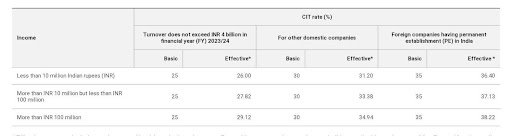
(Image source: PWC)
The tax deduction is allowable for corporate engaged in the specified business, this is done with the purpose of promotion and growth of those industries providing incentives to entrepreneurs and investors to invest in those industries:
- Integrated businesses who involve handling, storage, and transportation of food grains.
- Businesses involved in commercial production or refining of mineral oils.
- Processing, preservation, and packaging of fruits or vegetables.
- Operating and managing a hospital in a rural area.
But these are applied to some specific industries that do for a specific period of time. Therefore, companies need to opt for a certain strategy for tax saving, this is done through corporate tax planning.
Figure 1: Top Reasons Startups Fail (Source: CB Insights)


What is corporate tax planning?
In effective financial management of business corporate tax planning plays a pivotal role, it involves a strategic method to minimize the tax liability of a company in compliance with the legal standards.
Corporate tax planning involves structuring and analysing a company’s financial position in such a way that we can achieve tax efficiency.
In the sections that follow, we’ll go over the top strategies for entrepreneurs to save money on business taxes.
- Income Deferral: Income deferral is a tax planning strategy where businesses postpone or advance recognizing the income to a future financial year rather than reporting it in the current year. This allows the company to delay tax liabilities which results in lower tax payments
- Expense repayment: Also known as expense reimbursement, where company reimburses the expenses incurred by employees, partners or contractors on the company from their own pocket. These are not treated as taxable income. This can be considered as one of the best options of business tax savings methods.
- Transfer pricing: Transfer pricing is a technique used by multinational corporations to shift profits out of the countries where they operate and into the countries with their subsidiaries to get advantage of different tax jurisdiction. In this method, the company charges prices from one division to another division for providing the goods and services. This method helps reduce tax liability in legal terms, helping in business saving their taxes.
- Tax exempt investments: This involves investing in securities which provide tax exemptions. For this make sure your portfolio involves securities which legally provide tax rebates reducing your tax liability further.
- Use accelerated methods (like Section 179 or bonus depreciation in the U.S.) to write off capital expenditures faster. Corporate tax planning also involves depreciation maximization.
Meaning: Accelerated depreciation is a depreciation method in which a capital asset reduces its book value at a faster rate than it would using traditional depreciation methods such as the straight-line method. This helps in Lowering the taxable income in the short term, improving cash flow and allowing reinvestment. - Research & Development (R&D) Tax Credits: deductions or credits for qualified R&D expenses. Meaning: Incentives or tax credits for R&D activity is when companies can claim complete, partial, or extra deductions on the expenses they incurred for scientific research and development. Businesses can benefit by claiming research and development tax deduction under section 35 of the Income Tax Act. This encourages innovation while reducing tax liability significantly.
Conclusion
The above strategies for corporate tax planning contain all the options businesses can opt for tax savings. Incorporating these strategies will significantly reduce the tax burden, leaving a substantial portion of resources available for growth and innovation. One thing every entrepreneur should keep in mind is to implement corporate tax planning strategies from the initial stages of their business. With these available funds, businesses can further invest in their business for expanding their operations, and facilitating expansion.
References
- https://taxjustice.net/faq/what-is-transfer-pricing/
- https://www.investopedia.com/terms/t/transfer-pricing.asp
- https://www.bajajfinserv.in/corporate-tax-planning
- https://www.taxscan.in/how-tax-credits-and-incentives-work-on-indian-corporates/364451
FAQ Section: Corporate Tax Planning
Q1: What is Corporate Tax Planning and why is it important?
Corporate Tax Planning is the legal process of arranging a company’s finances to minimize tax liability. It improves cash flow, ensures compliance, and boosts profits.
Q2: How can Corporate Tax Planning reduce business expenses?
Through deductions, exemptions, and smart investments, Corporate Tax Planning helps reduce taxable income, lowering the overall tax burden.
Q3: Is Corporate Tax Planning legal in India?
Yes, Corporate Tax Planning is legal if done within the framework of the Income Tax Act and avoids tax evasion.
Q4: What are the top Corporate Tax Planning strategies in 2025?
Strategies include income deferral, expense reimbursement, R&D tax credits, accelerated depreciation, and tax-exempt investments.
Q5: What is income deferral in Corporate Tax Planning?
Income deferral delays recognizing income to future financial years, reducing current tax liability and improving cash flow.
Q6: How do companies benefit from R&D tax credits?
R&D credits reduce taxable income for companies investing in innovation. It’s a vital part of Corporate Tax Planning.
Q7: What role does accelerated depreciation play in tax savings?
Accelerated depreciation helps companies write off capital expenditures faster, a common tool in Corporate Tax Planning.
Q8: Are tax-exempt investments useful in Corporate Tax Planning?
Yes, investing in government bonds or eligible securities can offer tax exemptions, helping optimize Corporate Tax Planning.
Q9: How can transfer pricing be a tax-saving method?
Transfer pricing allows multinationals to allocate profits in low-tax regions legally, a key tactic in Corporate Tax Planning.
Q10: What documents are needed for effective Corporate Tax Planning?
Maintain accurate financial records, expense reports, investment details, and tax filings to support Corporate Tax Planning.
Q11: Can small businesses benefit from Corporate Tax Planning?
Absolutely. Even small companies can reduce liabilities and reinvest savings through proper Corporate Tax Planning.
Q12: When should Corporate Tax Planning be implemented?
Ideally, it should be applied from the early stages of a business to maximize long-term benefits.
Q13: Does Corporate Tax Planning affect business valuation?
Yes, efficient Corporate Tax Planning improves financial health, positively impacting a company’s valuation.
Q14: Who should handle Corporate Tax Planning for your business?
Hire a certified tax advisor or financial expert who understands corporate laws to ensure effective Corporate Tax Planning.
Q15: What are the risks of poor Corporate Tax Planning?
Neglecting Corporate Tax Planning can lead to penalties, cash shortages, and missed growth opportunities.
Penned by Indrakshi Singh
Edited by Ragi Gilani, Research Analyst
For any feedback mail us at info@eveconsultancy.in
Finance made simple, fast, and fun! 🏦💡 Sign up for your daily dose of financial insights delivered in plain English. In just 5 minutes, you’ll be smarter already!
Simplify Your Business Compliance with Eve Consultancy
Eve Consultancy is your trusted partner for end-to-end compliance services, including Company Incorporation, GST Registration, Income Tax Filing, MSME Registration, and more. With a quick and hassle-free process, expert guidance, and affordable pricing, we help businesses stay compliant while they focus on growth. Backed by experienced professionals, we ensure smooth handling of all your legal and financial requirements. WhatsApp us today at +91 9711469884 to get started.