
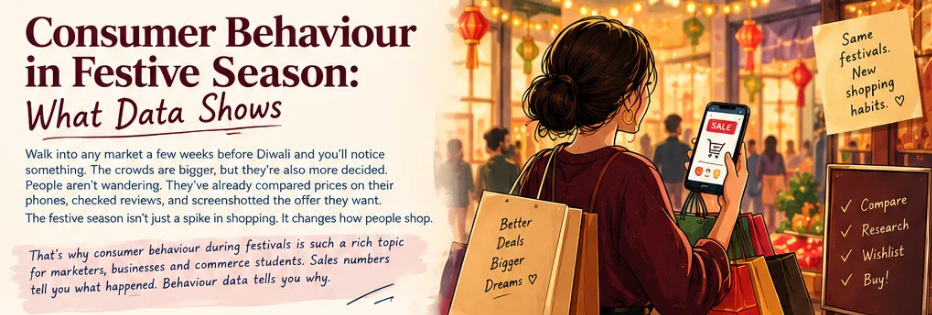
Walk into any market a few weeks before Diwali and you’ll notice something. The crowds are bigger, but they’re also more decided. People aren’t wandering. They’ve already compared prices on their phones, checked reviews, and screenshotted the offer they want. The festive season isn’t just a spike in shopping. It changes how people shop. That’s why consumer behaviour during festivals is such a rich topic for marketers, businesses and commerce students. Sales numbers tell you what happened. Behaviour data tells you why. Here’s what the patterns point to, and what they mean for festive buying strategy.
Here’s what the patterns point to, and what they mean for festive buying strategy.
How Consumer Behaviour Changes During the Festive Season
Festive seasons influence more than how much people spend. They change when people shop, what they buy, how they compare prices, and what influences their decisions. From early planning and emotional gifting to discounts and flexible payments, consumer behaviour reflects a mix of psychological, social and economic factors.
Planning Starts Earlier Than You Think
Understanding consumer behaviour helps businesses predict festive shopping patterns.
Festive shopping no longer begins in the final week. Browsing and wishlisting start weeks ahead, and big purchases like phones, appliances and furniture are often researched long before any sale goes live. Shoppers watch prices, add items to carts, and wait for the right moment.
For brands, this means the real competition starts at the research stage. By the time the festival arrives, many buyers have already narrowed their choices to two or three options.
Online and Offline Aren’t Opposites Anymore
A common pattern is that people research online and buy in a store, or see something in a store and order it online. Shoppers move between both without thinking about it. Many still prefer to touch, try or see high-value items in person, even when they end up paying digitally.
So the useful question isn’t “online or offline?” It’s “how do these two work together for the customer?” Businesses that connect them, with clear pricing, easy pickup and consistent offers, tend to win trust.
Discounts Matter, But Not the Way You’d Expect
Consumer behaviour during festive sales is influenced by both perceived value and emotional triggers.
Festive shoppers are deal-sensitive, no doubt. But the data on consumer psychology suggests it’s not only about the lowest price. Limited-time offers, bundles, cashback, exchange deals and “extra off” banners all trigger a sense of urgency and fairness. People want to feel they got a smart deal, not just a cheap one.
This is where behavioural concepts show up in real life: anchoring (the crossed-out original price), scarcity (only a few left), and loss aversion (the fear of missing the offer). Commerce students will recognise all three from their textbooks.
Easy Payment Changes What People Buy
EMIs, no-cost financing, buy-now-pay-later options and UPI have made big purchases feel more manageable. When the monthly payment looks small, shoppers often stretch toward a better model or a higher-priced product.
This feeds the wider trend of premiumisation, where people spend a bit more on quality during festivals, especially for gifts, home upgrades and electronics. At the same time, budget-conscious shoppers use the same season to buy what they’ve postponed all year. Both behaviours exist side by side.
Smaller Cities Are Part of the Story
Festive demand is no longer concentrated in metros. Reports from retailers and e-commerce platforms regularly highlight strong growth from smaller cities and towns, helped by better delivery networks, mobile access and regional-language shopping interfaces.
For marketers, this means one message won’t fit everyone. Language, local festivals, price points and trust signals vary, and brands that adapt to them connect better than those that copy-paste a metro campaign.
Gifting, Emotion and Habit
Festivals are emotional. A big share of spending goes to gifts, home décor, clothes, sweets and family celebrations. Purchases are driven by tradition, relationships and a sense of occasion as much as by need.
This explains why festive advertising leans on stories, family moments and nostalgia. Emotion drives the decision, and logic (price, features) often justifies it afterwards. It’s also why quick delivery and good packaging matter more around gifts.
What Businesses Can Learn
Analysing consumer behaviour allows brands to create more effective festive marketing campaigns.
Start early. Be visible during the research phase, not just the buying phase.
Connect channels. Make online and offline feel like one experience.
Keep offers clear. Confusing deals erode trust faster than small discounts build it.
Offer flexible payments. Easy finance often decides a close call.
Localise. Language and regional context matter outside the big cities.
Deliver on time. A late festive gift can cancel out all your marketing.
Why This Topic Belongs in Commerce Classrooms
Festive-season behaviour is a ready-made case study. It brings together psychology, pricing, marketing strategy, supply chain and digital payments in one live example. That’s why behaviour studies increasingly feed into marketing and commerce courses.
Students can learn much more by working with real material: compare festive campaigns from different brands, analyse how a single platform structures its sale, or survey friends and family about how they plan festive purchases. Connecting theory to something they’ve personally experienced makes it stick.
FAQs
Why does consumer behaviour change during festivals?
Emotion, tradition, gifting and limited-time offers all push people to buy more and decide faster than usual.
Do shoppers prefer online or offline during festivals?
Most use both. They research in one place and buy in another, depending on the product and convenience.
Are discounts the only thing that drives festive buying?
No. Trust, convenience, payment options, brand reputation and emotional connection play a big role too.
How can students study festive consumer behaviour?
Through case studies of festive campaigns, small surveys, and by applying concepts like anchoring, scarcity and loss aversion to real sales.
Why does festive behaviour matter for marketing courses?
It shows theory in action, from pricing psychology to channel strategy, using an example students already know.
Final Thoughts
Festive-season buying looks chaotic from the outside, but the patterns are consistent: people plan earlier, blend online and offline, respond to smart offers, and buy with emotion. Brands that understand this earn trust. Students who study it learn how markets really work. At Eve Consultancy, we help businesses, institutions and learners turn consumer insights into practical strategy and career-ready skills.