
The growing importance of soft skills cannot be underestimated. It has been suggested in a LinkedIn survey that 92% of professionals dealing with talent and hiring managers think that strong soft skills are either equally important or more important than hard skills. While technical skills may get candidates in the door, it is their ability to communicate, collaborate, and adapt that assures their growth and effectiveness in the organization.
In sectors such as consulting, customer service, health, and education, communication skills can directly affect client satisfaction and business outcomes.
2 Types of Video Assessments
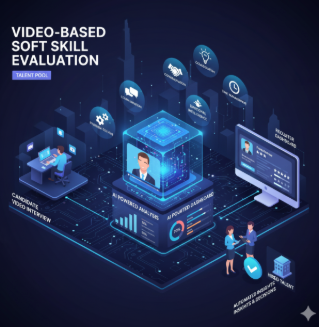
Video assessments are used to record either live or recorded responses of a given candidate. Usually, recruiters ask a pre-set number of questions or present scenarios to the applicants to be responded to via video with a time limit. AI and human evaluators then assess ways in which these responses were given, such as tone of voice and clarity, confidence, empathy, and overall communication.
The two predominant types of video assessment are:
- Asynchronous (Pre-Recorded): This involves recording answers at the candidate’s convenience and later reviewing them by recruiters. This type is flexible and affords the screening of large applicant pools.
- Synchronous: Allowed in real-time live video interviewing to catch spontaneous responses and interplay, as well as adaptive skills.
A combination of both styles allows for a good blend between efficiency and depth in evaluation.
Benefits of Video-Based Soft Skill Evaluation
Enhanced Objectivity: There can be an objective evaluation because of the use of predetermined questions during video assessment, which minimizes bias.
Scalability: Organizations can screen many hundreds of candidates quickly, thus saving time and costs.
Deeper Insights: They give insights into verbal as well as non-verbal cues that are critical for communication skill evaluation, unlike assessments through text responses.
Open Globally: Recruitment can go beyond borders, allowing flexibility in hiring candidates from many areas.
Improved Candidate Experience: The Ability to record at one’s time of choice has been appreciated by many candidates as it reduces pressure compared to traditional interviews.
Barriers and Pitfalls
But with this method of interview being a game-changer, challenges remain for companies that will have to be resolved before fairness and inclusivity can be achieved:
Technical Issues: Candidates may be at a disadvantage if they lack access to proper internet or good devices; thus, the company must include alternative options whenever applicable.
AI Analysis Bias: Unintended bias from automated systems may arise due to bias in their training data. Therefore, regular audit and human supervision are vital to fairness.
Candidate Comfort: Some candidates may feel uncomfortable recording themselves. Providing practice situations with clear instructions relieves some of this anxious feeling.
How Video Assessments Fit into Hiring
To ensure proper implementation, it is expected that organizations will treat video assessment as a recruitment product and not a stand-alone tool. Some of the best practices include:
Be clear: Say why the assessment is being made and what is intended to happen so that candidates will know what to expect from the process.
Balance Your Assessments: While their importance cannot be downplayed, video assessments should be assessed in conjunction with other measures like scores from technical tests, group discussions, or case studies.
Train Your Recruiters: Train the HR teams to consistently recommend evaluation of communication skills while eliminating bias stemming from unconscious behaviour.
Feedback Mechanism: Giving feedback helps to beautify the market since it shows consideration for the candidates and fosters their experience.
The Future of Video-Based Soft Skill Evaluation
The future of hiring is poised to embrace digital solutions, with video-based assessment taking on more advanced technological sophistication. Through the usage of emerging technologies like Natural Language Processing (NLP), facial recognition, and sentiment analysis, recruiters will discover even greater insights into candidates’ communication skills. Other technologies, such as gamified video simulations and AI-powered behavioural analytics, may soon be engaged in the usual business routine, injected with gamification elements for an engaging and accurate flow.
As industries value adaptability, creativity, and collaboration ever more, video assessments will stay a pillar in the recruitment approach. Those companies that best embrace this approach would then have a competitive edge in attracting and retaining top talent.
Conclusion
Video-based soft skill evaluation is changing how organizations identify talent by looking for the kind of attributes that often slip through the cracks of traditional methods. It allows the additional layer of insight into a candidate’s soft skills development, interpersonal skills, with an emphasis on communication skills, with which an improved decision can be made regarding an individual’s fit for the organizational culture and goals. Despite challenges such as technical barriers and bias, these need to be managed. As recruiting develops, video-based evaluation will play a core role in maximizing the development of a strong, collaborative, and future-oriented workforce.
References
[1] LinkedIn Talent Solutions, “Global Talent Trends 2023,” LinkedIn, 2023. [Online]. Available: https://business.linkedin.com/talent-solutions
[2] Gartner, “Video Assessments in Hiring: Opportunities and Challenges,” Gartner Research, 2023. [Online]. Available: https://www.gartner.com/en/human-resources
[3] HireVue, “The Science Behind Video Interviews,” HireVue Insights, 2022. [Online]. Available: https://www.hirevue.com
[4] Deloitte, “The Future of Work: Digital Hiring Trends 2023,” Deloitte Insights, 2023. [Online]. Available: https://www2.deloitte.com/insights
FAQ’S
1. Why are communication skills important in today’s workplace?
Communication skills are vital because they enable professionals to express ideas clearly, collaborate effectively, and build strong relationships within teams. Good communication also enhances productivity and reduces misunderstandings.
2. How do soft skills differ from hard skills?
Hard skills are technical abilities gained through education or training, while soft skills like communication skills, adaptability, and empathy focus on how a person interacts and works with others.
3. Why do employers value communication skills so highly?
Employers consider communication skills crucial because they directly influence teamwork, client satisfaction, and organizational success. Strong communicators can handle conflicts, lead discussions, and present ideas convincingly.
4. What is a video-based soft skill assessment?
A video-based soft skill assessment is a digital interview method where candidates record or participate in live video sessions to evaluate their communication skills, confidence, and emotional intelligence.
5. What are the main types of video assessments used by recruiters?
There are two main types:
Asynchronous (Pre-Recorded): Candidates record their answers at their convenience.
Synchronous (Live): Real-time interviews that test spontaneous communication skills and adaptability.
6. How do video assessments help evaluate communication skills effectively?
Video assessments allow recruiters to observe both verbal and non-verbal cues, such as tone, clarity, and body language, giving deeper insight into a candidate’s real communication skills.
7. What are the benefits of video-based communication skill evaluation?
Some key benefits include objective scoring, scalability, deeper insights into communication skills, and an improved candidate experience due to flexibility and convenience.
8. Can video assessments help reduce hiring bias?
Yes, video assessments with predefined questions promote fairness and consistency. However, companies should regularly audit AI tools to ensure unbiased evaluation of communication skills and other soft traits.
9. Are there challenges in using video assessments for communication skills?
Yes, issues like technical problems, candidate discomfort, and potential AI bias can arise. Providing support and transparency helps minimize these barriers.
10. How can candidates prepare for a video-based communication skills assessment?
Candidates should practice speaking confidently, maintain good posture, ensure proper lighting, and record mock responses to improve their overall communication skills performance.
11. What industries rely heavily on communication skills?
Sectors such as consulting, education, healthcare, and customer service depend greatly on communication skills since clear interaction directly impacts client satisfaction and business results.
12. How can companies integrate video assessments into their hiring process?
Organizations should use video assessments alongside other evaluation tools, train recruiters to spot strong communication skills, and provide feedback to candidates for a better experience.
13. How do AI tools analyze communication skills in video assessments?
AI tools analyze tone, speech patterns, facial expressions, and emotional cues to gauge confidence, empathy, and overall communication quality in candidate responses.
14. What is the future of communication skill evaluation in recruitment?
The future will involve AI-powered video tools using Natural Language Processing (NLP), sentiment analysis, and gamified simulations to measure communication skills with higher precision.
15. How can improving communication skills enhance career growth?
Strong communication skills lead to better teamwork, leadership opportunities, and faster career advancement. Professionals who communicate well are often seen as confident and reliable assets to their organization
Penned by Tanjal Kapoor
Edited by Reeya Kumari, Research Analyst
For any feedback mail us at info@eveconsultancy.in
Finance made simple, fast, and fun! 🏦💡 Sign up for your daily dose of financial insights delivered in plain English. In just 5 minutes, you’ll be smarter already!
Simplify Your Business Compliance with Eve Consultancy
Eve Consultancy is your trusted partner for end-to-end compliance services, including Company Incorporation, GST Registration, Income Tax Filing, MSME Registration, and more. With a quick and hassle-free process, expert guidance, and affordable pricing, we help businesses stay compliant while they focus on growth. Backed by experienced professionals, we ensure smooth handling of all your legal and financial requirements. WhatsApp us today at +91 9711469884 to get started.