
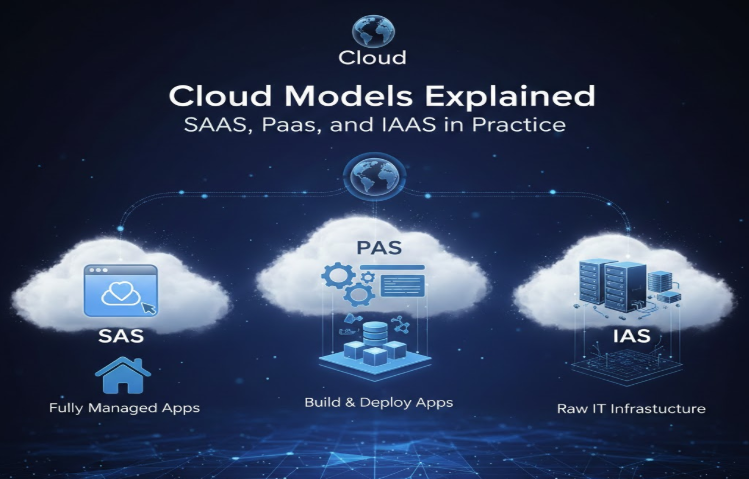
I started learning about cloud computing. I used to see these three terms again and again, SaaS, PaaS, and IaaS. At first, they honestly felt confused and a bit unnecessary. Everything was cloud anyway, right? But after spending some time reading and seeing examples, I realised these cloud models actually explain how cloud services are used.
So instead of thinking too technically, it helps to think about what the user is getting and how much work they still need to do.
What Cloud Models Really Mean
Cloud models are different ways of providing services through the internet. Instead of installing software or buying servers, companies now use online services.
The main idea behind cloud models is responsibility.
- Who manages the software
- Who manages the platform
- Who manages the infrastructure
Based on this we get SaaS, PaaS, and IaaS.
SaaS: The Simplest Cloud Model
SaaS basically stands for Software as a Service. This is the cloud model most people are already using, even if they don’t know the term.
With SaaS:
- You just use the software
- No installation is needed
- Updates are handled automatically
- You don’t worry about servers or storage
Things like email services, online file storage, or meeting apps fall under SaaS.
This cloud model is actually very easy to use. You open the app, log in, and that’s it. Among all cloud models, SaaS is the most convenient and least technical.
PaaS: Meant for Building Things
PaaS basically stands for Platform as a Service. This model is mainly used by developers.
Here, the provider gives a ready platform where applications can be built and tested.
With PaaS:
- You focus on coding
- The platform is already set up
- No need to manage servers
- Development becomes faster
Compared to SaaS, PaaS gives more flexibility. But it still avoids the headache of managing infrastructure. That is why many teams prefer PaaS when they want custom applications.
IaaS: Full Control but More Work
IaaS basically stands for Infrastructure as a Service. This is the most flexible cloud model, but also the most demanding.
With IaaS:
- You get virtual servers and storage
- You decide how everything runs
- You manage security and updates
- You need technical knowledge
This model is usually used by companies that want complete control over their systems. Among cloud models, IaaS gives the most freedom, but also comes with more responsibility.
SaaS PaaS IaaS Compared Simply
If you compare SaaS PaaS IaaS in a simple way:
- SaaS is about using ready software
- PaaS is about building applications
- IaaS is about managing infrastructure
There is no single best option. Different cloud models are useful for different needs. Many organisations actually use a mix of SaaS PaaS IaaS together.
Why Cloud Models Matter
Cloud models have made IT systems easier to manage.
They help organisations:
- Reduce hardware costs
- Scale services easily
- Save time and effort
- Focus on actual work instead of setup
Startups usually begin with SaaS because it is simple. Developers like PaaS because it saves time. Larger organisations use IaaS when they need flexibility.
Understanding cloud models helps in choosing the right service instead of just following trends.
Conclusion
SaaS, PaaS, and IaaS are three important cloud models that explain how cloud services are used. They may sound technical at first, but when broken down, they are quite practical.
Once you understand what SaaS PaaS IaaS actually offer, cloud computing becomes much easier to understand. These cloud models will continue to be a big part of how modern IT systems work.
References
[1] Amazon Web Services, “Types of cloud computing,” Amazon Web Services, 2023. [Online].
Available: https://aws.amazon.com/types-of-cloud-computing/.
[2] Microsoft Azure, “What are SaaS, PaaS, and IaaS?,” Microsoft, 2023. [Online].
Available: https://azure.microsoft.com/en-in/resources/cloud-computing-dictionary/what-are-saas-paas-iaas/.
[3] IBM, “Cloud service models explained,” IBM, 2023. [Online].
Available: https://www.ibm.com/cloud/learn/iaas-paas-saas.
FAQs
1. What are cloud models?
Cloud models are different ways cloud computing services are delivered over the internet, based on responsibility and control.
2. What does SaaS mean in cloud computing?
SaaS (Software as a Service) allows users to access software online without installing or managing it.
3. What is PaaS used for?
PaaS (Platform as a Service) is mainly used by developers to build, test, and deploy applications easily.
4. What is IaaS in simple terms?
IaaS (Infrastructure as a Service) provides virtual servers, storage, and networking with full control for users.
5. How are SaaS, PaaS, and IaaS different?
SaaS offers ready software, PaaS offers a development platform, and IaaS offers complete infrastructure control.
6. Which cloud model is easiest to use?
SaaS is the easiest cloud model because it requires no technical setup or maintenance.
7. Which cloud model gives the most control?
IaaS gives the most control over systems but also requires more technical knowledge.
8. Can companies use multiple cloud models together?
Yes, many organisations use a mix of SaaS, PaaS, and IaaS based on their needs.
9. Why are cloud service models important?
They help organisations reduce costs, scale easily, and manage IT systems efficiently.
10. Are cloud models important for beginners in IT?
Yes, understanding cloud models makes cloud computing easier to learn and use.
Penned by Pranjal Sharma
Edited by Arpita Gupta, Research Analyst
For any feedback mail us at info@eveconsultancy.in
Finance made simple, fast, and fun! 🏦💡 Sign up for your daily dose of financial insights delivered in plain English. In just 5 minutes, you’ll be smarter already!
Simplify Your Business Compliance with Eve Consultancy
Eve Consultancy is your trusted partner for end-to-end compliance services, including Company Incorporation, GST Registration, Income Tax Filing, MSME Registration, and more. With a quick and hassle-free process, expert guidance, and affordable pricing, we help businesses stay compliant while they focus on growth. Backed by experienced professionals, we ensure smooth handling of all your legal and financial requirements. WhatsApp us today at +91 9711469884 to get started.