

Personal career websites are a collection of webpages that can be used to establish one’s online presence and identity. The content and the structure of the personal career websites are focused on a single entity or a single person. The main aim of a personal website is to exhibit your expertise and boost your brand while building trust with your viewers. They prove to be great assets for individual professionals, freelancers, entrepreneurs, etc. They help you make a prominent space in your industry, can significantly increase your revenue, and thus, help you progress in your career. It is needless to say that by building a personal website, you gain more credibility. You can also benefit by playing on various digital marketing techniques like search ads, Search Engine Optimisation (SEO), banner ads, and many more.
Essential Components of a Personal Website
- Homepage: Homepage is the first page that opens up when someone views your website. You should give careful thought to preparing the design of your homepage to make a strong first impression. It should have a summary of the work you do and the services that you offer.
- About me Page: You can strategically introduce yourself on this page by sharing your personal journey, skills, and achievements. Through this page, you get your chance to leave a good impression on your viewers and make them feel connected with you. You can also add your resume and portfolio to this page.
- Contact Us: Your contact information should be readily available on your site so that your potential clients, collaborators, and employers can get in touch with you if they seem to like your website. It must contain your address, email ID, social media handles and maybe a business phone number.
- Testimonials: Adding testimonials to your website increases your credibility. These can be added in the footers.
- Blog: The content of your blog posts should be relevant and tailored according to your target audience. This not only increases your SEO rankings but also builds trust.
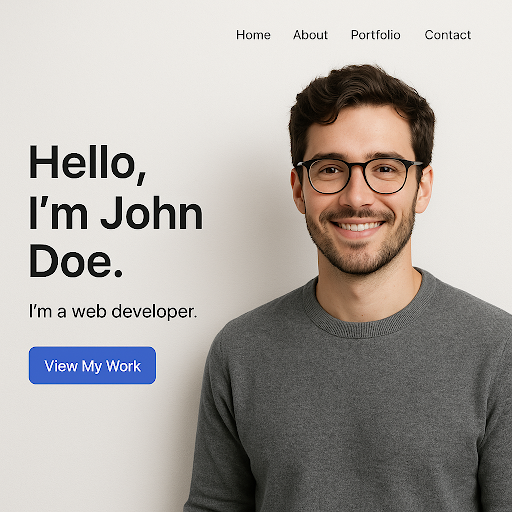
An example of a Personal Website
9 Easy Steps to Build a Personal Website
- Define your purpose: The aim of creating a website must be clear in your mind, which would help you to create a structure that best suits your purpose.
- Search for inspiration: After you have figured out your purpose for building a website, it is now necessary to look at the websites of the leaders of your industry and the people whom you admire. You must try to understand the design and particular content that they have used, which makes them stand out from others. The key is not to copy but to take inspiration only.
- Choose a template style: You should choose a template that suits your purpose, matches your content, and enhances your brand identity. The theme, typography, layout, design, etc., should be carefully chosen for this purpose.
- Tailor your content: The level of engagement on your website is decided by the content that you choose to put up. Add related and relevant content to your website and make sure that it is coherent.
- Customize your design: Another deciding factor for increased engagement is the design of your website. The design should be eye-catching so that your website retains viewers.
- Make it mobile-friendly: The data says that over 62% of the internet traffic comes from mobile devices, which makes it necessary for your website to be pixel-perfect and adaptable to various screen sizes.
- Optimize for SEO: Search engine optimization is used to improve the ranking of your website on search engines. The right set of keywords must be identified and used for this purpose.
- Test before Publishing: Preview your website and check for typos and other errors like broken links. Fix the identified errors and take a third-person opinion for necessary tweaks before publishing.
- Promote your website: Once you hit the “Publish” button, it is now time for you to go ahead and promote it using email marketing, social media handles, business cards, etc.
Conclusion
Personal websites are brilliant tools for personal branding. It helps you build your professional online presence and increases your credibility. Through various strategies discussed above, like choosing the right template, customizing your design, tailoring content, optimizing for SEO, etc., you can easily build a winning personal website.
References
- Curator.io, “10 Key Elements To An Effective Personal Website Design,” [Online]. Available: https://curator.io/blog/personal-website-design
- Shopify, “How To Create a Personal Website in 9 Steps (2025),” [Online]. Available: https://www.shopify.com/blog/personal-website
- Wix, “How To Make a Personal Website: A Step-By-Step Guide,” [Online]. Available: https://www.wix.com/blog/how-to-make-a-personal-website
FAQs
Q1. Why is the Future of Privacy Laws in India important?
The Future of Privacy Laws in India shapes how personal data is protected, ensuring digital trust and compliance for citizens and organizations.
Q2. What role does the Digital Personal Data Protection Act play in the Future of Privacy Laws in India?
It provides the foundation for the Future of Privacy Laws in India, granting rights like access, correction, and deletion of personal data.
Q3. How do Draft Rules 2025 impact the Future of Privacy Laws in India?
The Draft Rules 2025 bring stricter compliance, consent requirements, and data breach reporting, influencing the Future of Privacy Laws in India.
Q4. Why did the recognition of privacy as a fundamental right change the Future of Privacy Laws in India?
The 2017 judgment gave privacy constitutional status, which became the backbone for the Future of Privacy Laws in India.
Q5. What compliance challenges are expected in the Future of Privacy Laws in India?
Stricter audits, security checks, and reporting standards will make compliance central to the Future of Privacy Laws in India.
Q6. How will AI regulation affect the Future of Privacy Laws in India?
AI oversight and risk evaluation will be critical to shaping the Future of Privacy Laws in India.
Q7. How do RBI guidelines contribute to the Future of Privacy Laws in India?
They regulate how banks and financial firms handle sensitive data, directly impacting the Future of Privacy Laws in India.
Q8. How does India’s privacy regulation compare with GDPR in the Future of Privacy Laws in India?
Some rules in the Draft 2025 framework may be stricter than GDPR, reflecting the evolving Future of Privacy Laws in India.
Q9. What penalties are linked to violations in the Future of Privacy Laws in India?
The Future of Privacy Laws in India includes heavy fines for violations, signaling strong enforcement.
Q10. How can companies prepare for the Future of Privacy Laws in India?
Organizations must set up compliance programs, conduct audits, and train employees to adapt to the Future of Privacy Laws in India.
Q11. How will cross-border transfers shape the Future of Privacy Laws in India?
Regulations on cross-border transfers will tighten, protecting citizens’ data and redefining the Future of Privacy Laws in India.
Q12. Why is privacy culture important for the Future of Privacy Laws in India?
A strong privacy culture supports compliance, making the Future of Privacy Laws in India more effective.
Q13. Do startups face challenges in the Future of Privacy Laws in India?
Yes, startups must comply with strict standards, making the Future of Privacy Laws in India both challenging and essential for growth.
Q14. When will Draft Rules 2025 influence the Future of Privacy Laws in India?
Once enforced, these rules will mark a turning point in the Future of Privacy Laws in India.
Q15. What long-term impacts are expected from the Future of Privacy Laws in India?
The Future of Privacy Laws in India will build citizen trust, enhance compliance, and balance regulation with digital innovation.
Penned by Kinjal Bagrecha
Edited by Reeya Kumari, Research Analyst
For any feedback mail us at info@eveconsultancy.in
Finance made simple, fast, and fun! 🏦💡 Sign up for your daily dose of financial insights delivered in plain English. In just 5 minutes, you’ll be smarter already!
Simplify Your Business Compliance with Eve Consultancy
Eve Consultancy is your trusted partner for end-to-end compliance services, including Company Incorporation, GST Registration, Income Tax Filing, MSME Registration, and more. With a quick and hassle-free process, expert guidance, and affordable pricing, we help businesses stay compliant while they focus on growth. Backed by experienced professionals, we ensure smooth handling of all your legal and financial requirements. WhatsApp us today at +91 9711469884 to get started.