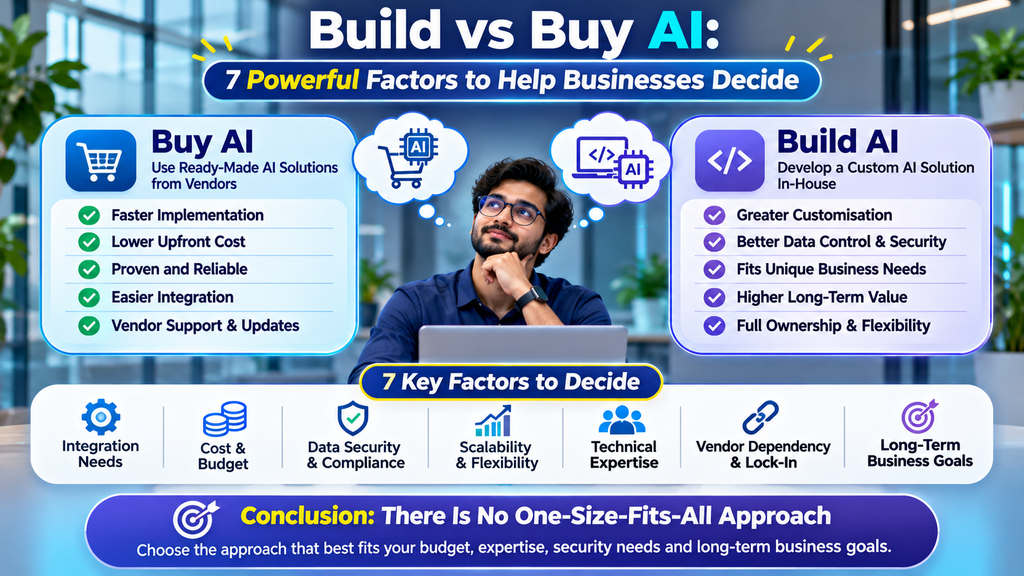
Build vs Buy AI is an important decision for businesses evaluating whether to purchase ready-made AI software or develop customised artificial intelligence systems in-house.
Imagine your boss asking you whether the company should buy an AI system or build one from scratch. And you give a blank expression and saying “Well, it depends on the company and its needs,” but struggle to explain why.
Don’t worry, I’ve got you covered!
In this article, we’ll explore the key factors that help businesses decide whether to purchase AI software from vendors or build their own systems.
More than 75% of enterprises rely on ready-made AI solutions because they are readily available, require lower upfront investment and can be integrated into existing business processes with less time and effort.
However, the right choice depends on how a business plans to use AI.
For a marketing company, AI acts as an operational tool, so buying AI software from vendors can be a practical choice. It can automate content creation and SEO research, improve efficiency and streamline business processes without requiring the company to develop its own technology.
Whereas for a bank like HDFC Bank may prefer building custom AI systems to maintain the confidentiality of customers’ personal information, bank statements and transaction details. This gives the bank greater control over sensitive financial data and helps it meet specific security requirements. AI can help in fraud detection, loan processing and customer support
Build vs Buy AI: 7 Essential Factors Businesses Should Consider
If a ready-made AI solution can automate only one specific task within a business process but cannot handle the entire workflow, buying may not be the most suitable option. In such cases, businesses may consider building a customised AI solution that better meets their overall requirements
Overdependence on Vendors
When a company purchases an AI system, it may become dependent on the vendor for technical support, data integration and software updates. Changes in pricing, features or services can also affect business operations and limit the company’s control over the system.
The Hybrid Approach
Technology-driven companies with highly skilled data scientists, ML engineers and AI enthusiasts can choose a hybrid approach by combining ready-made AI tools with customised in-house solutions. This saves development time and improve operational efficiency.
Benefits of In-House AI Solutions
- Lower Long-Term Costs
Buying AI systems may require lower upfront investment, but lower multiyear subscription fees, licensing charges Developing an in-house solution may help to reduce recurring vendor expenses, although the initial development and maintenance costs can be high.
- Better Data Security
When purchasing AI systems, there may be a risk of exposing sensitive business information to third-party vendors. Building custom AI solutions can provide better control over how sensitive and proprietary information
- Scalability
In-house AI systems can be adjusted according to changing business demand. During off-peak periods, businesses can reduce resource allocation to avoid unnecessary costs. During peak periods, they can scale up their AI systems or use external AI services to handle increased workloads without permanently investing in additional infrastructure.
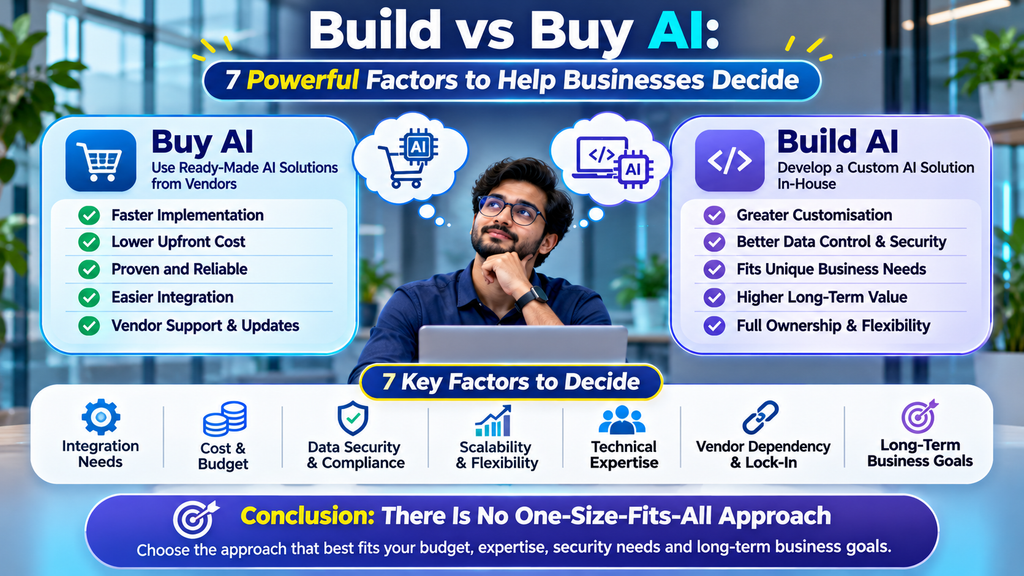
Conclusion: There Is No One-Size-Fits-All Approach
The decision to build or buy AI depends on a company’s budget, technical expertise, security requirements and business goals. While buying can offer faster implementation, building provides greater customisation and control. Businesses should choose the approach that best meets their needs and supports their long-term growth
Businesses evaluating their AI strategy should also understand how an AI operating model for mid-size companies can align technology investments with business goals and operational requirements.
NIST AI Risk Management Framework – NIST AI RMF
OECD AI Principles – OECD AI Principles
NIST AI Resource Center – NIST AI Resource Center