Source : Ai Generated Image
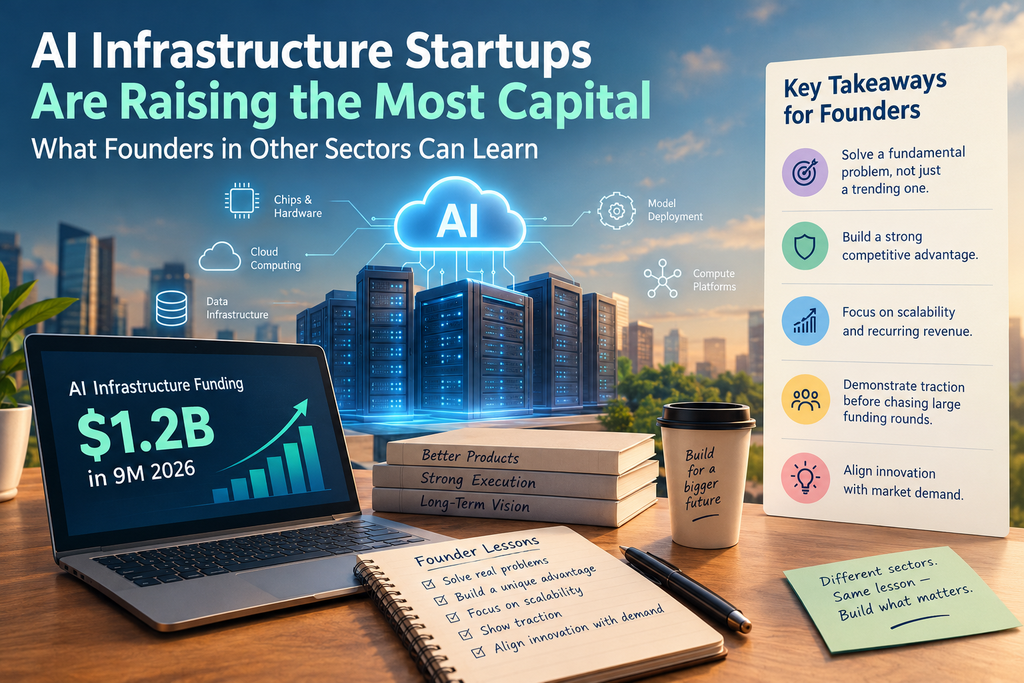
1. AI Infrastructure Funding: Five Key Lessons Every Startup Founder Should Know
AI infrastructure funding offers valuable lessons for startup founders on solving important problems, building competitive advantages, creating scalable revenue, and demonstrating business value to investors.
The number one founder lesson from the AI infrastructure boom is to address a problem that businesses have that needs to be solved. There are infrastructure companies which provide resources for other companies which make their work easier, so they are easier to link to the real business needs.
This should be something that all the founders, especially those in other industries, should do. For instance, a fintech startup may be working to lower the number of failed payments, enhance fraud detection or increase financial services accessibility. An education start-up might be a personalised learning platform, a student engagement or administrative inefficiency.
The task for founders is to find a genuine problem that is still occurring and provide a solution that people are willing to pay for, not a product that’s trendy and fashionable. The more the product meets the core needs, the more likely that it will have a continuing demand.
2. Develop a good competitive edge.
AI-infrastructure vendors usually require special technical knowledge, processing power and engineering expertise. These conditions can complicate it for people to easily copy products offered by competitors.
While startups in different industries may not require a high investment in infrastructure, they can build their own competitive edge by having a unique data asset, special industry knowledge, effective distribution channels, client relationships or a more loyal and understanding audience for a specific market.
A healthcare startup can stand out through reliable clinical workflows and with the involvement of healthcare providers, for instance. High quality products, customer loyalty and good distribution are all ways that a consumer brand can generate a competitive edge.
The key takeaway is that the founders will have to know what they are uniquely selling. A product with something to offer that is unique and different, will have a better basis for future growth than a product that is only based on price competition.
3. Pay attention to the Scalability and Recurring Revenue.
Investors want to invest in companies that can expand without a commensurate increase in costs. While infrastructure platforms can still go through the process of growing through existing systems, this may require a substantial amount of investment in energy, equipment, and computing power.
Others entrepreneurs can learn to develop a business model that can yield perpetually income and sustainable growth. More stable income streams can be developed via subscription services, enterprise contracts, repeat sales and long-term customer contracts.
But, with a recurring revenue comes no guarantee of profitability. The founders should also monitor costs of acquiring customers, customer retention, operating costs and gross margins.
It’s important for a startup business to know how their economics will shift as they grow. Scaling a business is only helpful when it strengthens the company financially, and doesn’t cost the business a lot of money.
4. Do invest in quality and, where funding is available, apply for it.
The AI infrastructure funding wave highlights the interest of investors in companies meeting big, long-term technology needs. However, the founders should not assume that once they’ve raised a lot of money that they can only do so in that way.
An investor will want a startup to have proof of business plan execution. This potential can be demonstrated through the following: early customer adoption, repeat usage, revenue growth, pilot projects and measurable improvements in customer outcomes.
Initially, it’s important to see if the business model has proven itself, not whether it is going to expand. If a small group of paying customers regularly purchases a product, they can offer good evidence of its demand.
It’s also a great idea for the founders to work their funding needs to milestones like product development, hiring, market expansion or infrastructure investment etc. That’s a sign of financial discipline and it gives investors an idea of what their investments will get them.
5.Ensure that innovation is oriented towards market demand.
Opportunities can be created through technological innovation but they do not necessarily lead to commercial success. With the rise of AI adoption, AI infrastructure companies can have their share in this demand. Their growth is partially driven by the ongoing investments businesses are making in AI systems and AI capabilities that will facilitate their growth.
Other founders must bring innovations that meet their customer’s changing needs as well. In education, this can be the creation of resources which support institutions in enhancing their learning outcomes. It could be a matter of improved stock control in the retail industry or a more individual shopping experience.
The founders can validate their solutions to the actual needs through market research, customer interviews, pilot programmes and feedback loops.
It is not merely to produce a new product. It’s about getting something out there that customers will use and continue to use, and spread the word!
What the Founders Ought NOT Do!
There are also some dangers entrepreneurs should consider amid the funding frenzy. Too much investment in a sector may attract the competition to invest more in the sector and foster false expectations of future demand.
It is important that the founders do not go into raising funds for the purpose of “catching up” with their competition or for valuation that has no relation to the business. Particularly they must not be too general a launch into too many markets before establishing a good product and a loyal customer base.
Capital efficiency is another factor to take into consideration. Technical and operational needs of infrastructure startups can make them costly to invest in. There is no logic in comparing the expenditure of other companies with less capital intensive companies unless this comparisons are based on their economics.
Instead, those who are the founders of the business have to opt for the ways in which they can fund the business, depending on the time and requirements of the business. While venture capital can help propel growth, it is not limited to just that. For some businesses, however, it might be better to consider revenue growth, strategic partnerships, and smaller funding rounds.
Conclusion
The investments in AI infrastructure during the first nine months of 2026, totaling around $1.2 billion, underscore the increasing significance of systems that enable AI. This also indicates investor support for companies that are tackling the fundamental technology requirements and opportunities for growth.
What founders in fields other than the AI infrastructure industry can learn is not what they can do to replicate a specific technology or to secure more and bigger funding rounds. They are focused on finding solutions to critical problems, establishing defensible edges, creating scaling revenue options, proving traction and matching the innovation with market need.
In the end, startups that succeed are the ones that understand their customer needs and execute them in an organized and disciplined way. The most important takeaway from AI infrastructure funding is that it is straightforward: create something that’s necessary, demonstrate its worth, and grow as the business grows.
Founders can strengthen their approach to raising capital by applying startup fundraising strategies that focus on customer demand, measurable progress, financial discipline, and long-term growth.
References
[1] YourStory, “India’s tech cos raise $10.3B in 2026, clocking a modest growth: Tracxn,” Sep. 24, 2026. [Online]. Available: https://yourstory.com/2026/09/indias-tech-cos-raise-usd-103b-in-2026-tracxn-report
[2] The New Indian Express, “India tech funding rises 7% to $10.3 billion in 9M 2026 despite fewer deals,” Sep. 24, 2026. [Online]. Available: https://www.newindianexpress.com/business/2026/Sep/24/india-tech-funding-rises-7-to-103-billion-in-9m-2026-despite-fewer-deals
[3] OECD, Venture Capital Investments in Artificial Intelligence Through 2025. Paris, France: OECD Publishing, 2026. [Online]. Available: https://www.oecd.org/content/dam/oecd/en/publications/reports/2026/02/venture-capital-investments-in-artificial-intelligence-through-2025_3bcb227f/a13752f5-en.pdf
[4] Stanford Institute for Human-Centered Artificial Intelligence, AI Index Report 2026. Stanford University, 2026. [Online]. Available: https://hai.stanford.edu/assets/files/ai_index_report_2026.pdf
[5] Bain & Company and Indian Venture and Alternate Capital Association, India Venture Capital Report 2026. 2026. [Online]. Available: https://static.levocdn.com/WGLBUT82/bainreportindiaventurecapitalreport20261-7457340414102605824.pdf