
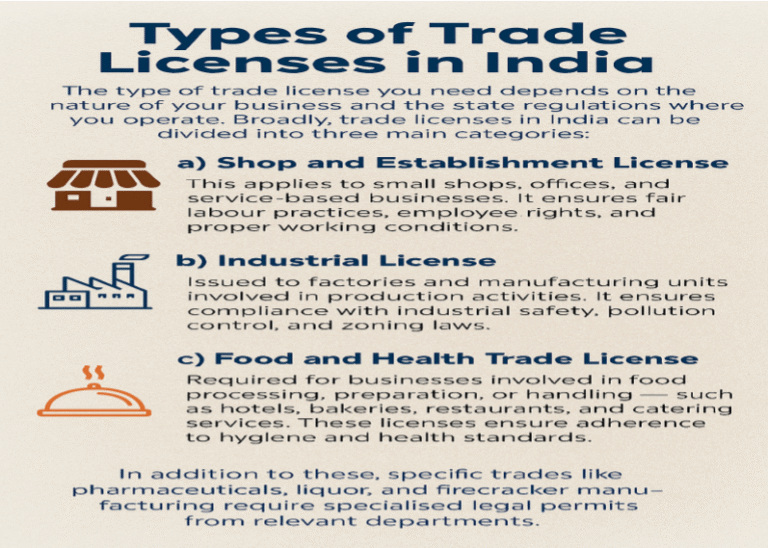
Launching a business in India is a thrilling adventure full of dreams and aspirations. Planning the business and organizing the money, it is easy to get caught up in the bureaucratic hurdles. Understanding Trade Licenses is one of the first and most important steps for anyone planning to start a business in India. Whether you are opening a café in Mumbai, operating a factory in Pune, or starting an online service in Bengaluru, acquiring the appropriate licenses and permits ensures that your business is legal, preventing penalties. This legal permit forms the very basis of building a compliant and trustworthy business.
In the fast-growing entrepreneurial status of India, many new business owners underestimate the seriousness of compliance. A trade license is not just a document; it is also an official sign-off from the local government that allows your business to operate. The local government will assess your business to make sure that it adheres to safety, health, and regulatory standards. If you do not possess a Trade License, you may be fined, shut down, or subject to legal action. For any budding entrepreneur, it can feel like a difficult task to obtain a Trade License. Do not worry, it does not have to be!
This article outlines everything you need to know, as an entrepreneur, from what they are, the different kinds of Trade Licenses, to the process of applying for, renewing, and not complying with a Trade License.
What Exactly is a Trade License?
In the simplest terms, a trade license is a document or certificate that permits you to operate a particular business or trade in a specific location. A trade license is an official document issued by the municipal corporation or local authority that grants permission to carry out specific business activities within a particular area. It ensures that the trade or business is conducted in accordance with the law and does not pose any threat to public safety, health, or the environment.
It is issued by the local municipal corporation of the area where your business is located. In India, trade licenses are governed primarily under the Municipal Corporation Acts of the respective states. The concept was introduced more than 40 years ago to maintain discipline in the trade and business sector.
The primary purpose of this license is not to generate revenue for the government, but to regulate business activities and ensure that the enterprise complies with the local laws, safety standards, and public health guidelines. It ensures that your business does not cause a nuisance or pose a danger to the residents of the locality. It is the government’s way of keeping a check on commercial activities to maintain a safe and orderly environment for everyone.
Who Needs a Trade License in India?
A trade license is required by any business entity involved in buying, selling, manufacturing, or providing services within the city limits, before the operation of that business starts. Not just merchants, a trade license will be required of:
- Sole proprietorship
- Partnership firm
- Private limited company
- Limited liability partnerships (LLPs)
- NGOs or societies involved in trade activities.
Even a home-based business or an online store will still need to confirm with local legislation to see if a trade license is required.
A home bakery, even though operating from a residential area, may need to acquire permission from the municipal authority to ensure there are no fire or hygiene hazards.
Operating without the proper legal permits may result in penalties or even being sealed up.
Why Is This Legal Permit Non-Negotiable?
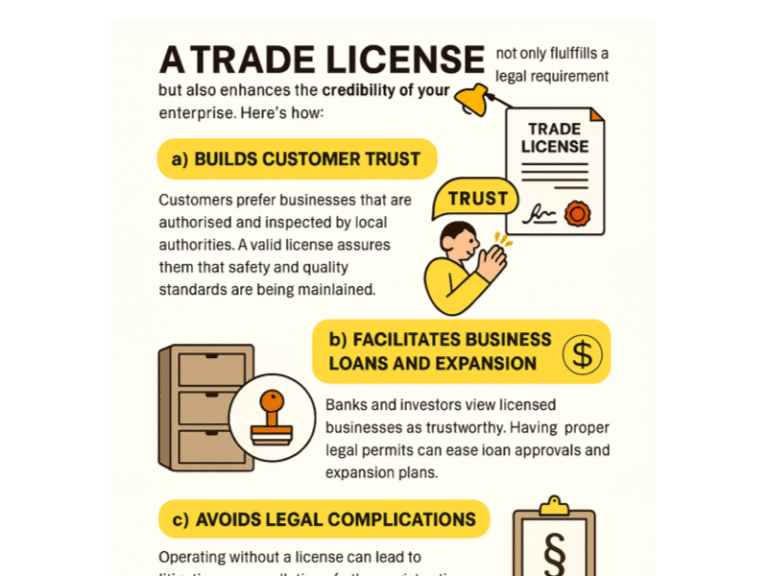
New entrepreneurs often ask if they can simply start to run their business and figure out the paperwork later; this is a bad and dangerous idea. There are at least a few reasons that a trade license is important. First, a trade license gives your business legal status. You are not (legally) able to run a business without a real license; the penalties can be stiff, and in some cases, your business can be shut down altogether. Second, it gives your business enormous credibility. For example, when you apply for a business loan, banks and other financial institutions will nearly always ask you for your trade license. When they see certification of your trade license, they know that you are serious, a real operation, and aware of the laws and regulations that pertain to your business. Finally, a trade license adds credibility and trust in a customer’s eyes. Displays of your trade license certificate may provide an extra sense of confidence for customers by simply knowing they are doing business with some entity that is following the rules.
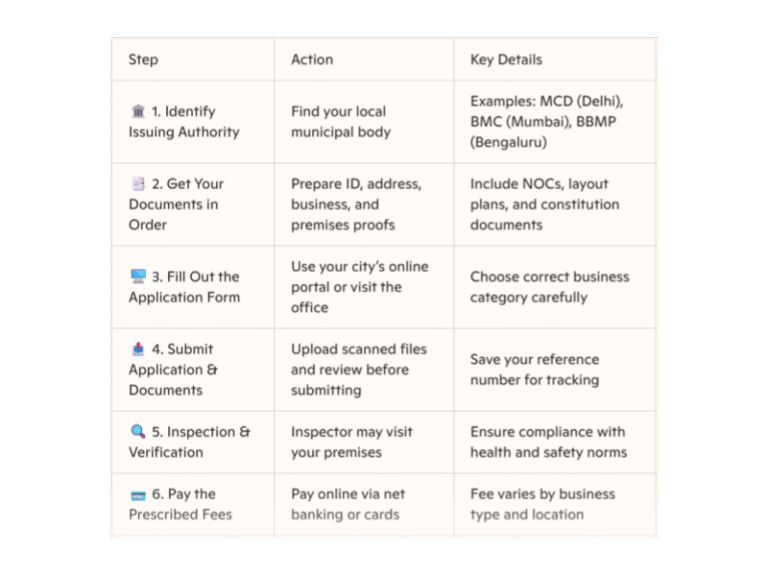
The Ultimate 7-Step Guide to Your Application
Navigating the application process can be smooth if you follow a structured approach. Here is a step-by-step breakdown to guide you.
Validity, and Penalties
A trade license is not a one-and-done process.
Validity: Most trade licenses are valid for one year from the date of issue and must be renewed on an annual basis (i.e., for renewals, the time frame is always from Jan 1 through one is renewed.)
Renewal Process: Businesses can apply for renewal online and submit the attached:
- Old license copy
- Last property tax receipt
- Payment of the renewal fee
- Compliance documents (if updated)
Penalties for Non-compliance: If a business is operating without a valid license or is not timely renewing, the authorities can impose:
- Heavy fines (e.g., between ₹5,000- ₹50,000, depending on the city)
- Sealing or shutting down their business premises
- Possibility of litigation to continue illegal business- not to reference continued negligent behaviour.
For example, municipal corporations in Bengaluru and Delhi have ramped up inspections in the past several years and have sealed businesses. Thus, renewing licenses can protect against unauthorized risks on behalf of the entrepreneur. Operating without a valid license is like operating without a license.
Who Needs to Apply for a Trade License?
Trade licenses in India are regulated at the state level by each state’s Municipal Corporation Act. While the specifics may differ slightly between jurisdictions, the bottom line is the same: almost every business activity must be licensed to carry on business. This largely applies to:
– Retail and Wholesale Shops: From your local Kirana store to a supermarket
– Restaurants and Eateries: Hotels, food stalls, cafes, bakeries, and canteens
– Service-Based Businesses: IT companies, consulting businesses, coaching centres, and private offices
– Manufacturing Businesses: Small factories and industrial workshops
-Entertainment Venues: Cinemas, theatres, and amusement parks
This is significant, as businesses must file their application 30 days before opening to be able to legally operate from day one.
Importance of Trade Licenses for Business Legitimacy
Common Challenges and Reforms in the Licensing System
While progress has been made to improve licensing, small entrepreneurs still encounter barriers to the licensing application process and licensing renewal. Common problems addressed include the reluctance to approve permits due to bureaucratic hindrances, adding time and confusion about what documents are required to apply for permits. As a small entrepreneur, it is also difficult to prepare the necessary applications if each department requires separate approvals or permits.
To help ease those barriers, the Government of India and many state governments have implemented digital reforms and created a single-window system.
Sample Recent Reforms Include:
- Online filings through municipal e-portals
- Alignment with UDYAM and GST registration systems
- Common application forms for obtaining multiple licenses
- Automated tracking updates and SMS alerts on statuses
Also, the Ease of Doing Business initiative through the Department for Promotion of Industry and Internal Trade (DPIIT) seeks to reduce redundant compliance burdens on entrepreneurs in an industry.
For entrepreneurs, these reforms lead to fewer visits to government offices and a quicker means of obtaining essential legal permits.
Legal Framework Governing Trade Licenses in India
The legal foundation for trade licensing in India varies across states but generally falls under the following acts and municipal by-laws:
Shops and Establishments Act, 1948
Food Safety and Standards Act, 2006 (for food-related businesses)
Factories Act, 1948 (for industrial activities)
Environmental Protection Act, 1986 (for pollution-sensitive trades) Municipal Corporation Acts
(specific to each state)
These regulations collectively ensure that business operations do not endanger the public or the environment and that labour and consumer rights are protected.
Conclusion: A Foundation for Success
A trade license is much more than a bureaucratic formality, it is a business necessity. It provides legal recognition, ensures compliance with public safety norms, and enhances your credibility among customers, lenders, and authorities. In the grand scheme of starting and running a business, obtaining trade licenses and other legal permits might seem like a tedious chore. However, it is an indispensable step that legitimises your operations and safeguards your business from legal troubles. It is a sign of a responsible entrepreneur who is committed to building a sustainable and compliant enterprise. By following the steps outlined in this guide, you can navigate the process efficiently and lay a strong legal foundation for your business to grow and prosper.
In India’s growing startup and SME ecosystem, awareness about trade licenses and related legal permits is vital for sustainable growth. Entrepreneurs who take compliance seriously not only safeguard their operations but also position themselves for future expansion, government incentives, and global partnerships.
In short, before investing in marketing or branding, invest in legitimacy. Because a strong business begins with one crucial step: getting your trade license right.
References
[1] “Trade License,” Municipal Corporation of Delhi, Government of NCT of Delhi. [Online]. Available: https://mcdonline.nic.in/portal/services/tradelicense
[2] “Shop and Establishment Act in India,” India Filings. [Online]. Available: https://www.indiafilings.com/learn/shop-and-establishment-act-in-india/
[3] “How to Get a Trade License in India: A Complete Guide,” Clear tax. [Online]. Available:https://cleartax.in/s/trade-license-india
[4] Ministry of Housing and Urban Affairs, “Municipal Licensing Framework in India,” Government of India, 2024. [Online]. Available:https://mohua.gov.in
[5] Department for Promotion of Industry and Internal Trade (DPIIT), “Ease of Doing Business Reforms,” 2024. [Online]. Available: https://dpiit.gov.in
[6] Food Safety and Standards Authority of India, “Guidelines for Licensing and Registration,” 2023. [Online]. Available: https://fssai.gov.inhttps://fssai.gov.in
[7] Government of Maharashtra, “Trade License Rules and Procedures,” 2024. [Online]. Available: https://maharashtra.gov.in
[8] Greater Chennai Corporation, “Trade License Application Portal,” 2023. [Online]. Available: https://chennaicorporation.gov.in
[9] NITI Aayog, “SME Regulatory Compliance Review,” 2024. [Online]. Available: https://niti.gov.in
[10] World Bank, “Doing Business in India 2024 Report,” 2024. [Online]. Available: https://worldbank.org
Penned by Pranjali
Edited by Reeya Kumari, Research Analyst
For any feedback mail us at info@eveconsultancy.in
Finance made simple, fast, and fun! 🏦💡 Sign up for your daily dose of financial insights delivered in plain English. In just 5 minutes, you’ll be smarter already!
Simplify Your Business Compliance with Eve Consultancy
Eve Consultancy is your trusted partner for end-to-end compliance services, including Company Incorporation, GST Registration, Income Tax Filing, MSME Registration, and more. With a quick and hassle-free process, expert guidance, and affordable pricing, we help businesses stay compliant while they focus on growth. Backed by experienced professionals, we ensure smooth handling of all your legal and financial requirements. WhatsApp us today at +91 9711469884 to get started.