
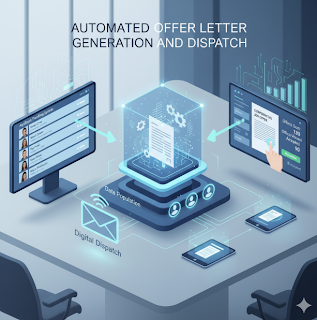
Automated Offer Letter Generation and Dispatch
In today’s competitive talent market, organizations are continually seeking ways to enhance hiring operations and expedite onboarding. One of the most significant advancements in this space is the adoption of automated offers, a technology-driven solution that simplifies the creation and distribution of offer letters. As businesses strive for greater process efficiency, automated offer letter generation and dispatch have emerged as a game-changer — reducing manual tasks, eliminating delays, and ensuring a seamless candidate experience.
In fact, companies that adopt automated offers report improved turnaround times, enhanced accuracy, and better communication, all of which contribute to stronger employer branding and operational excellence. Ultimately, investing in automation enhances process efficiency, enabling HR teams to focus on strategic decision-making rather than repetitive administrative tasks.
5 Must-Know Insights on Automated Offer Letter Generation & Dispatch
1. The Need for Automation in Recruitment
The recruitment landscape has undergone significant evolution over the past decade. Organizations today face increased pressure to hire quickly, personalize candidate experiences, and maintain compliance — all while managing large volumes of applicants. Traditional offer letter generation is often slow and error-prone, requiring HR professionals to manually draft documents, verify details, and manage email dispatches.
This manual approach not only delays onboarding but also risks mistakes that can damage candidate trust and corporate reputation.
Automated offers solve these challenges by integrating offer generation directly into recruitment platforms. With predefined templates, automated data entry, and one-click dispatch, offer letters can be produced and shared in minutes rather than days. The result is a dramatic boost in process efficiency, allowing companies to stay agile and competitive in fast-moving hiring cycles.
2. How Automated Offer Letter Generation Works
The core principle behind automated offers is simple: replace manual, repetitive tasks with intelligent, rule-based workflows. The system pulls candidate information directly from the applicant tracking system (ATS), applies company-approved templates, and automatically generates a personalized offer letter. Once approved, the document is securely dispatched to the candidate via email or a self-service portal.
This automation not only reduces administrative burden but also ensures accuracy and consistency. Every offer letter follows the same format, includes the correct legal clauses, and is free from human error. It also creates a digital audit trail, improving compliance and transparency — both critical aspects of modern HR operations. The result is a more reliable process that enhances process efficiency from recruitment to onboarding.
3. Key Benefits of Automated Offers
The adoption of automated offers delivers a wide range of tangible benefits for organizations of all sizes. Some of the most significant include:
- Speed and Scalability: Automation reduces offer letter creation from hours to minutes, enabling organizations to handle large hiring volumes without additional HR resources.
- Accuracy and Compliance: By eliminating manual data entry, the risk of errors is significantly reduced. Pre-approved templates ensure all legal and regulatory requirements are met.
- Enhanced Candidate Experience: Quick, professional, and error-free offer dispatch improves employer branding and increases offer acceptance rates.
- Cost Savings: Streamlining the offer generation process reduces administrative overhead and frees HR staff to focus on more strategic tasks.
- Seamless Integration: Most automated systems integrate easily with existing HR software, ensuring a smooth flow of data and documentation.
By implementing automation, organizations achieve measurable improvements in process efficiency, reducing hiring bottlenecks and enhancing workforce planning capabilities.
4. Overcoming Challenges in Implementation
While the benefits are significant, transitioning to automated offers requires careful planning. Some organizations may face resistance to change or encounter integration challenges with legacy systems. To overcome these hurdles, companies should:
- Conduct a Process Audit: Identify inefficiencies and determine where automation will have the greatest impact.
- Customize Templates: Ensure offer letters reflect company culture, legal requirements, and industry standards.
- Train HR Teams: Provide comprehensive training to ensure teams are comfortable using the new system and understand its capabilities.
- Monitor and Optimize: Continuously review the system’s performance and make improvements to enhance process efficiency further.
A well-planned implementation strategy ensures a smooth transition and maximizes the benefits of automation.
5. The Future of Offer Letter Automation
As technology continues to evolve, automated offers will become even more intelligent and adaptable. AI-powered systems will soon be able to analyse market trends, suggest competitive salary ranges, and personalize offer letters based on candidate preferences. Additionally, integration with e-signature platforms will further accelerate acceptance timelines, while analytics tools will offer insights into hiring performance and candidate behaviour.
In the near future, automation will extend beyond offer letters to include onboarding workflows, training assignments, and employee documentation — creating a seamless, end-to-end HR process. Companies that embrace these innovations will enjoy unparalleled process efficiency, enabling them to attract and retain top talent in an increasingly competitive landscape.
Conclusion
In an era where speed, precision, and candidate experience define recruitment success, automated offers are no longer a luxury — they are a strategic necessity. By streamlining the generation and dispatch of offer letters, organizations can reduce manual work, eliminate errors, and accelerate hiring timelines. More importantly, automation empowers HR teams to focus on people-centric initiatives that drive long-term growth and engagement. As businesses continue to prioritize process efficiency, the adoption of automated offers will remain a cornerstone of modern recruitment strategies, shaping the future of workforce management.
References
[1] S. Strohmeier, “Digital human resource management: A conceptual clarification,” German Journal of Human Resource Management, vol. 34, no. 3, pp. 345–365, Aug. 2020. [Online]. Available: https://doi.org/10.1177/2397002220921131
[2] Deloitte, “HR Technology Disruptions 2023,” Deloitte Insights, 2023. [Online]. Available: https://www2.deloitte.com/insights/us/en.html
[3] Gartner, “Future of HR: AI and Automation in Recruitment,” Gartner Research, 2024. [Online]. Available: https://www.gartner.com/en/human-resources
[4] LinkedIn Talent Solutions, “The Future of Recruiting 2024 Report,” LinkedIn, 2024. [Online]. Available: https://business.linkedin.com/talent-solutions
FAQs
1. What is automated offer letter generation?
It’s a digital method that uses pre-approved templates and candidate data to create offer letters automatically, ensuring accuracy and consistency across the hiring process.
2. How do automated offers enhance HR operations?
Automated offers help recruiters save time, eliminate manual errors, and deliver a seamless candidate experience by speeding up the overall offer creation process.
3. What impact does this system have on efficiency?
It significantly boosts process efficiency by reducing repetitive tasks, streamlining approvals, and accelerating the time-to-hire.
4. Can automated offers integrate with existing HR tools?
Yes, they can easily integrate with HRMS, ATS, and onboarding platforms, allowing data to flow smoothly and improving team collaboration.
5. Is automation suitable for companies of all sizes?
Definitely. Whether you’re a startup or a large enterprise, automated offer generation adapts to your scale, helping you maintain uniformity and speed.
6. How secure are automated offer?
They follow strict data security protocols and compliance standards to protect candidate information and ensure confidentiality.
7. What are the biggest time-saving benefits of automation?
Automating offer letters removes manual drafting and approval delays, freeing HR teams to focus on strategy instead of repetitive administrative work.
8. How does automation contribute to process of recruitment?
By minimizing human intervention and enabling real-time updates, it strengthens process efficiency from candidate selection to final offer dispatch.
9. Can offer templates be customized in automated systems?
Yes, organizations can customize templates with their branding, terms, and conditions while maintaining accuracy and consistency.
10. What results can companies expect after implementing automated offers?
They can expect faster offer rollouts, improved communication, better compliance, and measurable gains in overall HR process efficiency.
Penned by Tanjal Kapoor
Edited by Reeya Kumari, Research Analyst
For any feedback mail us at info@eveconsultancy.in
Finance made simple, fast, and fun! 🏦💡 Sign up for your daily dose of financial insights delivered in plain English. In just 5 minutes, you’ll be smarter already!
Simplify Your Business Compliance with Eve Consultancy
Eve Consultancy is your trusted partner for end-to-end compliance services, including Company Incorporation, GST Registration, Income Tax Filing, MSME Registration, and more. With a quick and hassle-free process, expert guidance, and affordable pricing, we help businesses stay compliant while they focus on growth. Backed by experienced professionals, we ensure smooth handling of all your legal and financial requirements. WhatsApp us today at +91 9711469884 to get started.