
Topics: Compliance Reporting Processes, Regulatory Submissions
The process of understanding the company’s compliance activities is known as compliance reporting. It is a compliance practice report card that highlights both the advantages and disadvantages of compliance programs. Furthermore, compliance reporting might help firms in making consistent choices about risk management and future planning; these organizations cultivate a culture of openness and accountability that guarantees sustained performance. Once more, it might be a proactive approach to your expanding company. Producing and submitting reports that demonstrate the organization’s adherence to particular laws and guidelines is a continuous activity. The reports also go into detail about data privacy, ethical behaviour, financial procedures, and worker safety. Additionally, several regulatory agencies or other organizations require compliance reports in order for the industry to comprehend how the firm operates. As a result, organizations that fail to submit reporting or have insufficient reporting may occasionally be subject to severe fines and legal repercussions.
Understanding the 5 Core Types of Compliance Reports
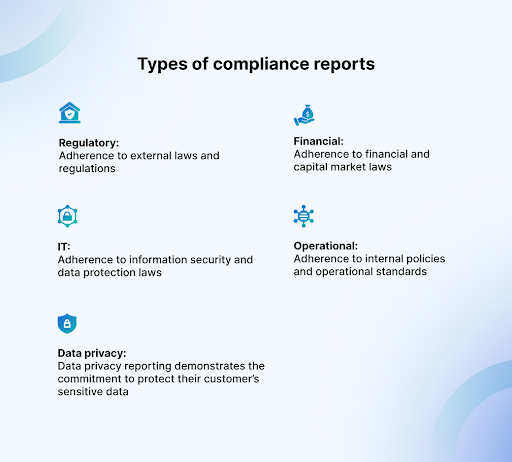
- Regulatory Compliance Reporting: Reporting, as the name implies, shows that an organization is following the law. Regulatory agencies will examine this type of external reporting. Reporting is also influenced by the geographies, industries, and laws of a company.
- Financial Statements Reporting: An organization’s compliance with economic rules and regulations is indicated by this reporting. The balance sheet, income statements, and cash flow information are all included in the report. As a result, it aids in identifying the financial stability and efficacy of internal controls within a business.
- IT Management Reporting: The report describes an organization’s compliance with data privacy and information security. As such, it demonstrates an organization’s dedication to efficient IT governance and aids in identifying its best practices for storage, privacy encryption, and data protection.
- Operational Process Reporting: Such reporting demonstrates an organization’s adherence to the industry-specific operational procedure and enlists the organization’s commitment to upholding the operational standard. Details about supply chain management, safety, and quality control are included in the reports.
- Data Privacy Reporting: These reports guarantee that businesses follow data protection rules and regulations when handling and safeguarding sensitive and personal data. They usually contain information on permission procedures, data processing and storage methods, breach response plans, and data gathering policies.
Steps to Build a Compliance Reporting Process
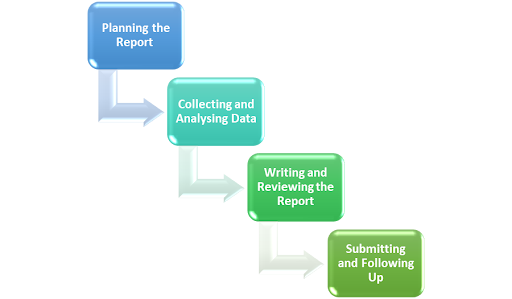
A number of crucial procedures are followed in compliance reporting to guarantee that the data is correct, comprehensive, and supplied on schedule. These actions assist organizations in reducing risks, identifying opportunities for improvement, and fulfilling their legal requirements.
Planning the Report
Identifying pertinent requirements, figuring out what information is needed, establishing due dates, and allocating tasks are all part of the planning phase of compliance reporting. For uniformity and clarity, it also entails choosing the format and organization of the report. Planning ahead guarantees that all specifications are fulfilled, the report is delivered on schedule, and the material is precise and comprehensive. This stage is essential to creating a thorough, well-structured compliance report that shows how effectively the company complies with regulations.
Collecting and Analysing Data
Finding the precise rules and guidelines that apply is a crucial first step in creating a compliance report, since it guarantees that all legal and policy requirements are met. Setting timelines for each stage of the process, deciding what information has to be included, and delegating tasks to team members are all part of this step. Selecting the report’s format and structure also aids in preserving coherence and clarity. This phase of careful planning guarantees that the report is accurate, comprehensive, and delivered on schedule.
Writing and Reviewing the Report
Present results, insights, and recommendations in a clear, concise, and easily comprehensible manner while creating a compliance report. To increase accuracy and clarity, carefully review for mistakes or omissions and get input from superiors or coworkers. Before completing the manuscript, make the necessary modifications. In addition to reflecting the organization’s compliance status, a well-written, error-free report helps make well-informed decisions by guaranteeing that the data is trustworthy, appropriate, and helpful to all parties.
Submitting and Following Up
Delivering and monitoring a compliance report includes sending it by the deadline to the appropriate authorities or stakeholders, verifying receipt, and answering any follow-up inquiries. Maintaining documentation of the report and submission information shows responsibility and helps avert future compliance problems.
Conclusion
Industry standards, laws, rules, and regulations enforced by several regulatory and standard-setting authorities extensively influence the environment in which businesses function today. If these strict conditions are not met, there may be serious and far-reaching consequences. Businesses risk facing severe financial fines, losing their reputation, getting caught up in costly legal battles, and, in the worst situation, having to shut down.
References
- “What is Compliance Reporting? – Definition, Types, Examples,” MetricStream. [Online]. Available:https://www.metricstream.com/learn/compliance-reporting.html.[Accessed: Aug. 14, 2025].
- A. Patil, “Understanding Compliance Reporting: Types, Processes, and Examples,” CertPro[Online].Available:https://certpro.com/compliancereports/#:~:text=for%20better%20results.-,COMPONENTS%20OF%20EFFECTIVE%20REPORTING%20FOR%20BUSINESSES,new%20ways%20to%20improve%20compliance. [Accessed: Aug. 14, 2025].
- S. Kenney, “The Step-By-Step Guide to Crafting a Compliance Report,” AuditBoard. [Online]. Available: https://auditboard.com/blog/the-step-by-step-guide-to-crafting-a-compliance-report8. [Accessed: Aug. 14, 2025].
- P. Wadhwa, “Compliance Reporting: Types, Reporting Process and Examples,” Sprinto. [Online]. Available: https://sprinto.com/blog/compliance-reporting/. [Accessed: Aug. 14, 2025].
- “Getting Started with Compliance Offshoring: A Step-by-Step Guide,” SolutionsCentric. [Online]. Available: https://solutionscentric.com.au/getting-started-compliance-offshoring-step-by-stepguide/#:~:text=Step%202:%20Defining%20Objectives%20and%20Scope%20Clearly,well%2Ddefined%20goals%20will%20guide%20your%20offshoring%20partnership. [Accessed: Aug. 14, 2025].
- “Compliance Reporting 101: Best Practices & Requirements,” Eyer.ai. [Online]. Available:https://www.eyer.ai/blog/compliance-reporting-101-best-practices-and-requirements/utm_source=chatgpt.com. [Accessed: Aug. 14, 2025].
FAQ Section: Build Effective Compliance Reporting Processes
1. What are compliance reporting processes?
Compliance reporting processes are structured steps organizations follow to prepare, review, and submit reports that demonstrate adherence to laws, standards, and internal policies.
2. Why are compliance reporting processes important for businesses?
They ensure transparency, reduce legal risks, support informed decision-making, and demonstrate accountability to regulators, stakeholders, and clients.
3. What is included in compliance reporting processes?
They typically include planning, data collection, analysis, report writing, internal review, submission, and follow-up with regulatory bodies or stakeholders.
4. How do compliance reporting processes support regulatory submissions?
By standardizing data collection and validation, compliance reporting processes make regulatory submissions accurate, timely, and audit-ready.
5. What are the 5 core types of compliance reports?
They include regulatory compliance reporting, financial statements, IT management reporting, operational process reporting, and data privacy reporting.
6. How often should compliance reports be submitted?
The frequency varies by industry and regulation—some reports are quarterly or annually, while others (like IT or safety reports) may require real-time updates.
7. What happens if a company fails in compliance reporting processes?
Poor or missing reports may result in penalties, reputational damage, operational disruptions, or even legal action.
8. How do regulatory submissions differ from internal compliance reporting?
Regulatory submissions are prepared for government or industry authorities, while internal compliance reporting tracks adherence within the organization.
9. What role does data accuracy play in compliance reporting processes?
Accurate data is critical, as errors can cause failed regulatory submissions, audits, and potential fines.
10. How can companies improve their compliance reporting processes?
By adopting automation tools, standardizing templates, training employees, and regularly auditing compliance systems.
11. What are common challenges in compliance reporting processes?
Challenges include fragmented data, unclear reporting guidelines, strict deadlines, and evolving regulatory requirements.
12. How do compliance reporting processes enhance risk management?
They identify gaps in policies, highlight areas of non-compliance, and allow organizations to take proactive corrective actions.
13. Can advanced analytics improve compliance reporting processes?
Yes, analytics tools help track compliance metrics, forecast risks, and streamline regulatory submissions with real-time insights.
14. How do compliance reporting processes impact organizational culture?
They promote accountability, transparency, and ethical behavior across all levels of the organization.
15. What are best practices for regulatory submissions within compliance reporting processes?
Best practices include early planning, maintaining complete documentation, using compliance software, and conducting pre-submission reviews.
Penned by Iqra
Edited by Reeya Kumari, Research Analyst
For any feedback mail us at info@eveconsultancy.in
Finance made simple, fast, and fun! 🏦💡 Sign up for your daily dose of financial insights delivered in plain English. In just 5 minutes, you’ll be smarter already!
Simplify Your Business Compliance with Eve Consultancy
Eve Consultancy is your trusted partner for end-to-end compliance services, including Company Incorporation, GST Registration, Income Tax Filing, MSME Registration, and more. With a quick and hassle-free process, expert guidance, and affordable pricing, we help businesses stay compliant while they focus on growth. Backed by experienced professionals, we ensure smooth handling of all your legal and financial requirements. WhatsApp us today at +91 9711469884 to get started.