

Introduction
In a demanding and competitive landscape, businesses must predominantly prepare for potential legal hardships. Litigation readiness refers to an organization’s ability to comprehend and respond swiftly and defensibly to lawsuits, audits, and investigations. When unified with risk management, it becomes a strategic asset—helping companies diminish exposure, reduce costs, and maintain operational continuity. This article will identify the possible legal exposure, response to fight them with legal preparedness and will conclude by the probable risk involved in the procedure.
Identifying Legal Vulnerabilities in Operations
From the past experiences it can be found out that there are four vulnerabilities or risks in operations which can be grouped as
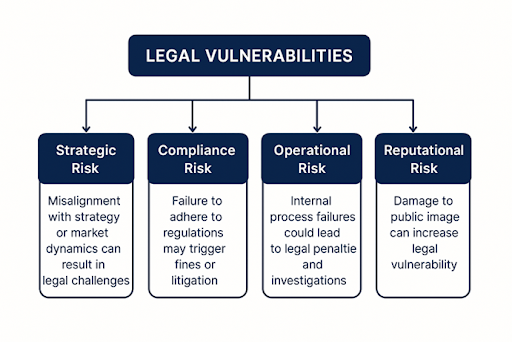
The understanding of the business risk involves plotting the probable risks that could interrupt commerciality and reputation for example a failure to comply with the data privacy law may trigger investigation and fines same way an ill contract management may trigger a litigation over the volition of agreement.
To save a business from legal trouble the precautionary measures are important .Precautionary measures do more than just identify potential hazards. The effectiveness of a hedge framework should also estimate the uncertainties and forecast how they will affect a company. The end outcome is a decision about whether to accept or reject risks. The degree of tolerance that a corporation has already established for itself determines whether risks are accepted or rejected.
The precautionary measures can be used to support other risk mitigation systems if a corporation establishes risk mitigation as a continuous, disciplined process for identifying and resolving concerns. They consist of budgeting, cost control, planning, and organization. Since proactive risk management is the main focus, the company won’t often face many shocks in this situation.
Designing a Response Framework for Legal Triggers
An effective lawsuit response framework allows business to react conclusively minimizing disruptions and concreating their position.
This kind of framework must be uniform and re-applicable ensuring all involved entities must know their roles and responsibilities.
- Procedure for legal holds- This guarantees that relevant data and documents are preserved when some anomaly takes place, it is very well required for the legal integrity of the firm.
- Identification of the custodian- Companies need to set up a protocol where all the confidential records and information of each vertical must be under a custodian for easy access when in grave need.
- ESI Preservation- Electronically stored information (ESI) must be accessible and defended throughout the legal process underway for timely availability of deliverables.
Cross-Functionality for preparedness
The legal readiness is not the sole duty for the legal department; it requires a clear effort across IT, HR, operations etc. Agile proactive measures require open dialogue among departments.
Cross functional collaboration ensures that everyone understands their role in legal preparedness. Additionally, it promotes a common language regarding risk, which facilitates coordination in situations where time is of the essence. Collaboration makes legal readiness a company-wide endeavour, whether it is through the implementation of automated alerts or collaborative training sessions.
Directions, Drilling and Continuous Refinement
1.Directions
- Define and document legal policies with clarity and consistency.
- Regularly review governance protocol to ensure alignment with the changing laws and standards.
- Assign responsibilities for maintaining SOPs and legal response frame work
2.Drilling
- Conduct mock drills and scenario-based pilot test to represent actual scenarios
- Provide continuous legal awareness sessions
- Customize training sessions to reflect new technologies, team roles and regulatory obligations.
3.Continues Refinement
- Monitor industry trends and adjust legal framework regularly
- Create a closed feedback loop using audit outcomes and real-world reviews
- Upgradation for accommodation of new platforms like cloud storage and security protocols etc.
Conclusion
In today’s evolving environment litigation readiness is no longer optional it is essential. By proactively assigning legal procedures across departments and refining risk management protocol’s, businesses can tackle and pass investigations, lawsuits and audits with integrity. An effective litigation response protocol is essential for cross-functional collaboration and continuous governance to minimize exposures and uphold resilience. Moreover, embracing structured measures and real time feedback from the stakeholders enchant the organization to stay limber in uncertainty. Ultimately litigation readiness is a synonym of sound risk management. Organization that holds continuity, safeguards reputation supports long term growth.
References
- Business Risk: Definition factor as an example (May 2025) https://www.investopedia.com/terms/b/businessrisk.asp
- Risk management: The identification analysis and response to risk factors affecting a business https://corporatefinanceinstitute.com/resources/career-map/sell-side/risk-management/risk-management/
- Navigating The legal landscape and regulatory landscape (April 2025) https://fastercapital.com/content/Navigating-the-Legal-and-Regulatory-Landscape.html
- Legal Framework for incident response: ensuring Compliance and Security (May 2024) https://lawhub.blog/legal-frameworks-for-incident-response/
- What is Litigation Readiness plan? https://zapproved.com/blog/what-is-a-litigation-readiness-plan/
- Litigation Readiness: how to form and execute plan( November 2022) https://www.veniosystems.com/blog/litigation-readiness-how-to-form-and-execute-your-plan
FAQ : How to handle litigation readiness for the business
Q1. What is litigation readiness?
Litigation readiness is an organization’s ability to respond quickly and defensibly to lawsuits, audits, or investigations.
Q2. Why is litigation readiness important for businesses?
It reduces exposure to legal risks, saves costs, and ensures business continuity during lawsuits or audits.
Q3. How does litigation readiness connect with risk management?
Litigation readiness complements risk management by proactively identifying vulnerabilities and preparing response frameworks.
Q4. What are common legal vulnerabilities businesses face?
Examples include data privacy violations, poor contract management, and non-compliance with regulations.
Q5. What is a litigation response framework?
It’s a structured process that defines roles, responsibilities, and procedures to handle lawsuits effectively.
Q6. What is the role of legal holds in litigation readiness?
Legal holds ensure preservation of key documents and data, safeguarding the integrity of evidence.
Q7. How does ESI preservation affect litigation readiness?
Maintaining electronically stored information (ESI) ensures compliance and timely availability during legal processes.
Q8. Who is a custodian in litigation readiness?
A custodian is a designated person responsible for safeguarding confidential business records and information.
Q9. Which departments should be involved in litigation readiness?
Legal, IT, HR, operations, and compliance teams must collaborate for effective readiness.
Q10. How do drills improve litigation preparedness?
Mock drills and scenario-based training prepare employees for real-world investigations and lawsuits.
Q11. What role does continuous refinement play in litigation readiness?
Regular reviews and updates align legal frameworks with evolving laws and industry practices.
Q12. How does cross-functional collaboration strengthen readiness?
It ensures all departments speak the same language on risk, improving coordination and response.
Q13. Can litigation readiness protect business reputation?
Yes, a proactive legal framework safeguards reputation by demonstrating compliance and integrity.
Q14. What technologies help with litigation readiness?
Cloud storage, automated alerts, and secure document management systems enhance preparedness.
Q15. What is the ultimate benefit of litigation readiness?
It ensures resilience, reduces disruptions, and supports sustainable business growth.
Penned by Priyansh Sharma
Edited by Sneha Seth, Research Analyst
For any feedback mail us at info@eveconsultancy.in
Finance made simple, fast, and fun! 🏦💡 Sign up for your daily dose of financial insights delivered in plain English. In just 5 minutes, you’ll be smarter already!
Simplify Your Business Compliance with Eve Consultancy
Eve Consultancy is your trusted partner for end-to-end compliance services, including Company Incorporation, GST Registration, Income Tax Filing, MSME Registration, and more. With a quick and hassle-free process, expert guidance, and affordable pricing, we help businesses stay compliant while they focus on growth. Backed by experienced professionals, we ensure smooth handling of all your legal and financial requirements. WhatsApp us today at +91 9711469884 to get started.