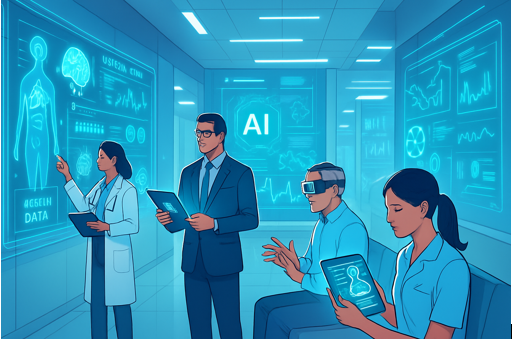
With the advent of technology, there have been major changes in the healthcare industry as well. There has been a major increase in AI consulting in the healthcare industry, especially within the new generation, who rely heavily on artificial intelligence, and these days doctors rely on AI as well for clinical decision-making.
With the increasing use of AI and it getting better and better every passing day, artificial intelligence has made its place in the healthcare industry as well. It’s not only the common man who relies on artificial intelligence to detect what they are suffering from before consulting a doctor, but it’s also the doctors who have trained AI models to help them, whether it be at the time of surgeries or during drug discovery as well.
Read along the article to know more about the usage of artificial intelligence in healthcare consulting.
5 Key Applications of AI in Healthcare Consulting: Challenges and Future Outlook
Current landscape of AI in healthcare industry
- Recently the use of and reliance on AI for image analysis has increased rapidly. For various important scans like radiology, pathology, and early disease prediction, especially for diseases like cancer, has increased.
- AI has been proficient in analyzing patient data and predicting responses as well. And, accordingly, recommending optimal strategies for patient care, operational improvements, and market entry.
- In today’s metropolitan cities with large hospitals, AI has been quite helpful as well in managing large data, supply chain optimization, and administrative tasks. It also helps in analyzing the potential investments that are required or can be useful in the future as well.
- AI also helps governments to make recommendations for process improvements, resource allocation, and patient flow in government and private hospitals. It also helps them to keep a check on small dispensaries, whether they are functioning properly or not, and whether they are keeping proper and full stocks of medicines as well.
- With the outbreak of COVID-19 in 2020, AI to date helps us predict any disease outbreaks in different regions of the world, how they can be prevented, and what kind of medicines can be used to prevent them.
Challenges and risks of AI adoption
- The major issue of artificial intelligence is the risk of losing our own privacy, which prevails in the healthcare industry as well. We will always be at risk of losing the patients’ privacy, their medical history, and any diseases they are suffering from.
- We can’t fully rely on AI, as at times AI models are trained on limited or skewed data that can lead to biased diagnoses, which is not beneficial at all.
- We need AI-equipped staff, which is at times difficult to have in this industry, as in hospitals, we need people who are skilled enough to use AI in the right way, and do not lead to incorrect treatment of patients.
Future of AI in Healthcare Consulting
- There has been a major increase in specialized AI healthcare firms that mainly focus on the implementation of AI in healthcare.
- There has been an increase in collaboration between human consultants and AI tools working together and robots doing advanced, difficult, and life-saving treatments and surgeries, like open-heart surgery.
- There’s great eventuality for AI-powered consulting to address healthcare differences and improve access in rural areas, as well as ameliorate healthcare in those regions.
Conclusion
In conclusion, AI’s capabilities in the healthcare industry are limited in its capability to enhance clinical decision support, streamline operations, and unlock data-driven insight that ameliorates patient issues as well. For consulting enterprises, success in healthcare AI consulting requires investing in mortal capital that’s invested in using AI.
AI should be included in the healthcare industry, but it shouldn’t replace mortal croakers and nurses, as they’re the main caregivers. Overall, there should be a nonstop elaboration of AI in healthcare consulting that promises to shape a more effective, informed, and case-centred healthcare ecosystem.
FAQs on AI in Healthcare Consulting
Q1: What is AI in healthcare consulting?
AI in healthcare consulting refers to the integration of artificial intelligence tools and strategies within healthcare systems, guided by professional consultants. It includes using AI for diagnostics, patient care, operational efficiency, and strategic decision-making in hospitals, clinics, and health organizations. Healthcare consultants leverage AI to provide data-driven insights, improve patient outcomes, and streamline business processes.
Q2: How is AI used in healthcare consulting?
AI in healthcare consulting is applied in several ways. For example, AI supports clinical decision-making by analyzing medical images, predicting disease risks, and recommending treatment plans. In operations, AI helps with hospital resource management, supply chain optimization, and staff scheduling. Consultants also use AI to assess investment opportunities, regulatory compliance, and risk mitigation strategies. In addition, AI-powered analytics assist governments and organizations in monitoring healthcare delivery at local and global levels.
Q3: What are the benefits of AI in healthcare consulting?
The benefits of AI in healthcare consulting include improved patient outcomes, cost efficiency, and enhanced operational effectiveness. By automating routine tasks, AI frees up healthcare professionals to focus on patient care. Predictive analytics allows consultants to forecast trends in patient health and hospital needs, reducing risks and supporting better decision-making. Furthermore, AI enables precision medicine by tailoring treatment options to individual patients based on genetic and clinical data, improving recovery and survival rates.
Q4: What challenges are associated with AI in healthcare consulting?
Despite its benefits, AI in healthcare consulting faces several challenges. One of the biggest concerns is patient data privacy and security. Healthcare organizations handle sensitive medical records, and AI systems must comply with regulations like HIPAA and GDPR. Another challenge is bias in AI algorithms, which can result from skewed or incomplete training data, potentially leading to inaccurate diagnoses. Additionally, many healthcare facilities lack trained staff capable of effectively using AI technologies, which slows adoption. Finally, resistance to change from both patients and healthcare workers can hinder smooth implementation.
Q5: How does AI improve clinical decision-making in healthcare consulting?
AI enhances clinical decision-making by providing physicians with accurate and timely insights. For example, AI systems analyze radiology scans to detect early signs of cancer or other diseases, sometimes with higher accuracy than human experts. Consultants use these AI findings to recommend treatment pathways and strategies. AI can also monitor patient progress in real time, alerting doctors to potential complications and enabling faster interventions. This reduces human error and improves patient safety.
Q6: What is the future of AI in healthcare consulting?
The future of AI in healthcare consulting is promising. Emerging technologies like blockchain, natural language processing, and advanced machine learning models will increase transparency, accountability, and personalization in healthcare delivery. Collaboration between AI tools and human consultants will expand, allowing for advanced surgeries, robotic-assisted treatments, and better healthcare access in underserved rural areas. Moreover, governments and organizations will increasingly rely on AI to track disease outbreaks and predict public health challenges.
Q7: Will AI replace healthcare consultants?
AI is not expected to replace healthcare consultants but rather augment their capabilities. While AI can process vast amounts of data, human expertise is still essential for interpreting results, making ethical judgments, and providing compassionate patient care. Consultants bring contextual knowledge, cultural sensitivity, and strategic insights that machines cannot replicate. The ideal future lies in collaboration, where AI and human consultants work together to deliver more efficient, equitable, and innovative healthcare solutions.
References
[1] M. North, “7 ways AI is transforming healthcare,” Forum Stories (World Economic Forum), Aug. 13, 2025. [Online]. Available: https://www.weforum.org/stories/2025/08/ai-transforming-global-health/. [Accessed: Sept. 1, 2025].
[2] World Health Organization, “Harnessing Artificial Intelligence for Health,” WHO, May 27, 2024. [Online]. Available: https://www.who.int/teams/digital-health-and-innovation/harnessing-artificial-intelligence-for-health. [Accessed: Sept. 1, 2025].
Penned by Mehak Behl
Edited by Seema Acharya, Research Analyst
For any feedback mail us at info@eveconsultancy.in
Finance made simple, fast, and fun! 🏦💡 Sign up for your daily dose of financial insights delivered in plain English. In just 5 minutes, you’ll be smarter already!
Simplify Your Business Compliance with Eve Consultancy
Eve Consultancy is your trusted partner for end-to-end compliance services, including Company Incorporation, GST Registration, Income Tax Filing, MSME Registration, and more. With a quick and hassle-free process, expert guidance, and affordable pricing, we help businesses stay compliant while they focus on growth. Backed by experienced professionals, we ensure smooth handling of all your legal and financial requirements. WhatsApp us today at +91 9711469884 to get started.