
Topics: Import duties USA, HTS USA
In our tech world, data is a key asset that firms hold. It covers stuff like buyer profiles, worker logs, and money info. Data helps in making choices and drives new ideas. But, more data being kept, used, and shared means big risks of data theft and wrong use. To handle these risks and keep trust, firms need a strong data privacy plan to guard personal info, meet rules, and boost a sense of duty.
Data privacy isn’t only about following laws; it’s basic for business. Big data leaks and wrong use of personal data can harm a firm’s name, lead to fines, and make buyers lose trust. Laws like Europe’s GDPR, the CCPA in the U.S., and others around the world ask that firms treat data very carefully. More than just meeting laws, firms should be open about how they deal with data. Buyers today know their digital rights and want firms to look after their privacy. A strong data privacy plan can help a firm stand out by keeping buyer loyalty and a good name.
8 Critical Components Every Data Privacy Plan Needs
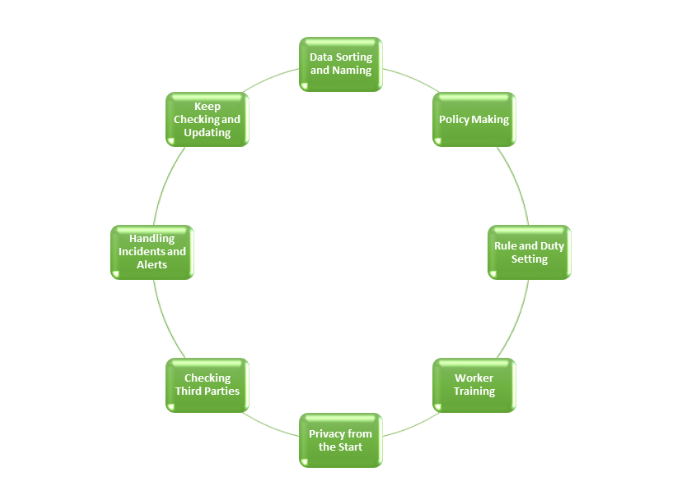
Making a good data privacy plan is more than just putting in safety apps. It needs a plan, rules, worker input, and ongoing work to get better. Here are the main parts of a good plan:
- Data Sorting and Naming
Companies need to know their data – where it’s kept, how it travels, and who can look at it. Giving data names and tags keeps this task easy.
- Policy Making
A data privacy plan needs rules that say how personal data is collected, used, kept, shared, and disposed of. These rules should fit with legal needs.
- Rule and Duty Setting
Firms should name a Data Protection Officer (DPO) or privacy lead, mainly in regulated fields. This person or group looks after the plan, checks that rules are followed, handles requests about data, and leads in handling data problems. This setup should also make clear who in the firm handles privacy tasks.
- Worker Training
Since people can make errors that cause data leaks, it’s vital that all workers learn the best ways to keep data safe, spot fake emails, deal with data right, and know how to tell if something’s wrong. Training must suit the job, grab attention, and get new info often.
- Privacy from the Start
Privacy should be part of creating new products, services, and systems from the start, not just added later. This means taking only needed data, using ways to hide data, and setting privacy as the default.
- Checking Third Parties
Firms should check and watch any third parties that deal with personal data for them. Deals should have clauses on protecting data, and third parties must show their own privacy steps.
- Handling Incidents and Alerts
Even with good efforts, leaks can happen. Firms need a tested plan for dealing with leaks that covers controlling the problem, looking into it, telling people and groups affected, and fixing issues. Legal timelines must be met.
- Keep Checking and Updating
Privacy tasks aren’t just done once. Regular checks, risk watching, and reviews are key to spotting weak points and improving. Companies must track things like how many problems come up, how quickly they fix them, and questions about data to know how well they are doing.

Conclusion
In a world where data spills can harm a company’s trust and cash, a solid data privacy plan is key—not just a perk. Companies that work to keep personal info safe and honour customer privacy dodge fines and earn deep trust from customers and everyone else. Privacy isn’t just about sticking to laws; it’s now a big piece of doing business well and right.
References
[1] European Parliament and Council, Regulation (EU) 2016/679 of the European Parliament and of the Council (General Data Protection Regulation), Apr. 2016.: https://eur-lex.europa.eu/legal-content/EN/TXT/?uri=CELEX%3A32016R0679
[2] California State Legislature, California Consumer Privacy Act (CCPA), California Civil Code §§ 1798.100 – 1798.199, 2018.: https://oag.ca.gov/privacy/ccpa
[3] International Association of Privacy Professionals (IAPP), Building a Privacy Program, IAPP, 2023: https://iapp.org/resources/article/building-a-privacy-program/
[4] National Institute of Standards and Technology (NIST), NIST Privacy Framework: A Tool for Improving Privacy through Enterprise Risk Management, Version 1.0, Jan. 2020.: https://www.nist.gov/privacy-framework
[5] Deloitte, Data Privacy Trends 2024, Deloitte Insights, 2024. :https://www2.deloitte.com/global/en/pages/risk/articles/data-privacy-trends.html
[6] PwC, How to Build a Data Privacy Program That Works, PwC, 2023.: https://www.pwc.com/gx/en/services/consulting/cybersecurity/data-privacy.html

SEO FAQ Section on Data Privacy Program
Q1. What is a data privacy program?
A data privacy program is a structured approach that organizations use to protect personal information, comply with privacy regulations, and build trust with customers.
Q2. Why is a data privacy program important for businesses?
A strong data privacy program helps prevent data breaches, ensures regulatory compliance, and enhances customer confidence in how personal data is managed.
Q3. What are the key elements of a data privacy program?
Core elements include data classification, policies, accountability roles, employee training, privacy-by-design, third-party oversight, incident response, and continuous monitoring.
Q4. How does a data privacy program support regulatory compliance?
A data privacy program ensures that businesses follow frameworks like GDPR, CCPA, and other global standards, reducing legal and financial risks.
Q5. Who should manage a company’s data privacy program?
Typically, a Data Protection Officer (DPO) or privacy lead oversees the data privacy program, supported by compliance and IT teams.
Q6. How does employee training strengthen a data privacy program?
Employees trained in privacy practices reduce human errors, identify phishing threats, and follow correct procedures, making the program more effective.
Q7. What role does privacy-by-design play in a data privacy program?
Privacy-by-design ensures data protection is integrated into products, services, and systems from the start, rather than as an afterthought.
Q8. How often should a data privacy program be reviewed?
A data privacy program should be reviewed regularly, with audits, risk assessments, and updates to adapt to evolving regulations and threats.
Q9. How do third-party vendors affect a data privacy program?
Vendors that process personal data must meet strict privacy requirements; businesses should assess and monitor them as part of the program.
Q10. What is the connection between a data privacy program and cybersecurity?
While cybersecurity protects data from technical threats, a data privacy program ensures lawful, ethical, and transparent handling of personal information.
Q11. How does incident response fit into a data privacy program?
An incident response plan allows organizations to act quickly on data breaches, contain damage, notify stakeholders, and stay compliant with reporting laws.
Q12. Can small businesses benefit from a data privacy program?
Yes. Even small businesses gain trust, reduce risks, and meet compliance obligations through an effective data privacy program.
Q13. What metrics show if a data privacy program is working?
Key metrics include number of incidents, response time, compliance audit results, and customer privacy requests handled.
Q14. How does a data privacy program improve customer trust?
Transparency about data use and strong safeguards build long-term customer loyalty and reputation.
Q15. What tools can help manage a data privacy program?
Data mapping tools, compliance software, and monitoring platforms help automate and track data privacy program performance.
Q16. How does a data privacy program reduce vendor risk?
By requiring vendors to meet contract-based privacy standards, companies minimize the risk of third-party data misuse.
Q17. What industries need a strong data privacy program?
Sectors like healthcare, finance, technology, and retail need robust data privacy programs due to sensitive data handling.
Q18. How does a data privacy program align with a compliance framework?
A well-designed program fits within a compliance framework, ensuring alignment with global standards and internal accountability.
Q19. What challenges do businesses face in building a data privacy program?
Common challenges include keeping up with evolving laws, managing cross-border data transfers, and ensuring employee compliance.
Q20. How can companies future-proof their data privacy program?
Future-proofing requires adopting flexible policies, ongoing employee training, integrating AI-driven monitoring, and adapting to new regulations.
Penned by Akshat Duggal
Edited by Reeya Kumari, Research Analyst
For any feedback mail us at info@eveconsultancy.in
Finance made simple, fast, and fun! 🏦💡 Sign up for your daily dose of financial insights delivered in plain English. In just 5 minutes, you’ll be smarter already!
Simplify Your Business Compliance with Eve Consultancy
Eve Consultancy is your trusted partner for end-to-end compliance services, including Company Incorporation, GST Registration, Income Tax Filing, MSME Registration, and more. With a quick and hassle-free process, expert guidance, and affordable pricing, we help businesses stay compliant while they focus on growth. Backed by experienced professionals, we ensure smooth handling of all your legal and financial requirements. WhatsApp us today at +91 9711469884 to get started.