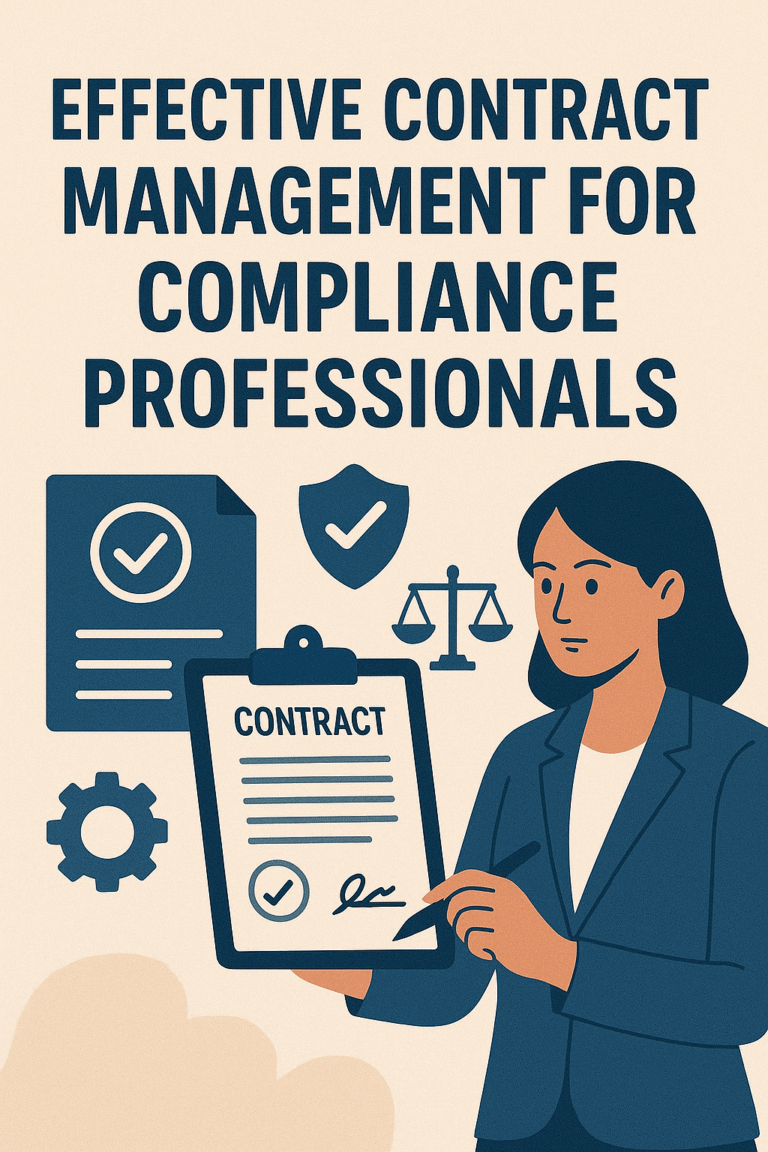
Compliance professionals in a quickly changing legal scene have growing obligations to proactively avoid problems rather than simply identify them. Contract management is at the heart of this endeavor, a seemingly administrative but rather an important activity.
Properly done, it shields the company from its liabilities, guarantees contract management compliance, and promotes larger objectives, including corporate integrity and operational openness as well.
Whether you work for a major corporation or a developing startup, contract supervision is now a shared priority that greatly impacts the legal compliance attitude of your company rather than only a task of legal teams.
Contracts and Compliance Intersections
Every contract is a legally binding relationship. These papers specify terms, rights, responsibilities, and liabilities from supplier agreements and employee contracts to collaborations and outsourcing arrangements. They show a company’s legal footprint but also much beyond that.
Each agreement has to follow local laws as well as changing global frameworks and internal governance, as compliance specialists have to make sure of.
Consider
- Data privacy laws like GDPR or India’s DPDP Act,
- Regulations on financial disclosure standards specific to a field (e.g., healthcare, education, fintech),
- Clauses on ethical sourcing and ESG,
- Provisions against corruption and bribery.
- Even one clause not adhered to can result in legal fines, brand damage, or even legal action.
Thus, contract management compliance is a frontline defense, not a back-office chore. With careful supervision, it fosters agility, foresight, and self-assurance in outside events.
Fundamental Elements of a Strong Contract Compliance System
Companies need a systematic strategy to raise contract management beyond paperwork:
1.Pre-Contract Risk Evaluation
Every contract should be risk reviewed before preparation. This covers vendor credentials, regional legal consequences, and regulatory standards (e.g., tax disclosures or restrictions on foreign investment).
2. Review and Standardization of Clause
A clause library helps guarantee consistency across contracts. This preserves alignment with present legal compliance standards while lowering reliance on manual legal review.
3.Version Controls and Audit Trails
Negotiations result in edits; therefore, contracts change. Capturing every version with an immutable audit trail guards against arguments and promotes openness during audits.
4. Lifecycle Compliance Checkpoints
Set quarterly or annual post-signing reviews to guarantee parties are living up to their obligations(e.g., SLAs, reporting, renewals).
5. Protocols for Exit and Termination Risks
Clear closing protocols, whether willfully or otherwise, ensure the organization leaves partnerships without any residual obligations when contracts terminate. These include data deletion, equipment return, and payment clearance.
Tools to ensure compliance with contract management
Technologically, it is an essential enabler in the compliance arsenal. Manual tracking—through dispersed emails or spreadsheets—is no longer enough.
Modern compliance professionals are employing these:
1. Software for contract lifecycle management, CLM, automates drafting, negotiating, approval, and archival. Tools like Ironclad, DocuSign CLM, and Agiloft offer configurable modules.
2. Assures digital contracts’ legality and enforcement through e-signature integration.
3. Analytics dashboards: Offer information on contract value, expiration dates, and obligations fulfilled or breached.
4. Compliance Triggers: Notifications for occasions including supplier onboarding without adequate due diligence or data-sharing with third parties.
Though these resources have advantages, professionals still bear the burden of interpreting clauses, evaluating legal repercussions, and modifying procedures to maximize contract management compliance impact.
Non-Compliance Costs: Actual Risks
Contract mismanagement is not only a little slip-up; it can have cascading effects throughout the whole company. Here are some of the most frequent (and expensive) hazards that emerge when compliance is not given first focus:
1.Failed to Meet Renewal Deadlines- Unreviewed auto-renewing contracts can lock businesses into antiquated pricing, empty conditions, or provider partnerships not in line with business objectives.
2. Unmanaged Obligations and Deliverables– Failure to track payments, deadlines, or service quality can cause unfulfilled expectations, fines, and tense vendor-client relationships.
3. Non-Conformance Conditions- It is possible to have clauses that do not agree with the laws in the region, international standards, or internal moral code that may result in cancellation of a contract, heavy fines, and legal investigations.
4. Data breaches of Third-Party –Inadequate data processing/sub-processing terms may have a customer information data breach, likely leading to costly court cases and data protection agency actions.
5. Internal disagreements and Audit Failures- Incomplete documentation, missing authorizations, or outdated contract revisions can result in companies failing regulatory inspections, causing them harm to their reputations among auditors, investors and regulators.
6. Contractual disputes and court battles- Ambiguous or poorly worded obligations, antiquated points of reference, and so on can lead to examining lawsuits that consume time, attention, and resources much essential to more critical activities.
7. Loss of Competitive Advantage– Companies without well-managed contracts can overpay vendors, pass over innovation chances, or lag in market agility as a result of inflexible terms.
Each of these risks harms customer happiness, board confidence, and investor confidence as well as legal status. Organizations that incorporate contract management compliance into their operational structure, on the other hand, promote:
1. Initiative risk detection and correction
2. More authority over contractual duties
3. Business transaction openness
4. Straight and well-executed regulatory inspections
5. Less legal exposure
These companies run from strength—legally, financially, and reputatively, by matching legal compliance needs with corporate objectives.
Conclusion: Contracts as a Compliance Compass
Comprehensive management of contracts is one of the powerful tools in the bag of a compliance officer. Tracking documentation is only one aspect of establishing an organization of openness, ethical performance and operational performance. Contracts are breathing documents that reflect on the values and risk tolerance of a company and its responsibilities. They become strategic assets when handled well; when ignored they become weaknesses.
Contract management compliance ensures that an organization can effectively identify risks, ensure that there is responsibility and prevent commission of a breach of law all through the contract lifecycle; i.e., negotiating, drafting, executing, renewing and closing out a contract. Each of the clauses turns into a checkpoint; each of the approvals turns into a safeguard; each of the renewals turns into optimization
Real-time visibility, data-driven insights, and flexible governance define legal; legal’s compliance future. Nowhere is this more obvious than in the way an organization creates, preserves, and upholds its agreements. Their capacity to handle contracts ethically and effectively will determine their worth and influence as compliance experts move into more strategic positions.
Having a firm hold on legal compliance, organizational integrity, and long-run corporate resiliency ultimately results from strong contract management. That’s not only a sensible habit but also a business necessity in the cutthroat, government-heavy world of today.
Works Cited
- Ironclad. “What is Contract Lifecycle Management (CLM)?” Ironclad, 2023, https://ironcladapp.com/journal/glossary/contract-lifecycle-management-clm.
- DocuSign. “Contract Lifecycle Management: Everything You Need to Know.” DocuSign Blog, 2023,https://www.docusign.com/blog/contract-lifecycle-management-everything-you-need-know.
- European Commission. “General Data Protection Regulation (GDPR).” European Union, 2018, https://gdpr.eu.
- Ministry of Electronics & IT, Government of India. “The Digital Personal Data Protection Act, 2023.” MeitY https://www.meity.gov.in/data-protection-framework.
- McKinsey & Company. “Contract Management: It’s Time to Digitize.” McKinsey Insights, June 2022, https://www.mckinsey.com/business-functions/risk-and-resilience/our-insights/contract-management-its-time-to-digitize
Penned by Nishita Kumari
Edited by Sneha Seth, Research Analyst
For any feedback mail us at info@eveconsultancy.in
Finance made simple, fast, and fun! 🏦💡 Sign up for your daily dose of financial insights delivered in plain English. In just 5 minutes, you’ll be smarter already!
Simplify Your Business Compliance with Eve Consultancy
Eve Consultancy is your trusted partner for end-to-end compliance services, including Company Incorporation, GST Registration, Income Tax Filing, MSME Registration, and more. With a quick and hassle-free process, expert guidance, and affordable pricing, we help businesses stay compliant while they focus on growth. Backed by experienced professionals, we ensure smooth handling of all your legal and financial requirements. WhatsApp us today at +91 9711469884 to get started.