
Topic: digital kyc meaning, kyc revolution
In the fast-moving financial and digital services landscape, identity proofing is now an easy automated procedure, when it was once a paper-based undertaking. Digital KYC — the technology that enforces Know Your Customer processes in an effort to survive regulatory examination — is now a foundation of secure, effective onboarding. With further e-identity regulation in the pipeline, this kind of innovation is changing the dynamic between regulators, firms, and clients.
The rule of law effect of e-KYC compliance has come a very long way beyond the technical obligation to register a human person’s name, address, and documents. It is a seismic shift in the banks’-customers’ relationship. It is about trust, transparency, and responsibility in an increasingly borderless digital economy.
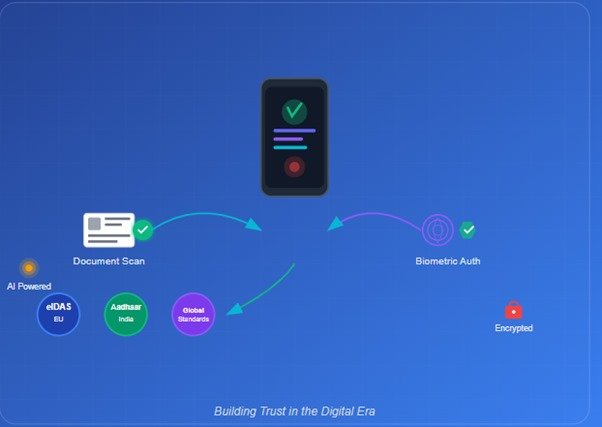
From Paper to Pixels: The Digital KYC Revolution
It used to be clunky, time-consuming, and error-prone. Consumers once had to physically come to a branch office, make photocopies, and then wait days — sometimes even weeks — for them to be approved. Digital KYC compliance came along and turned everything around. With encrypted document uploads, biometric verification, and secure mobile apps, customers can now do the entire thing in minutes from the farthest reaches of the globe.
This evolution goes far beyond convenience. E-identity legislation geographically has been designed to render such online processes as unobtrusive and safe as feasible. From the European Union’s eIDAS directive, India’s Aadhaar-based e-KYC system, to Africa and Southeast Asia’s trailblazing standards, e-identity legislation is creating an intercontinental lingua franca of trust.
Regulators as Enablers, Not Just Enforcers
One of the most significant consequences of the digital KYC function is the way regulators are shifting their function from merely being a watchdog to that of facilitators of innovation. With the issuance of clear guidance, embracing e-identity regulations, and ensuring secure credentials technology, they facilitate institutions in enhancing compliant solutions at an accelerated rate.
Consider, for instance, the marriage of AI-based document verification software and electronic KYC compliance. Regulators in pioneering markets not only approve such software programs but also push them into use, subject to being e-identity regulation and anti-money laundering (AML) best practices compliant. With trend-leading intelligence, banks and fintechs can onboard in bulk without compromising on compliance or customer experience.
Balancing Compliance and Customer Experience
The advantages of e-KKY are not a fantasy for the users. They can gain access to bank accounts, investment platforms, and insurance products at a quicker pace without any delay. Yet, safety vs. convenience is still their biggest issue.
Robust e-identity regulations guarantee that no corners are cut when there is speed involved. Biometric information captured under digital KYC compliance, for instance, must be encrypted, stored safely, and processed in line with robust data protection legislation. This not only preserves confidentiality but also inspires trust in digital onboarding services.
Cross-Border Challenges and Opportunities
Though onboarding has gone frictionless within national borders due to e-KYC compliance, cross-border payments remain an issue. E-identity rules vary radically country-to-country and add friction to global finance.
But here as well is the possibility of regulation harmonization to release gigantic opportunity. Products like digital identity interoperability frameworks are being considered in an effort to make a KYC-verified customer in one place or jurisdiction smoothly accepted elsewhere and eliminate redundancy and expense. If implemented, these frameworks are able to offer digital KYC compliance as a passport to worldwide financial inclusion.
The Future: Technology-Driven Regulation
In the coming couple of years, regulatory muscle for digital KYC compliance will continue to develop as the regulation of e-identity proceeds toward new technology. Blockchain-based identity, zero-knowledge proof used to preserve privacy during verification, and AI-based risk analysis are already on the horizon.
Regulators have come to increasingly understand that digital KYC compliance does not equal a static list of things to do but an ongoing ecosystem that will need to adapt to stay in tune with emergent threats like deepfake identities, synthetic scams, and data breaches. e-identity regulation in the future will therefore necessarily imply more dynamic, real-time compliance obligations.
Conclusion: Building Trust in the Digital Era
The arrival of electronic KYC compliance is not just a process of enhancement; it is a platform where trust in the digital economy can be established. Coupled with tight and dynamic e-identity rules, it is a secure and sound system where businesses can flourish, consumers can pay comfortably, and regulators can exercise control without strangling innovation.
In a world of globalized finance, the compliance footprint of electronic KYC will only grow. Its stakeholders — customers and banks and fintechs, and regulators — are not only keeping up; they are leading finance toward a future that is safer, more inclusive, and more efficient everywhere.
References
1. Ondato – What is eKYC? Explained Simply https://ondato.com/blog/ekyc-explained.
2. The Impact of eIDAS on European Digital Transactions and KYC Standards. FinTech Global(2025).
3. Designing a Framework for Digital KYC Processes Built on Blockchain-Based Self-Sovereign Identity. ResearchGate (2021).
4. eIDAS 2.0 and Digital Identity: A Revolution in KYC Processes. Concentrix (2024).
5. The Role of Digital Identity and e-KYC in Expanding Financial Inclusion: A Comparative Study.ResearchGate (2024).
FAQ Section on Regulatory Effects of Digital KYC
1. What is the digital KYC meaning in the financial world?
The digital KYC meaning in finance refers to verifying a customer’s identity online through biometrics, encrypted uploads, and databases, replacing outdated paper-based KYC methods.
2. Why should businesses understand the digital KYC meaning?
Understanding digital KYC meaning is crucial for businesses because it ensures compliance with regulations, prevents fraud, and speeds up customer onboarding without physical paperwork.
3. How has the digital KYC meaning evolved from traditional processes?
The digital KYC meaning has evolved from slow, manual branch visits into instant online verification, powered by AI, mobile apps, and regulatory-approved digital identity systems.
4. What role does regulation play in the digital KYC meaning?
Regulators shape the digital KYC meaning by enforcing secure frameworks like eIDAS in Europe and Aadhaar-based e-KYC in India, ensuring safe and standardized identity verification.
5. Is the digital KYC meaning linked to customer trust?
Yes. The digital KYC meaning goes beyond compliance — it builds trust by protecting customer data, enabling transparent onboarding, and ensuring safe participation in the digital economy.
6. How does the digital KYC meaning improve customer experience?
The digital KYC meaning improves customer experience by enabling users to open accounts, access loans, and invest instantly, instead of waiting days for manual approvals.
7. What technologies define the digital KYC meaning today?
AI-based document checks, biometric authentication, blockchain identity, and real-time fraud detection all shape the digital KYC meaning in modern financial ecosystems.
8. How does the digital KYC meaning help fight financial crime?
The digital KYC meaning is critical in preventing money laundering and fraud by verifying documents, detecting anomalies, and enforcing anti-money laundering (AML) standards.
9. Is the digital KYC meaning the same across countries?
No, the digital KYC meaning varies worldwide since each country has unique e-identity regulations. Harmonization efforts aim to make the digital KYC meaning globally consistent.
10. Why is the digital KYC meaning important for fintechs?
For fintechs, the digital KYC meaning equals faster onboarding, compliance readiness, and the ability to scale internationally without compromising customer trust and regulatory obligations.
11. Can customers benefit directly from the digital KYC meaning?
Yes, the digital KYC meaning allows customers to securely access banking, insurance, and investment platforms within minutes, regardless of location or device.
12. How is the digital KYC meaning shaping financial inclusion?
The digital KYC meaning is empowering underserved populations by removing the need for branch visits, helping people in rural areas access financial services digitally.
13. What future trends will affect the digital KYC meaning?
Emerging trends like blockchain-based IDs, zero-knowledge proofs, and AI risk engines will redefine the digital KYC meaning in the coming years, making it more adaptive and secure.
14. How does the digital KYC meaning balance speed and security?
The digital KYC meaning balances both by allowing instant onboarding while enforcing strict data protection rules, encrypted biometric storage, and compliance monitoring.
15. Why is the digital KYC meaning called a revolution in onboarding?
It is called a revolution because the digital KYC meaning represents a complete shift from manual paperwork to secure, fast, and global identity-proofing in the digital era.
Penned by Nitya Gosain
Edited by Shashank Khandelwal, Research Analyst
For any feedback mail us at info@eveconsultancy.in
Finance made simple, fast, and fun! 🏦💡 Sign up for your daily dose of financial insights delivered in plain English. In just 5 minutes, you’ll be smarter already!
Simplify Your Business Compliance with Eve Consultancy
Eve Consultancy is your trusted partner for end-to-end compliance services, including Company Incorporation, GST Registration, Income Tax Filing, MSME Registration, and more. With a quick and hassle-free process, expert guidance, and affordable pricing, we help businesses stay compliant while they focus on growth. Backed by experienced professionals, we ensure smooth handling of all your legal and financial requirements. WhatsApp us today at +91 9711469884 to get started.