
Nowadays, in a competitive business environment, Financial Modeling is no longer a spreadsheet; it is a method to allow companies to predict prospective performance, assess the risks, and make decisions. As a start-up that needs financing modelling or an existing corporation that intends to expand, financial modeling gives you the visibility to grow with great certainty.
Problem: Growth Without Financial Modelling Structure Is Risky
Lots of companies do not have organized financial forecasting. Most of the time, choices are made out of instincts, not facts, which causes:
– Cash flow mismatches
– Overestimated revenues
– Poor investment decisions
The trend of capital formation in the various sectors is volatile, according to the National Accounts Statistics 2024. This has been attributed to poor financial planning. In the absence of a strong model, businesses are unable to prepare funds ahead of time, evaluate profitability, or control operating risks.
Agitate: The Real Cost of Poor Financial Planning
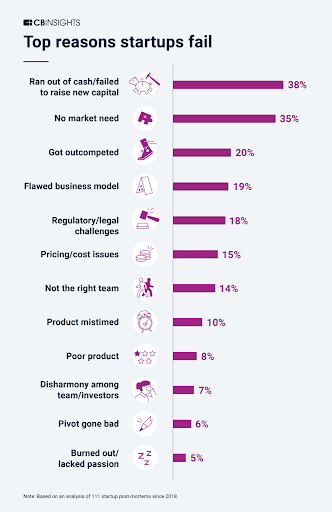
Figure 1: Top Reasons Startups Fail (Source: CB Insights)
CB Insights has studied the postmortems of more than 100 startups to find out the reasons why startups fail. The most common cause (38%) is the lack of cash or the inability to attract new capital, followed by the lack of market need (35%), being beaten (20%), having flawed business models (19%), and regulatory/legal issues (18%). These perfectly coincide with regions in which financial modeling can be applied; these include capital planning, market analysis, and forecasting. A financial model is a good way of understanding the expected cash requirements of startups, testing the market assumptions, and planning for regulatory challenges.
The consequences of poor or inadequate financial modeling extend beyond the internal blunders. They may result in:
- Doubt among investors during fundraising rounds
- Wrong valuations of companies
- Lost growth opportunities because of scenario planning.
- Lack of trust in stakeholders
Other information lost when companies fail to build or maintain models includes the sustainability of pricing models, cash capacity to ride out market downturns, or the value that a given business entity is adding to overall profitability.
In brief, in the absence of financial modeling, decision-making will be reactive as opposed to proactive.
Solution: Framework of Strategic Financial Modeling
To achieve explosive growth, the disciplined approach to modelling should be embraced by a business:
- Define Objectives
Explain what the model is. Is it a fundraising model, valuation model, budgeting, or scenario analysis? This determines its shape and its depth.
- Make use of Approved Data
Assumptions should be based on audited and industry benchmarks, and macroeconomic indicators. Good data is reliable, hence credible and accurate.
- Design a Layered Model
- Revenue and cost drivers
- Segment-level analysis
- Cash flow projections
- Valuation techniques (e.g., DCF)
- Risk analysis and sensitivity analysis
- Benchmarking verification
It is necessary to compare the important ratios, such as EBITDA margin, asset turnover, and debt-to-equity, to industry players to make them realistic and help compete.
- Data Watching and Repetition
Refresh quarterly and test strategic movements such as pricing updates, hiring, or entering a new market to evaluate the financial implications.
Case Study: CRISIL GR&A – Japanese Air Conditioner Manufacturer
CRISIL Global Research & Analytics constructed a two-language, Excel-based financial model of a Japanese air conditioning maker. This was aimed at making investment decisions. The model was built around the following core components-
- 5 years of data history
- 3-year forward projections
- Segment analysis- Detailed
- Discounted Cash Flow (DCF) valuation methodology
- Cross-scenario testing of sensitivity
- A bilingual interface (Japanese/English) to cater to multinational stakeholders
Key Results:
- The model indicated that the company was overpriced, which initiated a recommendation to sell.
- Sensitivity analysis provided an investor with a realistic price range that boosted confidence in decisions.
- The two-language capability facilitated international cooperation between analysts and investors.
Conclusion: A Blueprint of Strategic Scale-Up
It is not only about numbers in financial modelling. It is a matter of visibility, discipline, and strategy. A good one exposes the invisible risks, promotes intelligent investment, and offers a transparent course of long-lasting growth.
The CRISIL case study demonstrates that ambiguity can be converted into action through a well-developed model. Need funding, need expansion, need to assess your current performance? A financial model puts you in a position of data clarity and foresight on how to scale with confidence.
References:
CRISIL GR&A Case Study – Financial Modelling & Valuation (PDF):
https://imarticus.org/blog/wp-content/uploads/2020/01/kn1.pdf
National Accounts Statistics 2024 – MOSPI:
https://www.mospi.gov.in/publication/national-accounts-statistics-2024
CB Insights’ detailed report on why startups fail:
https://www.cbinsights.com/research/report/startup-failure-reasons-top/
NDAP – National Data & Analytics Platform:
FAQ: Financial Modeling for Explosive Business Growth
Q1: What is financial modeling?
Financial modeling is the process of creating a structured representation of a company’s financial situation. It helps in forecasting performance, assessing risks, and making data-driven decisions.
Q2: How does financial modeling help in business growth?
Financial modeling supports business growth by predicting future performance, identifying funding needs, and allowing better strategic planning.
Q3: Why is financial modeling important for startups?
Startups use financial modeling to attract investors, plan cash flow, and test business assumptions before scaling.
Q4: Can small businesses use financial modeling too?
Yes, financial modeling benefits small businesses by improving budgeting, expense tracking, and identifying growth opportunities.
Q5: What tools are commonly used for financial modeling?
Excel, Google Sheets, and software like Finbox or Quantrix are commonly used for financial modeling.
Q6: What are the components of a strong financial model?
A good financial model includes income statements, balance sheets, cash flow projections, and scenario analysis.
Q7: How often should financial modeling be updated?
Ideally, financial modeling should be updated quarterly to reflect market changes, new data, or strategic shifts.
Q8: Is financial modeling only useful for fundraising?
No, financial modeling is also used for valuation, internal planning, budgeting, risk analysis, and scenario testing.
Q9: What is scenario analysis in financial modeling?
Scenario analysis in financial modeling allows businesses to test different market situations and their impact on financial outcomes.
Q10: How does financial modeling help in decision-making?
By presenting clear financial forecasts, financial modeling empowers businesses to make informed investment and operational decisions.
Q11: What is sensitivity analysis in financial modeling?
Sensitivity analysis examines how changes in variables like sales or cost impact overall business performance in a financial model.
Q12: Can financial modeling predict a business’s failure?
Yes, financial modeling can highlight potential cash flow gaps or profitability issues that may lead to business failure.
Q13: Who creates financial models in a company?
Typically, financial analysts, CFOs, or consultants create financial models using accurate historical and forecast data.
Q14: What industries use financial modeling?
Almost all industries—from tech startups to manufacturing and finance—use financial modeling to guide business decisions.
Q15: Where can I learn financial modeling skills?
You can learn financial modeling through online courses, certifications (like CFA, CFI), or business school programs.
Penned by Tarun Singh
Edited by Reeya Kumari, Research Analyst
For any feedback mail us at info@eveconsultancy.in
Finance made simple, fast, and fun! 🏦💡 Sign up for your daily dose of financial insights delivered in plain English. In just 5 minutes, you’ll be smarter already!
Simplify Your Business Compliance with Eve Consultancy
Eve Consultancy is your trusted partner for end-to-end compliance services, including Company Incorporation, GST Registration, Income Tax Filing, MSME Registration, and more. With a quick and hassle-free process, expert guidance, and affordable pricing, we help businesses stay compliant while they focus on growth. Backed by experienced professionals, we ensure smooth handling of all your legal and financial requirements. WhatsApp us today at +91 9711469884 to get started.