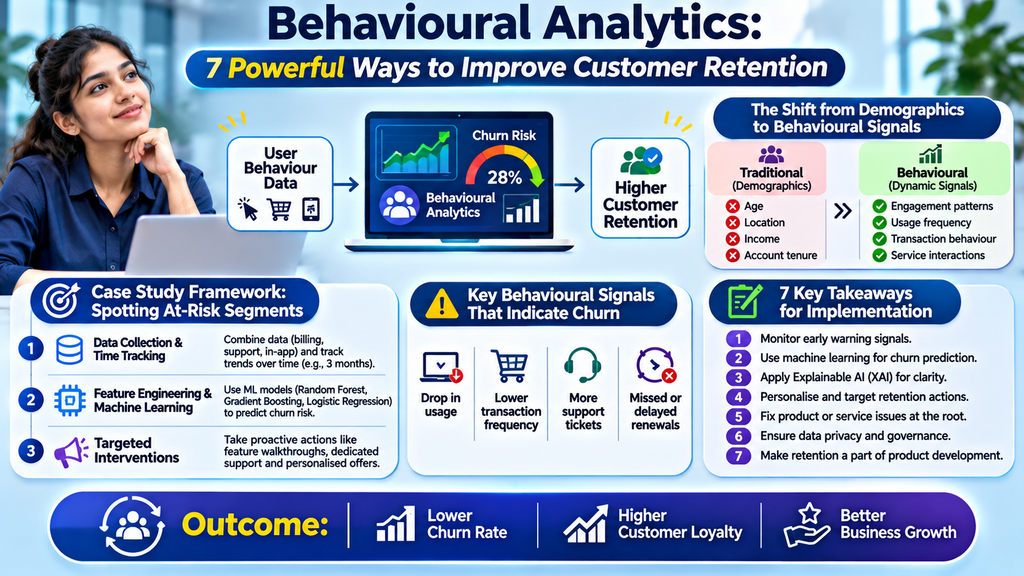
Behavioural analytics helps organisations predict customer churn by identifying changes in engagement, transaction frequency and customer interaction patterns before customers decide to leave.
Behavioural analytics allows organisations to move from a reactive to a proactive approach to customer retention by identifying the ‘small signals’ that occur prior to a customer making the decision to leave. Instead of having to wait for a customer to actually request to cancel or for a subscription to be cancelled, you can monitor changes in engagement, transaction frequency and interaction patterns and take action at the right time.
The Shift from Demographics to Behavioural Signals
Traditional churn models have been very much focused on static demographic data (age, location, income, length of time the customer has had the account etc). All of that is descriptive data and doesn’t explain why a user has churned.
- Behavioural analytics shifts the focus to dynamic, action-oriented telemetry:
- Monitoring changes in recency and frequency as to how often a user logs in, carries out a transaction or uses the core features.
- Consumption patterns: monitoring the decline in volume, instances of missed subscriptions at renewal time and shrinking purchase baskets.
- Friction catalysts: identifying spikes in the number of support tickets, delays in fulfilment or repeated runs into error screens.
Case Study Framework: Spotting At-Risk Segments
Across industries—from retail banking and telecommunications to SaaS and subscription e-commerce—behavioural case studies follow a structured lifecycle to stem attrition:
1. Data Collection and Time Tracking
- The issue is that the companies have data which is siloed within the billing, customer support and in-app clickstream areas.
- The solution in terms of behaviour is to apply temporal tracking (e.g. looking at billing or usage periods over a rolling 3 month timeframe) to establish a baseline of ‘normal’ levels of engagement against ‘drifting’ behaviour.
- For example in retail banking and the card industry a step by step reduction in the monthly credit balance coupled with a reduction in installment stability is the primary indicator of voluntary churn.
2. Feature Engineering and Machine Learning Classification
The method uses machine learning classifiers (Random Forest, Gradient Boosting, Logistic Regression etc.) to take the raw event streams and convert them into predictive features.
In the telecom and subscription space there have been studies which have shown that ensemble models (Random Forest in particular) can achieve over 91% to 95% predictive accuracy by weighting behaviour sequences (e.g. call drop rate, number of service complaints, platform engagement) rather than using static profiles.
3. Targeted Proactive Interventions
- The Action: Rather than blanketing all users with generic discount offers, behavioral segmentation allows precision outreach:
- If engagement with drift is low then kick off automated feature walkthroughs in the app or send targeted onboarding reminders.
- When it comes to churn driven by service friction, route accounts are a real source of frustration for the dedicated support reps right up until the contract renewal periods.
- For the price sensitive customer, offer flexible tier changes or personalised loyalty rewards.
Key Takeaways for Implementation
Look out for the early warning signs in the form of a drop in usage or a drop in second order conversion as that’s the way it manifests weeks before a cancellation actually takes place.
Combine the models with interpretability by using Explainable AI (XAI) with the classifiers as that enables the teams to work out what specific behaviour triggered the alert and hence makes the retention campaigns actionable.
Treat view retention as part of the product development cycle. Take the learnings from churn and feed them back into product development so that you’re actually fixing the root cause of the friction rather than just throwing temporary discounts at the problem.
Businesses can strengthen their data-driven decision-making by understanding how an AI operating model for mid-size companies connects analytics, technology and business strategy.
NIST – AI Risk Management Framework
Scikit-learn – Supervised Learning